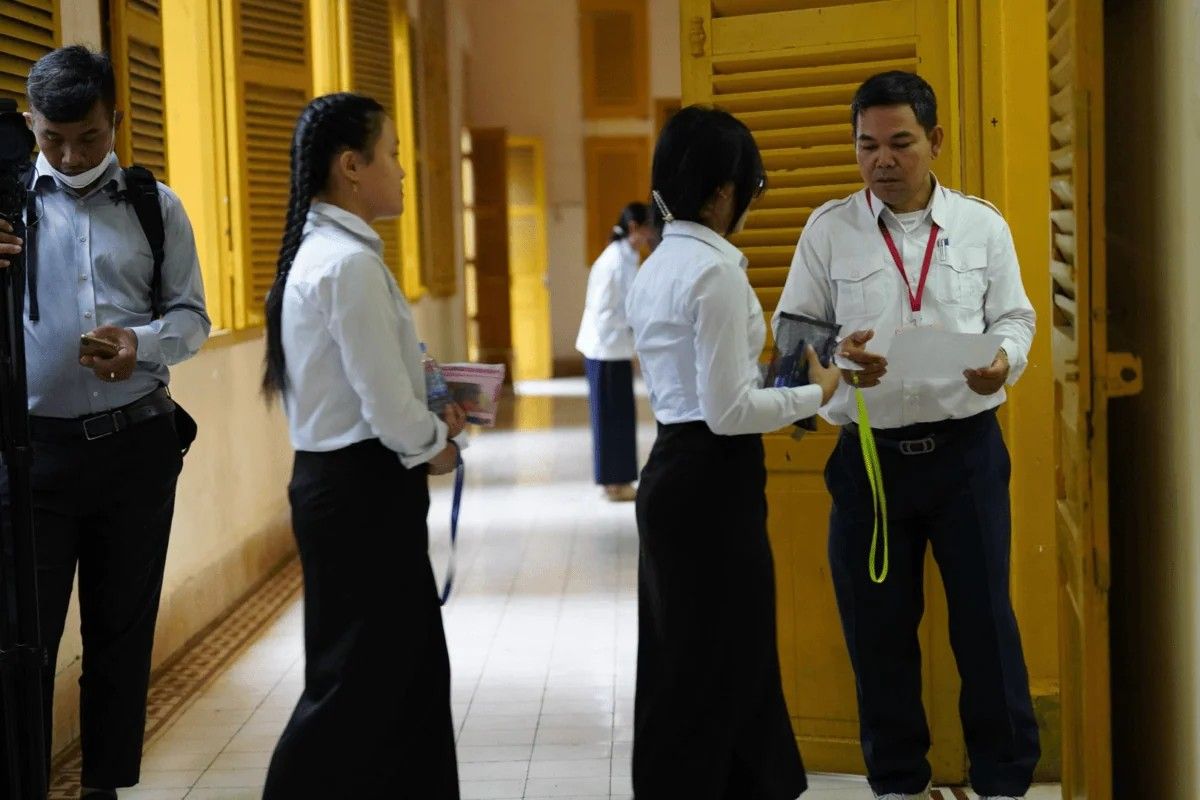
Cambodia's annual high school graduation examinations officially began on August 10, welcoming over 150,000 candidates across the Kingdom for what officials hope will be a more orderly affair than the previous year's troubled administration. The tests mark a significant milestone for the nation's education system as it attempts to move beyond the disruptions caused by last year's military incursions into border territories, which forced schools to suspend operations and displaced thousands of families fleeing conflict zones.
The examination cohort this year comprises more than 37,000 students sitting the science stream and over 130,000 pursuing the social science track, distributed across test centres throughout the country. Minister of Education, Youth and Sport Hang Chuon Naron presided over the opening ceremony in Phnom Penh, acknowledging both the progress represented by this year's examinations and the ongoing humanitarian crisis affecting students in contested border areas. His remarks underscored the resilience demonstrated by Cambodia's youth despite extraordinary circumstances that forced some learners to study while their families fled military attacks.
The contrast between this year's examination administration and last year's sits at the heart of the Education Ministry's messaging. In August 2025, just one month after the first armed clashes erupted along the Cambodia-Thailand border, the government pressed ahead with high school graduation tests despite widespread uncertainty and fear. Hang Chuon Naron highlighted that conditions this year represent a substantial improvement, with the immediate security situation stabilised enough to permit nationwide testing to proceed with greater predictability. He recounted meeting a student who, despite studying from atop tractors as their family fled Thai attacks in Oddar Meanchey province, nonetheless achieved top grades and successfully gained admission to a prestigious tertiary institution—a narrative illustrating the determination of Cambodian youth to advance their education regardless of external pressures.
Yet significant educational disruptions persist in border regions where Thai military presence continues to prevent normal school operations. Twenty-five schools across provinces adjacent to Thailand remain shuttered, unable to accommodate returning students because Thai forces occupy or control the physical facilities. This ongoing occupation represents not merely an inconvenience but a fundamental denial of educational access for thousands of young Cambodians whose academic futures depend on timely instruction and examination participation. The Royal Government has formally demanded restoration of these school facilities and the withdrawal of Thai forces, framing educational access as a sovereignty issue alongside military concerns.
Currently, only students from Banteay Mean Rith Lower Secondary School in Oddar Meanchey have managed to resume classes, though these take place in temporary camps rather than permanent school buildings. This partial accommodation falls far short of restoring normal educational services across affected border communities. The displaced students from the other 24 closed schools remain unable to return to formal classroom environments, creating significant disparities in examination preparation and raising questions about equity in assessment conditions across the nation. For Malaysian and broader Southeast Asian observers, the situation highlights how military tensions can disrupt civilian institutions and how educational systems remain vulnerable to geopolitical conflicts.
Authorities have implemented enhanced security measures to prevent a repeat of last year's examination irregularities, when mathematics papers were leaked prior to testing. The Anti-Corruption Unit has deployed more than 4,000 observers across examination centres nationwide—a figure matching the previous year's deployment—to monitor test administration and detect any improper conduct. Hang Chuon Naron emphasised that rigorous organisation, strict enforcement protocols, and stakeholder participation would combine to eliminate opportunities for corruption. These preventative steps reflect official determination to restore public confidence in examination integrity after last year's breach compromised the assessment system's credibility.
The scale of this year's examination administration underscores Cambodia's commitment to educational continuity despite ongoing security challenges in border regions. Beyond the immediate concerns of test security and displaced students, the examination season represents a crucial juncture in Cambodia's post-conflict educational development. Successful administration of nationwide tests demonstrates institutional resilience and signals to students, families, and international observers that Cambodia's education system can function despite regional tensions. Yet the persistence of closed schools in border areas reminds stakeholders that normality remains incomplete and that full educational recovery requires resolution of territorial disputes with Thailand.
For policymakers across Southeast Asia, Cambodia's experience illustrates the interconnection between border stability and educational access. When military tensions affect civilian infrastructure, education suffers disproportionately, with younger generations bearing long-term consequences of disrupted schooling. The examination process itself, while necessary for credential recognition and tertiary access, cannot fully compensate for months of interrupted instruction in conflict-affected communities. As students in 25 closed schools attempt to participate in nationwide examinations from temporary locations, significant equity questions emerge about whether all candidates face equivalent preparation conditions and assessment opportunities.
The Royal Government's continued insistence on full restoration of educational facilities in occupied border areas reflects recognition that educational access constitutes both a human right and a fundamental measure of territorial sovereignty. When foreign military forces prevent a nation's citizens from accessing their own schools, the implications extend beyond immediate academic disruption to challenge state capacity and jurisdiction over civilian space. Hang Chuon Naron's remarks framing educational restoration as a government priority signal that Cambodia views this issue through both humanitarian and political lenses, demanding not only that students be permitted to study but that they study in their own communities under national authority.

