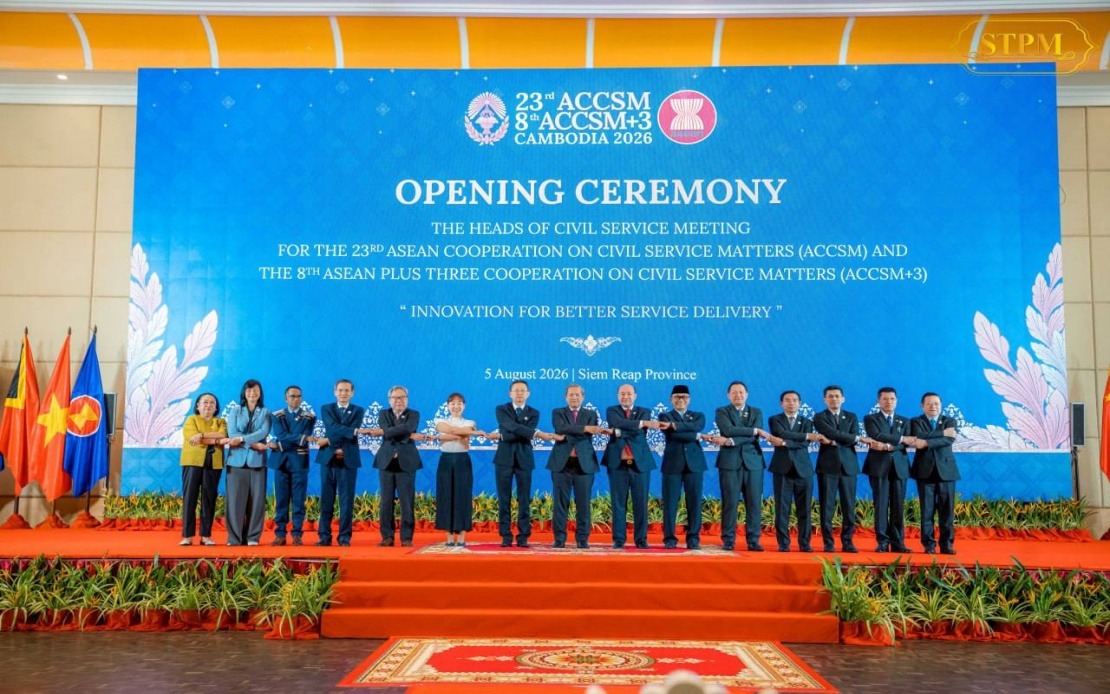
Cambodian Prime Minister Hun Manet has made a compelling case for ASEAN to embrace artificial intelligence and digital innovation as a means to strengthen public services across the bloc, while emphasizing that technological advancement must remain grounded in the practical needs of ordinary citizens. Speaking at a major civil service conference in Siem Reap, Hun Manet articulated a vision where innovation serves as a bridge to narrow the considerable development disparities that characterize the ten-nation region, rather than becoming an end in itself or a tool that benefits only the most technologically advanced economies.
The remarks came during the 23rd ASEAN Cooperation on Civil Service Matters and the 8th ACCSM+3 gathering held from August 3 to 5, events that brought together senior government officials tasked with modernizing public administration across the member states. The conference's central theme, "Innovation for Better Service Delivery", reflects growing recognition within ASEAN capitals that outdated bureaucratic systems hamper economic competitiveness and citizen satisfaction, even as artificial intelligence presents unprecedented opportunities for efficiency gains.
Hun Manet's intervention stands out for its sober acknowledgment that innovation cannot simply be transplanted wholesale from developed economies to Southeast Asia. Instead, he emphasized that genuine transformation in public services requires solid institutional foundations and adequate human resources—elements that vary considerably across ASEAN, where countries range from upper-middle-income Thailand to least-developed economies like Myanmar and Laos. This layered approach reflects the bloc's persistent challenge: how to pursue modernization without exacerbating existing inequalities between member states.
The Cambodian leader stressed that technological adoption must proceed at a pace sustainable for each nation, implying that ASEAN should resist pressure to implement uniform standards that might disadvantage countries with less developed digital infrastructure or smaller talent pools. This nuanced position carries implications for Malaysia and other more technologically advanced ASEAN members, which may need to recalibrate expectations about synchronized digital transformation across the region. The message suggests that ambitious digital agendas must be tempered by solidarity with less-developed neighbours to prevent the creation of a two-tier ASEAN.
Beyond the mechanics of implementing new technology, Hun Manet framed innovation as essential to ASEAN's collective resilience in confronting shared regional challenges. Climate-related disasters, uneven economic development, and persistent poverty represent transnational problems that no single nation can effectively solve in isolation, yet they disproportionately affect the region's most vulnerable populations. In this context, AI-powered services—from early warning systems for natural disasters to data-driven poverty alleviation programmes—acquire strategic importance far beyond conventional notions of administrative efficiency.
The prime minister's vision extends innovation beyond internal government operations toward a model of collaborative problem-solving within ASEAN. Knowledge sharing among civil services, mutual technical support, and coordinated adaptation to emerging challenges form pillars of this approach. For Malaysia, which has invested substantially in fintech, digital governance, and artificial intelligence capabilities, such framing suggests opportunities to position itself as a knowledge partner while also learning from peers facing distinct challenges in implementing digital services in resource-constrained environments.
Hun Manet's emphasis on ACCSM remaining a vital platform for mutual learning carries institutional weight. These forums serve as soft-power channels through which ASEAN members negotiate development priorities and establish norms around governance modernization. By centering the discussion on human-centric innovation rather than technology for its own sake, Cambodia has subtly reframed the debate away from competitive adoption benchmarks toward cooperative advancement. This rhetorical shift matters because it potentially influences how ASEAN member states approach bilateral partnerships with technology vendors and external powers offering AI solutions.
The timing of these remarks coincides with intensifying global competition for influence over Southeast Asia's digital future. Major powers including China, the United States, and India have vested interests in shaping how ASEAN adopts artificial intelligence and digital infrastructure. Hun Manet's insistence on ASEAN-centred deliberation and consensus-building around innovation policy suggests an attempt to preserve the bloc's strategic autonomy in technological choices, resisting external pressure to align wholesale with any particular power's digital standards or governance model.
For Malaysian policymakers and business stakeholders, the implications warrant close attention. The emphasis on institutional capacity and human resources development signals that ASEAN integration in digital services will likely remain uneven, creating both challenges and opportunities. Malaysian technology firms and governance experts may find expanding markets for localized solutions tailored to less-developed ASEAN contexts. Simultaneously, Malaysia's own push toward becoming a regional AI hub must account for the reality that meaningful ASEAN cooperation requires technological solutions adapted to diverse circumstances rather than one-size-fits-all approaches that work primarily in advanced economies.
The broader strategic direction articulated in Siem Reap reflects ASEAN's characteristic pragmatism—embracing transformative technologies while acknowledging internal constraints and external pressures. By centering citizen needs and sustainable adoption timelines rather than showcase projects, Hun Manet has proposed a template for responsible regional innovation policy. Whether ASEAN member states can effectively operationalize this vision, given budget constraints, political fragmentation, and varying levels of bureaucratic modernization, remains an open question that will shape the region's digital trajectory for years to come.

