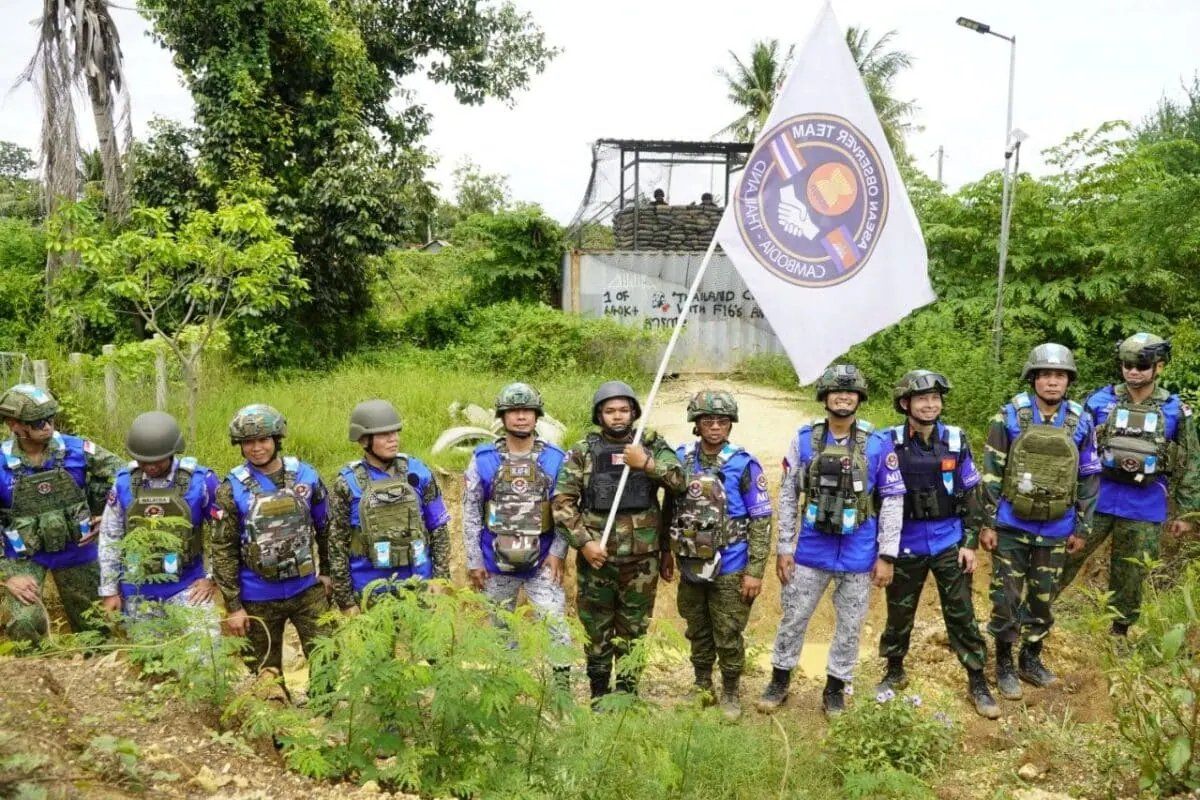
Cambodia has fundamentally shifted its approach to the long-running border dispute with Thailand, transitioning from bilateral argumentation to a strategy centred on international witnesses and third-party documentation. Information Minister Neth Pheaktra articulated this recalibration on Monday, responding to Thailand's latest denial of territorial encroachment allegations by emphasising that physical evidence of Thai military activities can no longer be dismissed as mere Cambodian assertion. Instead, Pheaktra contends, Asean monitors, foreign diplomats and United Nations representatives are now independently verifying conditions on the ground, thereby transforming what was previously a he-said-she-said dispute into a documented international concern.
The exchange reflects Thailand's persistent position, articulated by Air Chief Marshal Prapas Sornchaidee from the Joint Information Center, that Bangkok has no policy of invading or occupying neighbouring territory and that its military activities serve legitimate protective purposes for troops, civilians and Thai sovereignty in areas the kingdom considers legitimately under its control. Prapas explicitly rejected Cambodia's accusations of road construction, fortifications and other encroachment tactics, while acknowledging that military presence alone cannot determine international boundaries. This rhetorical move allowed Thailand to signal openness to formal boundary determination mechanisms—maps, evidence and the Joint Boundary Commission—even as it maintained that its current security posture remains justified and non-negotiable.
Yet Pheaktra seized upon this very principle to undermine Thailand's practical position. He argued that if both nations genuinely accept that boundaries must be determined through legal and technical mechanisms rather than military control, then the observable reality of shipping containers, razor wire barriers and fortifications in areas Cambodia claims as its own becomes legally and diplomatically significant. The minister's core argument rests not on emotion or historical grievance but on a simple proposition: physical evidence exists, it is being independently witnessed, and therefore it cannot simply be erased through public denials or rhetorical framing as necessary security measures.
The Asean Observer Team in Cambodia, led by a Philippine mission head, has recently conducted detailed inspections across three affected areas in Banteay Meanchey province, providing precisely the kind of multilateral verification that Pheaktra emphasises. At Boeung Trakuon in Kouk Romiet commune, within Thma Puok district, observers documented 44 shipping containers positioned across 14 locations in territory Cambodia claims as its own. The documented humanitarian cost is substantial: Cambodia reports that 7,873 residents from 1,869 families, including 1,847 children, remain displaced and unable to return to their homes in this single location. Additional inspections at Chouk Chey and Prey Chan villages revealed a further 72 containers across 10 locations, bringing the total across three areas to 116 containers at 24 separate locations, with Cambodia asserting that 13,259 people overall, including 3,416 children, cannot safely return.
Pheaktra's rhetorical strategy proves particularly potent when combined with the observations of UN Special Rapporteur on human rights in Cambodia Tom Andrews, who visited the border region and affected communities during a July mission. Andrews subsequently documented that approximately 650,000 Cambodians were displaced during the peak of conflict, with more than 20,000 individuals still unable to return to their homes. Critically, Andrews reported that people he directly interviewed cited Thai security force occupation of their residential areas as the reason for their continued displacement and inability to return safely. For Cambodia's information minister, these international human rights observations carry significant diplomatic weight precisely because they stem from non-partisan sources pursuing mandates entirely separate from Cambodia's territorial claims.
However, it is crucial to recognise the limitations of Cambodia's strategy. The Asean Observer Team operates specifically to monitor ceasefire compliance rather than to adjudicate sovereignty disputes, while Andrews' human rights mandate similarly sits separate from questions of international boundary determination. Neither body possesses the technical or legal authority to resolve the fundamental question of where the Cambodia-Thailand border actually lies. Thailand can and does distinguish between acknowledging humanitarian concerns and accepting Cambodian sovereignty claims over the contested territories. This distinction preserves Bangkok's negotiating position even as independent observers document conditions that embarrass Thailand internationally.
Pheaktra addressed this challenge head-on through a series of memorable formulations designed to strip away Thailand's security-based justifications. Shipping containers, he insisted, are not border markers; barbed wire cannot substitute for treaties; trenches do not constitute boundary maps; and planting flags represents no legal title to territory. These statements target the core of Thailand's approach: the notion that military presence, however justified on security grounds, somehow translates into legitimate territorial control or can create facts on the ground that subsequent boundary determination processes must accommodate. Cambodia's position remains anchored to what it considers a superior legal framework: the Franco-Siamese treaties and historical conventions, documented cartographic evidence, the 2000 Cambodia-Thailand border Memorandum of Understanding, the 2003 Terms of Reference for the Joint Boundary Commission, and the ongoing technical work of that Commission itself.
Thailand's response, as articulated by Prapas, maintains that neither country can determine sovereignty through unilateral public declarations, a principle that technically aligns with Cambodia's insistence on formal legal mechanisms. Yet Thailand simultaneously asserts that it will continue protecting what it considers its territory and will not suspend security measures simply because Cambodia demands it. This position creates a strategic impasse: if Thailand believes the areas are legitimately Thai, it logically follows that security infrastructure is appropriate; if Cambodia believes the areas are legitimately Cambodian, it logically follows that Thai military presence constitutes unlawful occupation. The two nations occupy fundamentally incompatible factual universes regarding precisely which areas lie within which country's boundaries.
The introduction of international monitors and human rights observers into this equation represents a calculated Cambodian attempt to shift the terrain of dispute. Rather than engaging in endless bilateral recriminations about intent and legality, Pheaktra has effectively invited the international community to simply look and verify. This approach carries particular resonance within the Southeast Asian context, where Asean's principles of non-interference and consensus decision-making have traditionally favoured bilateral resolution of disputes. By securing Asean observer presence and highlighting UN documentation, Cambodia has subtly reframed the problem as one requiring regional and international attention to humanitarian and factual dimensions that transcend bilateral disagreement.
Cambodia has also cannily connected the territorial dispute to the humanitarian provisions of the December 27 ceasefire agreement, specifically Point 4, which provides that affected civilians must be able to return to their homes on their respective sides without obstruction, in safety and with dignity. Pheaktra argued that thousands of Cambodians still unable to access their homes behind containers and barriers represent concrete evidence that post-conflict obligations remain unfulfilled. By framing the issue partly as a ceasefire compliance matter rather than purely as a sovereignty dispute, Cambodia creates additional diplomatic leverage. A ceasefire, Pheaktra stated pointedly, is not a licence to create new facts on the ground—a formulation that suggests Thailand may be using security justifications to consolidate territorial claims that formal boundary processes have not yet resolved.
The strategic implications for Southeast Asia extend beyond bilateral Cambodia-Thailand relations. If Cambodia successfully establishes that international monitors and documentation of disputed territories can influence both regional and global perception of claims and counterclaims, this precedent potentially affects other maritime and land boundary disputes throughout the region, including those involving major powers. Vietnam, the Philippines, Indonesia and other nations with contested boundaries or maritime zones maintain obvious interest in whether multilateral observation and documentation can effectively constrain more powerful neighbours. Conversely, if Thailand can successfully maintain its position despite mounting international documentation of its activities, this suggests that security arguments and military presence retain decisive practical weight regardless of formal legal principles or third-party observation.
For Malaysia, the Cambodia-Thailand dispute carries particular resonance given its own complex maritime boundaries and internal border management challenges. The case demonstrates both the potential and limitations of mobilising Asean mechanisms and international observers to pressure larger regional actors. It also illustrates how humanitarian and ceasefire compliance arguments can supplement and potentially outweigh pure sovereignty disputes in regional diplomacy. As Cambodia continues leveraging third-party documentation, and Thailand continues resisting what it views as interference in its legitimate security operations, the dispute threatens to become increasingly internationalised—precisely the outcome that bilateral dispute resolution mechanisms were intended to prevent.

