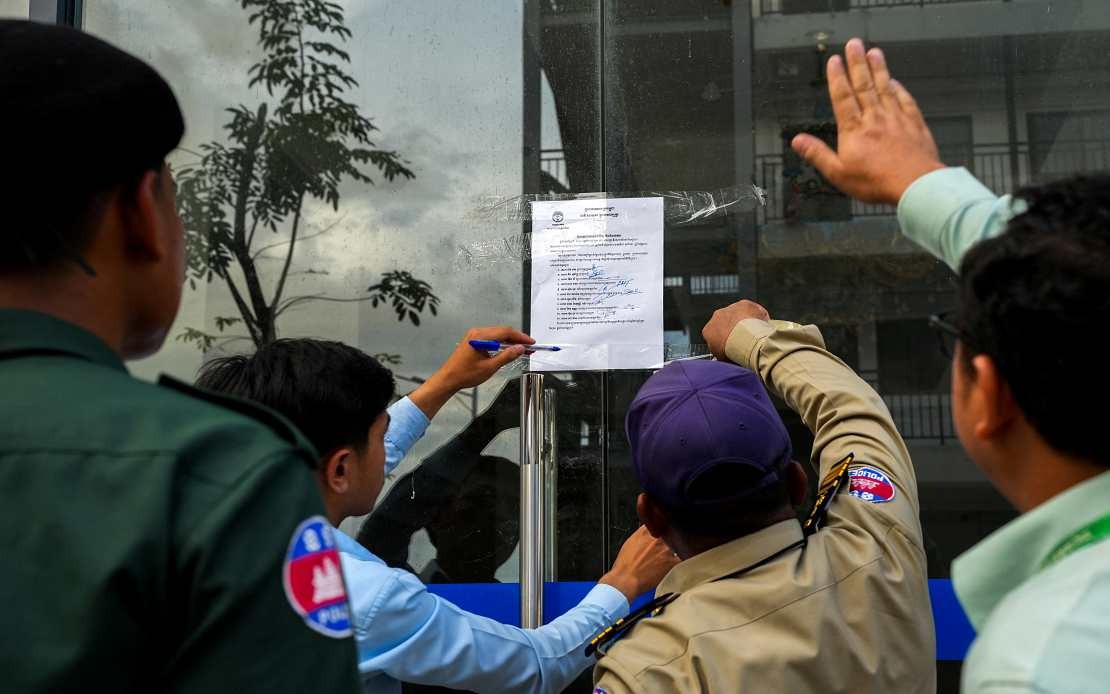
Cambodia has intensified its war on cybercrime, deporting over 16,000 foreign suspects accused of operating online scams during the first half of 2026. The sweeping enforcement operations underscore the Southeast Asian nation's determination to dismantle transnational fraud rings that have flourished on its territory, drawing international attention and scrutiny to the kingdom's security environment.
Police Lieutenant General Sok Veasna, who directs the General Department of Immigration, disclosed the scale of the deportation campaign during a mid-year review meeting on Tuesday in Phnom Penh. The figure represents a significant portion of the total 45,000 foreigners expelled from Cambodia during the January-to-June period, reflecting a deliberate administrative focus on cyber-fraud actors. Veasna emphasized that all deported individuals now face permanent entry bans, a measure intended to prevent recurring cycles of criminal operation and reentry across Cambodia's porous borders.
The crackdown reflects Cambodia's pivot towards confronting a longstanding vulnerability that has made the nation an attractive base for transnational criminal syndicates. Online scam operations—ranging from romance fraud to investment schemes targeting victims globally—have become entrenched in certain pockets of Cambodian society, generating substantial illicit revenue while simultaneously corroding the country's international standing. Tourism and foreign direct investment have suffered reputational damage as Cambodia became synonymous with cyber-fraud infrastructure and money laundering hubs.
In April, Cambodia enacted the Law on Combating Online Scams, a legislative instrument designed to impose severe penalties on orchestrators and senior operatives within these networks. The statute represents a watershed moment in the kingdom's policy framework, moving beyond reactive deportations towards establishing clear domestic legal consequences for those who organize and profit from fraud operations. The law's emphasis on ringleaders and senior figures signals an understanding that low-level operatives are easily replaceable and that structural disruption requires targeting command structures.
Thong Mengdavid, a researcher at the China-ASEAN Studies Centre of the Cambodia University of Technology and Science, acknowledges the deportation campaign as a necessary and overdue intervention to rehabilitate Cambodia's global image and disrupt the operational continuity of major fraud networks. However, he cautions against viewing the expulsions as a comprehensive solution. Mass deportations, while publicly visible and politically expedient, address symptoms rather than the systemic conditions enabling these operations to flourish.
Mengdavid's analysis points to a critical dimension often overlooked in public announcements: the domestic protection networks and corruption that allow cyber-scam operations to function with relative impunity. Many fraud rings operate from secure locations within Cambodia because they maintain relationships with local officials, security personnel, and intermediaries who facilitate their activities in exchange for financial compensation. Without dismantling these complicit networks, successfully deported operators could be replaced or rehabilitated into the system.
The underlying trafficking dimensions compound this challenge. Many individuals working in cyber-scam operations are themselves victims of human trafficking, coerced into roles as telemarketers, money handlers, or technical operatives under duress and debt bondage. Addressing the scam problem therefore requires simultaneous intervention against trafficking networks and labor exploitation patterns that funnel vulnerable migrants—often from Myanmar, Laos, and Vietnam—into criminal enterprises.
For Southeast Asian observers, Cambodia's situation carries cautionary implications. The region's relatively porous borders, variance in law enforcement capacity, and lucrative markets for fraudulent financial schemes create conditions where cyber-scam infrastructure can metastasize across multiple jurisdictions. Thailand, Laos, and Myanmar have grappled with similar challenges, sometimes competing with Cambodia as bases for international fraud operations. Enhanced regional cooperation on law enforcement, intelligence sharing, and extradition protocols remains inadequately developed compared to the sophistication of transnational criminal networks.
The Cambodian government's 2026 campaign represents a credible demonstration of political will, yet sustainability depends on maintaining enforcement pressure while addressing corruption. The permanent entry ban serves a deterrent function, but only if consistently enforced and communicated internationally. Cambodia's challenge mirrors broader Southeast Asian governance dilemmas: how to rapidly upgrade institutional capacity and integrity while confronting entrenched corrupt interests.
Meanwhile, Malaysia and other regional economies have mutual interests in Cambodia's success. Cyber-scam networks targeting Southeast Asian citizens frequently operate from Cambodia, and fraud originating in the kingdom extends into Malaysia's telecommunications and financial sectors. Collaborative initiatives addressing cyber-crime, trafficking, and official corruption would yield benefits for all ASEAN members, yet require sustained diplomatic coordination and resource commitment that transcends individual national campaigns.

