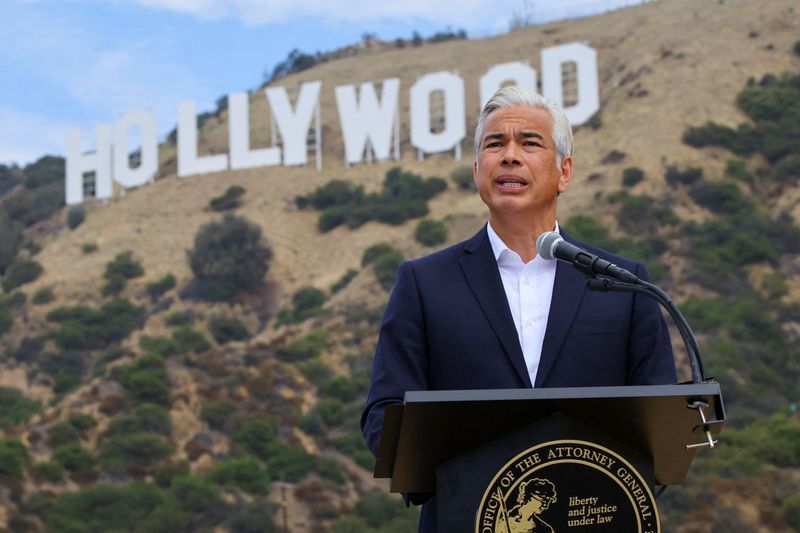
A coalition of twelve states led by California has launched a legal challenge against one of the entertainment industry's most significant proposed mergers in decades. The lawsuit, filed in Oakland federal court, targets Paramount's $110 billion acquisition of Warner Bros Discovery and represents a major obstacle to Chief Executive David Ellison's strategy to position his company as a formidable competitor to Netflix and Disney. The timing of the action signals growing tension between state-level regulators and the Trump administration's more permissive stance on corporate consolidation.
The core argument advanced by the state attorneys general centres on market concentration and its cascading effects throughout the entertainment ecosystem. According to the legal filing, the combined entity would control 27% of the distribution market for wide-release theatrical films in the United States, 30% of blockbuster film distribution, and 27% of the basic cable channel market. This concentration of power, the states contend, would enable the merged company to extract significantly higher revenues from every dollar generated in these segments—a phenomenon they characterise as creating a dangerous media behemoth with minimal competitive constraints.
The lawsuit carries particular resonance for understanding how antitrust enforcement has become increasingly politicised in recent American governance. All state attorneys general involved in the challenge are Democrats, while the federal Department of Justice cleared the deal last month under the Republican Trump administration. Critics have suggested that Paramount's connections to Republican political circles, particularly through CEO David Ellison's father Larry Ellison—a billionaire Oracle co-founder with cultivation of ties to President Trump—may have facilitated federal approval. This observation underscores how antitrust has evolved from a technical regulatory domain into a broader political instrument through which opposition parties challenge business consolidation they perceive as politically favoured.
California Attorney General Rob Bonta framed the challenge as part of a larger pattern, noting that the Trump administration's approach to antitrust enforcement appears designed to favour certain corporate interests. Bonta highlighted that several prominent Republican attorneys general have joined his office in unrelated antitrust cases involving Live Nation and Nexstar's acquisition of Tegna, though they notably declined to participate in the Paramount action—a gap Bonta characterised as an open invitation for reconsideration. This selective participation reveals fractures in what might otherwise be a unified state-level regulatory response to major mergers.
The practical implications of the proposed merger extend far beyond corporate boardrooms. Theater owners and independent distributors have voiced alarm, concerned that reduced competitive pressure between Paramount and Warner Bros would translate into restricted film slates and elevated exhibition costs. Currently, these two companies compete vigorously for optimal release dates and theater screens nationwide, a dynamic that constrains pricing power and ensures consistent content flow to moviegoers. Hollywood's creative workforce—writers, actors, directors, and technicians—similarly worries that consolidation would eliminate jobs as duplicate operations are eliminated and production pipelines are rationalised.
Paramount's response to these allegations invokes established antitrust doctrine while dismissing the states' characterisation of competitive dynamics. The company argues that the states misrepresent how competition functions within the contemporary entertainment landscape and that their legal theories rest on unsettled ground. Paramount has committed to invest the efficiency gains from its merger—projected at $6 billion from eliminating redundant infrastructure, marketing functions, and corporate overhead—into increased content production. The company specifically pledges that combined film studios would release thirty movies annually, a commitment that Paramount frames as evidence the deal would generate benefits rather than restrictions.
State attorneys general counter that such commitments lack meaningful enforceability and that even if honoured, they would not prevent price increases or quality degradation. They emphasise that the merger's ripple effects would extend throughout their respective economies, disrupting networks of suppliers, service providers, and workers whose livelihoods depend on robust competition between major studios. The states have requested that Paramount delay closing the transaction until legal proceedings conclude, threatening injunctive relief if the company proceeds without awaiting judicial determination.
The financial stakes for Paramount escalate with each month of delay. The company has committed to paying Warner Bros Discovery shareholders approximately $650 million in fees each quarter should the transaction fail to close before October. This structure creates mounting pressure and potential incentive for Paramount to renegotiate deal terms, refinance obligations, or fundamentally reconsider the acquisition's viability. Industry precedent suggests that similar merger challenges typically require eight months or longer for judicial determination, creating a timeline that could substantially exceed Paramount's financial commitments and trigger cascading consequences for corporate planning and shareholder value.
Analysts have characterised the state lawsuit as the most credible substantive threat to the merger's completion to date, despite the federal government's prior approval. Paolo Pescatore of PP Foresight noted that even if Paramount ultimately prevails in litigation, the costs associated with delay—including uncertainty regarding financing terms, stock price volatility, and the potential necessity to renegotiate fundamental transaction structures—could prove debilitating. This dynamic reflects a critical feature of contemporary merger litigation: judicial intervention need not ultimately succeed to impose enormous economic friction on proposed transactions.
For Malaysian and Southeast Asian observers, the case illuminates broader patterns in how developed markets are addressing corporate consolidation amid widespread economic anxiety. The politicisation of antitrust enforcement, the mobilisation of state-level regulators as counterweights to federal permissiveness, and the invocation of labour and consumer protection rhetoric all reflect governance challenges that increasingly preoccupy advanced economies. As media and technology companies continue pursuing regional consolidation across Asia, policymakers in the region should monitor how American jurisdictions navigate these tensions between regulatory ideology, political calculation, and substantive economic impact assessment.
The lawsuit also demonstrates that federal clearance no longer guarantees smooth transaction completion in an environment where state regulators possess independent legal authority and political incentive to challenge major mergers. For businesses planning significant consolidation—whether in media, telecommunications, or other concentrated industries—the prospect of coordinated multi-state litigation represents an unpredictable but potentially enormous friction point. The Paramount case will likely establish important precedent regarding state standing, proof standards for anticompetitive harm, and the threshold for judicial intervention in mergers previously approved by federal authorities. These developments will reverberate across industries and jurisdictions far beyond the entertainment sector.

