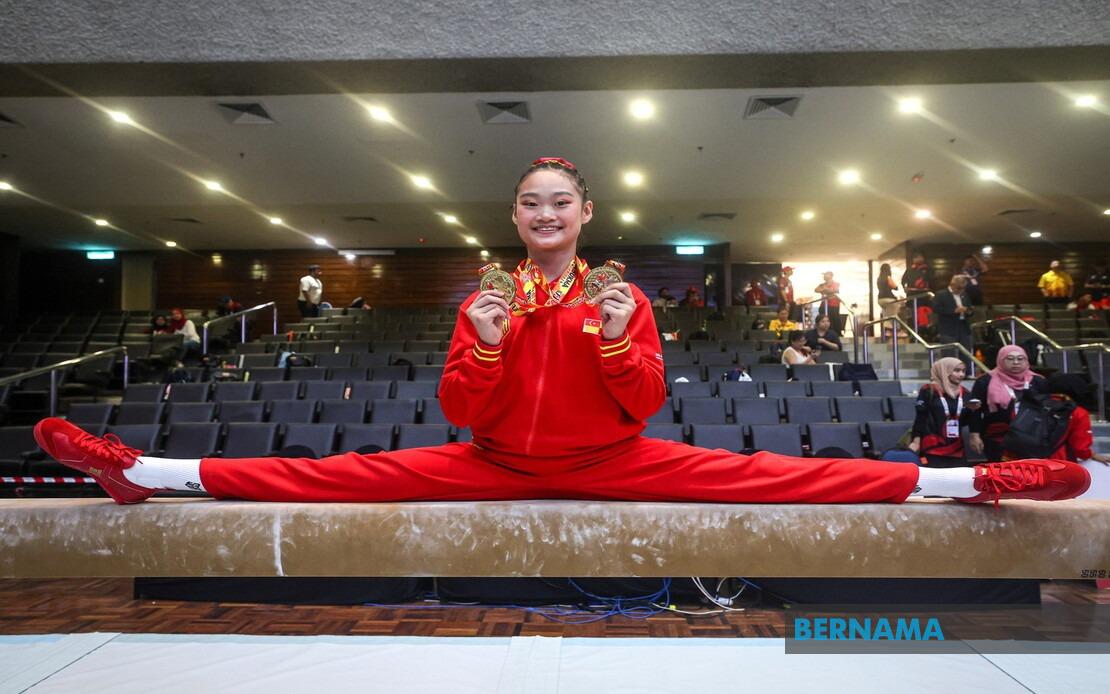
Selangor's star gymnast Cadence Teh Zi Qi delivered a commanding performance at the Malaysia Games 2026 in Bangi, capturing two gold medals in artistic gymnastics and cementing her status as the country's leading all-around talent. Competing at Dewan Canselor Tun Abdul Razak (DECTAR) at Universiti Kebangsaan Malaysia, the 17-year-old national gymnast successfully defended her individual all-around crown while guiding Selangor to victory in the team event, underlining the state's continued dominance in the sport.
Cadence's all-around victory came with a total score of 48.550 points, a demonstration of her well-rounded technical proficiency across all four apparatus. Her breakdown across the disciplines revealed both strengths and areas of strategic focus—a vault score of 12.050 points, uneven bars 11.400, balance beam 13.350, and floor exercise 11.750. The balance beam emerged as her strongest event, suggesting that the aerobic and directional control required on the apparatus aligns particularly well with her physical attributes and training methodology.
The podium reflected strong representation from across Malaysia's gymnastics fraternity. Aurin Zulkarnain from Sarawak secured the silver medal position with 44.500 points, a gap of 4.050 points behind Cadence that underscores the level of competitive separation between Malaysia's top tier gymnasts. The bronze medal was shared between Annabelle Ho Syin Yee of the Federal Territories and Penang's Amanda Ching Lee Wern, both finishing on 42.250 points. This distribution of medalists across multiple states indicates the widening talent pool in Malaysian gymnastics, though Selangor's dominance remains pronounced.
Beyond her individual triumph, Cadence formed part of a formidable Selangor team that accumulated 169.300 points to claim gold in the women's team competition. Her teammates—Nicole Wong Ziyi, Airisha Zuraidi, Wong Zi Qi, Leong Yee Shean, and Haifa Izzazi Mohd Faizul—contributed significantly to the state's collective success. The Federal Territories finished in the silver position with 166.300 points, while Johor rounded out the podium with 157.000 points. The 3-point margin between gold and silver demonstrates the razor-thin margins that often separate success and failure in competitive gymnastics at the national level.
Cadence's path to victory was not without obstacle. She experienced a moment of technical difficulty during the uneven bars segment, falling once during an apparatus where precise kinesthetic awareness and upper body strength prove critical. The incident appears to have stemmed from pre-competition nerves affecting her body awareness rather than technical deficiency in her routine construction. However, the gymnast demonstrated mental resilience and competitive maturity by compartmentalizing the setback and delivering improved performances on subsequent apparatus.
In candid remarks to journalists following the finals, Cadence attributed her early struggles to nervousness that disrupted her physical perception during bars execution. She characterized her beam routine as substantially stronger, described her floor exercise as meeting her own baseline expectations, and noted a strategic downgrade to her vault difficulty—performing a Tsukahara pike rather than her more complex variant. This tactical flexibility in competition reflects the coaching sophistication available to elite Malaysian gymnasts, who must balance difficulty ratings against execution consistency and injury risk.
Looking forward, Cadence revealed an ambitious technical trajectory aligned with the international calendar. She disclosed that her balance beam routine has been elevated to the difficulty level she intends to showcase at the 2026 Asian Games, positioning this SUKMA appearance as a critical staging ground for longer-term competitive objectives. Such early specialization and forward-planning in difficulty escalation indicates that Malaysian gymnastics development programmes are increasingly attuned to international benchmarking, moving beyond regional dominance toward competitive viability on the continental stage.
The gymnast articulated two primary areas for continued development: enhanced nervous system management during competition and sustained attentional focus across extended routines. These psychological and neurological dimensions of athletic performance have gained prominence in elite sports science, and their identification by Cadence suggests exposure to contemporary coaching methodologies. Nerves management in particular proves consequential in gymnastics, where split-second timing and spatial awareness determine success and injury probability.
Cadence's competitive calendar extends beyond the all-around medals. She will contest apparatus-specific finals in uneven bars, balance beam, and floor exercise scheduled for the following two days of competition. These individual apparatus finals represent opportunities for additional medal accumulation and specialization demonstration, particularly on beam where her technical proficiency proved most pronounced during the all-around event. Success across multiple apparatus finals would further consolidate her claim as Malaysia's premier all-around gymnast and justify investment in her training and development pathway.
The SUKMA 2026 results position Selangor as the state to beat in artistic gymnastics at the biennial Games, while establishing Cadence as the foundational element of the state's competitive structure. Her dual success—individual excellence combined with team contribution—illustrates the integrated approach required to build sustainable dominance in Olympic sports. For Malaysian gymnastics more broadly, Cadence's progress toward Asian Games-level difficulty standards suggests the sport may be approaching an inflection point, transitioning from reliable regional success toward meaningful international competitiveness within the next Olympic cycle.

