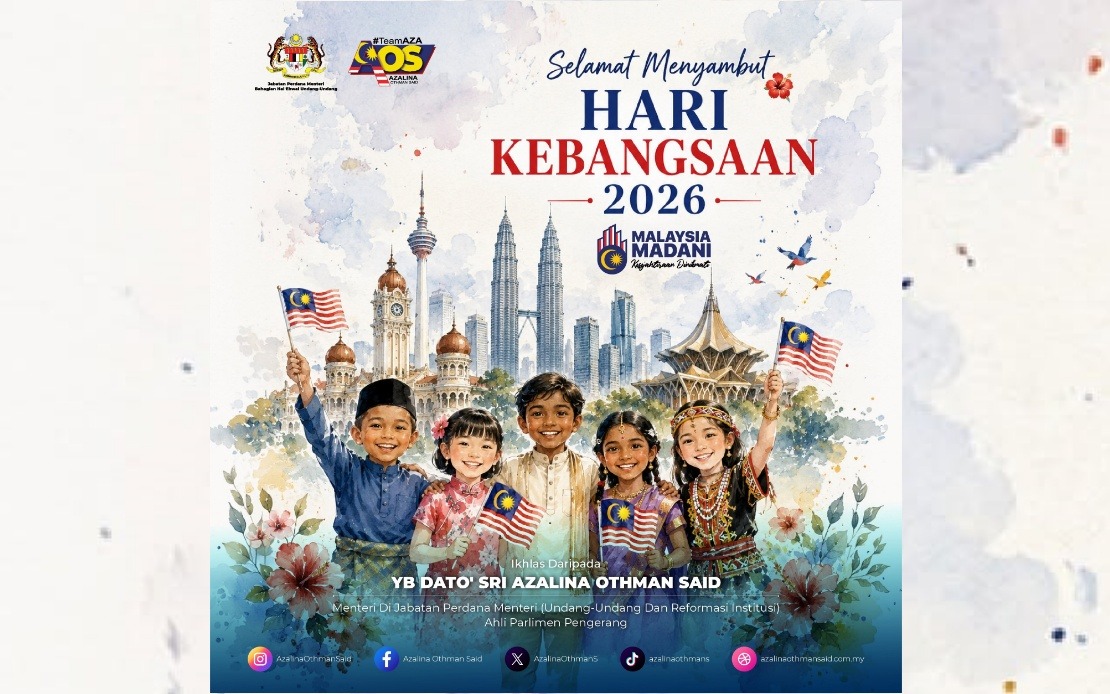
The Malaysian Cabinet has seized the nation's 69th National Day observance as an occasion to underscore a central political message: that continued success depends fundamentally on Malaysians of all backgrounds maintaining social cohesion and mutual respect. Senior ministers articulated this theme across multiple social media platforms on August 31, framing independence not as a historical milestone alone, but as an ongoing mandate requiring active commitment from citizens and government alike.
Datuk Seri Azalina Othman Said, the Minister in the Prime Minister's Department overseeing Law and Institutional Reform, positioned unity as the foundational element protecting national sovereignty. Her statement that Malaysia's historical strength has derived from its ability to unite people across ethnic and religious lines reflects a broader government narrative about what distinguishes the nation regionally. By linking independence explicitly to current social cohesion, she reframed National Day not primarily as historical commemoration but as an annual reaffirmation of the social contract underpinning Malaysia's multicultural framework.
Home Minister Datuk Seri Saifuddin Nasution Ismail articulated a generational obligation narrative, arguing that those living today inherit a responsibility to steward independence achieved through the sacrifices of earlier figures. This framing carries particular weight in contemporary Malaysian politics, where discussions about national direction often pivot on whether current leadership adequately honors founding principles. Saifuddin's emphasis on shared homeland despite demographic differences reflects government efforts to counter narratives that portray Malaysian society as irreducibly fractious.
Works Minister Datuk Seri Alexander Nanta Linggi extended this geographic dimension, explicitly invoking the peninsula, Sabah and Sarawak as interconnected components of a unified nation. This geographic inclusivity represents a deliberate rhetorical choice in a federation where regional distinct identities sometimes complicate national narratives. By emphasizing that diversity enriches rather than threatens national purpose, Alexander positioned multiculturalism as intrinsic to Malaysia's competitive advantage, particularly in a global context where many nations grapple with social fragmentation.
The religious dimensions of independence received particular attention through Minister Datuk Dr Zulkifli Hasan's invocation of spiritual and moral framings. By characterizing independence as a sacred trust requiring justice for all citizens, Zulkifli elevated National Day beyond patriotic ritual into theological territory. His invocation of founding figures including the late Tunku Abdul Rahman Putra Al-Haj and independence activist Dr Burhanuddin Al-Helmy connected contemporary governance to historical exemplars, suggesting that the MADANI Government's policy directions represent continuity with founding principles rather than departure from them.
This connection between historical narrative and current policy proved significant in Zulkifli's presentation of government initiatives. By linking BUDI MADANI subsidy expansion, infrastructure investment in education, artificial intelligence access for youth, and healthcare acceleration explicitly to the interpretation of independence, government ministers framed cost-of-living interventions not merely as administrative responses to economic pressures but as fulfillment of independence's ultimate promise. This rhetorical move transforms economic policy into expression of foundational national values, potentially enhancing political resonance of government measures among citizens evaluating government performance.
Minister Hannah Yeoh's participation, accompanied by ceremonial Merdeka declarations, demonstrated inclusive representation within government ranks, signaling that unity messaging transcends individual ministerial portfolios. Higher Education Minister Datuk Seri Dr Zambry Abd Kadir's observations about attendance at Dataran Putrajaya celebrations provided empirical grounding for unity claims, noting visible participation across societal segments. This combination of anecdotal observation and thematic messaging sought to validate the claim that unity remains observable social reality rather than merely aspirational rhetoric.
National Unity Minister Datuk Aaron Ago Dagang's characterization of on-display unity as a manifestation of government aspiration toward harmonious society represented an explicit link between state action and social outcomes. Digital Minister Gobind Singh Deo elevated Malaysia's multicultural success to global significance, positioning the nation as an exemplary model for international audiences. By contrasting Malaysia's demonstrated ability to govern diverse populations well with implied governance failures elsewhere, Gobind reframed domestic unity as achievement meriting international recognition and emulation.
The 2026 National Day theme, "Malaysia MADANI: Kesejahteraan Dinikmati" (Malaysia MADANI: Welfare Enjoyed), provided overarching framework connecting ministerial statements to explicit government branding. This thematic consistency across multiple ministers' statements suggests coordinated messaging strategy, with national observance functioning as platform for reinforcing government narrative about its stewardship of national interest. The emphasis on welfare distribution—moving beyond subsistence provision toward active enjoyment of national prosperity—represents rhetorical shift positioning MADANI Government as qualitatively distinct from predecessors.
The timing of these statements immediately following election cycles and amid ongoing debates about governance competence suggests ministers deployed National Day partly to reinforce government legitimacy narratives. By situating current policies within historical continuum of independence and founding values, ministers sought to preempt opposition claims that MADANI Government represents departure from established national principles. The repeated invocation of multiracial harmony appears calculated to address persistent concerns about social polarization observable in Malaysian political discourse.
For Malaysian and Southeast Asian observers, these ministerial statements reveal how government uses national commemorations to reinforce political messaging while appearing to transcend partisan politics. The focus on unity, welfare distribution, and inclusive development reflects broader regional trends toward claims of developmental inclusivity, as governments across Southeast Asia emphasize welfare provisions and harmonious pluralism as competitive advantages in both domestic political competition and regional positioning.
The statements collectively suggest government recognition that national unity cannot be assumed but requires continuous articulation and reinforcement through policy action. By explicitly linking independence to welfare provision, education access, and technology democratization, ministers attempted to demonstrate that abstract commitment to unity translates into concrete material benefits. Whether citizens perceive such benefits as adequately distributed and genuinely inclusive will substantially determine whether these National Day messages resonate beyond ceremonial occasions into sustained political legitimacy and social cohesion.

