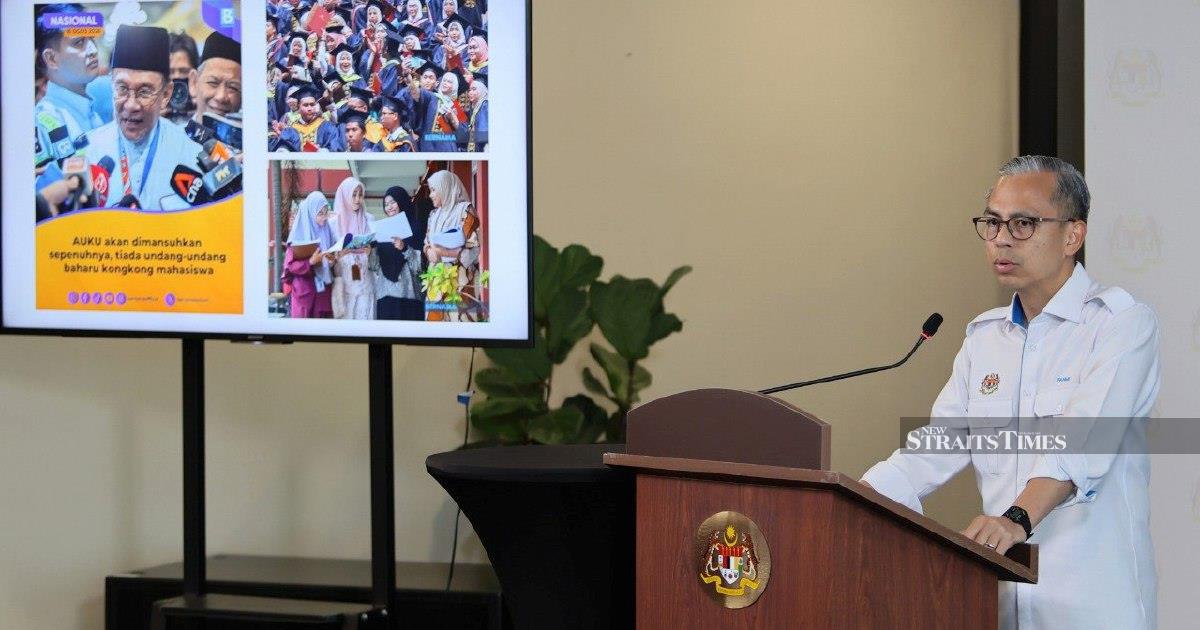
The Malaysian government has not placed Prime Minister Datuk Seri Anwar Ibrahim's recent Taiwan remarks on the cabinet's agenda, according to government spokesman Datuk Seri Fahmi Fadzil, clarifying the administration's position following criticism from Taipei.
Anwar's comments on Taiwan had sparked a pointed response from the island's leadership, raising questions about how the Malaysian cabinet would address the matter internally. However, Fahmi's statement indicates that the government has not scheduled any formal discussion or debate on the issue among ministers, suggesting an intention to manage the diplomatic sensitivity with restraint.
The clarification comes at a time when cross-strait tensions remain elevated and international actors, including Southeast Asian nations, face mounting pressure to navigate carefully between geopolitical interests. Malaysia, as chair of ASEAN this year, operates within a complex regional dynamic where maintaining equidistance from major powers is crucial to the bloc's cohesion and credibility.
Fahmi's remarks underscore a diplomatic strategy of compartmentalisation, wherein potentially contentious matters are absorbed at the administrative level rather than escalated through formal cabinet deliberation. This approach allows the government to avoid public divisions among ministers while simultaneously signalling restraint to an international audience watching Malaysian foreign policy decisions closely.
The statement also reflects Malaysia's broader commitment to the 'One China' policy, enshrined in its diplomatic framework and international commitments. By declining to elevate the matter through official channels, the government appears intent on preventing the situation from metastasising into a broader bilateral dispute with either Beijing or Taipei, a delicate balancing act that increasingly defines Southeast Asian diplomacy.
Regional observers have noted that ASEAN members continue to tread carefully on Taiwan-related matters, conscious that public rows over the island can disrupt the unity messaging that the bloc attempts to project. Malaysia's approach aligns with this cautious pattern, where managing perceptions often takes precedence over aggressive public posturing.
The episode highlights the constraints facing Malaysian leadership in articulating positions on cross-strait matters. While the government maintains official relations with Beijing and adheres to established diplomatic protocols, occasional statements touch raw nerves in Taipei, creating mini-crises that require careful damage control. The decision not to formally discuss the issue internally suggests confidence in the existing diplomatic messaging framework and a desire to prevent further escalation.
For Malaysian business and political stakeholders with interests spanning both sides of the Taiwan Strait, such incidents underscore the ongoing volatility in the region's geopolitical landscape. Companies operating across the strait or dependent on Taiwan-Malaysia trade channels remain attentive to diplomatic temperature fluctuations, as tensions can eventually translate into tangible commercial impacts.
Fahmi's clarification also serves a domestic audience, reassuring various political factions within government that coherence and discipline are being maintained on sensitive foreign policy matters. In Malaysia's coalition-heavy political environment, where multiple parties share ministerial portfolios and divergent views, centralising control over Taiwan commentary helps prevent freelance diplomacy or conflicting statements from undermining national messaging.
The broader context reveals how challenging it has become for middle-power nations like Malaysia to navigate the great-power competition between the United States and China, each maintaining competing stakes in Taiwan's status and regional stability. ASEAN's collective preference for neutrality on the question only adds pressure on individual member states to balance between principle, pragmatism, and partnership obligations.
Moving forward, Malaysia's approach suggests that while the government remains attentive to Taiwan-related developments, it prefers resolving such matters through conventional diplomatic channels rather than high-profile internal or public debate. This reflects a maturation of Malaysia's diplomatic toolkit, where managing what is said—and crucially, what remains unspoken—has become central to effective statecraft in an increasingly complex regional environment.

