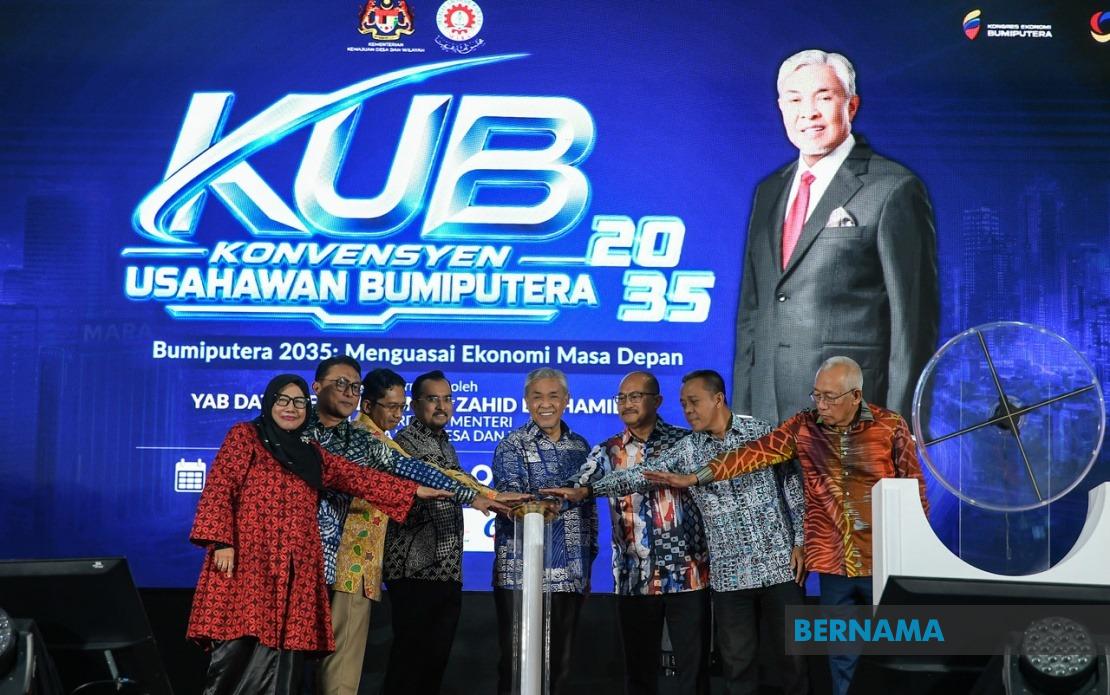
Deputy Prime Minister Datuk Seri Dr Ahmad Zahid Hamidi has called on Bumiputera entrepreneurs to move decisively beyond their current role as participants in Malaysia's economic value chain, arguing instead that the community must now focus on acquiring ownership stakes, expanding operations substantially, and exercising meaningful control within their respective industries. Speaking at the closing ceremony of the Bumiputera Entrepreneurs Convention (KUB) 2035 Declaration in Alor Setar today, Ahmad Zahid characterised the next phase of Bumiputera economic participation as fundamentally different from decades of foundational work, signalling a strategic pivot in how the government views indigenous business development.
The Deputy Prime Minister, who also holds the Rural and Regional Development portfolio, acknowledged that government support mechanisms would remain in place to create pathways for growth, develop the underlying business ecosystem, and broaden access to critical resources. However, he emphasised that these external enablers alone would be insufficient without corresponding courage and ambition from Bumiputera entrepreneurs themselves. The partnership framework Ahmad Zahid outlined places responsibility squarely on business owners to pursue expansion aggressively, engage in competitive markets directly, and generate tangible economic value rather than relying indefinitely on protective policies or preferential programmes.
Central to Ahmad Zahid's vision are three structural transformations he believes the Bumiputera entrepreneurship ecosystem must undergo before 2035. First among these is the integration of fragmented support mechanisms, a recognition that Malaysia's current approach to nurturing indigenous businesses suffers from siloed operations where financing, professional training, and market access channels operate independently rather than in concert. This fragmentation, he suggested, forces entrepreneurs to navigate multiple bureaucratic pathways simultaneously, dissipating their energy and resources. By consolidating these support systems into a coordinated framework, entrepreneurs could access comprehensive assistance more efficiently, reducing friction and accelerating their progression through successive growth stages.
The second transformation Ahmad Zahid advocated involves fundamentally recalibrating how the government produces and develops entrepreneurial talent. Rather than continuing to focus on simply creating more entrepreneurs through conventional start-up initiatives and business formation programmes, he argued that policy should shift toward nurturing existing entrepreneurs to reach greater maturity and operational scale. This distinction reflects a maturation in thinking—acknowledging that Malaysia has successfully created numerous Bumiputera-owned businesses, but that many remain trapped in small and medium-sized categories without the support infrastructure or strategic guidance needed to evolve into substantial regional players. The emphasis moves from quantity of entrepreneurs to quality of business outcomes.
The third pillar involves aligning Malaysia's broader economic growth trajectory with the strengthening of local companies, particularly those with Bumiputera ownership. Ahmad Zahid's framing suggests that national development cannot be decoupled from indigenous business expansion; rather, the country's macroeconomic progress should be deliberately structured to create multiplier effects that benefit locally-owned enterprises. This approach recognises that many foreign and non-Bumiputera firms capture value from Malaysia's economic expansion, while indigenous businesses remain peripheral. Strategic economic policy should instead ensure that growth opportunities are distributed across the ownership base more equitably.
The Deputy Prime Minister's remarks reflect broader anxieties within Malaysia's political and business establishment about the long-term viability of preferential policies if they produce entrepreneurs lacking genuine competitive capability or business scale. The Bumiputera framework has successfully created access points for indigenous Malaysians to participate in commerce, yet critics frequently note that participation often remains subordinate—with Bumiputera firms serving as subcontractors, distributors, or junior partners rather than sector leaders. Ahmad Zahid's emphasis on "ownership" directly addresses this concern, signalling that the next generation of Bumiputera business policy may prioritise building dominant market players rather than simply multiplying the number of marginal participants.
For regional observers and Malaysian business communities, Ahmad Zahid's statement carries implications beyond domestic entrepreneurship. As the government positions Bumiputera businesses as engines of national economic growth, there may be corresponding policy shifts affecting foreign investment, market access for non-Bumiputera firms, or the competitive landscape in key sectors. Multinational corporations and regional businesses operating in Malaysia may face revised expectations regarding technology transfer, employment of local management, or partnership arrangements with indigenous enterprises. The Deputy Prime Minister's framing suggests that growth strategies prioritising foreign direct investment alone will no longer suffice; instead, policymakers will increasingly evaluate economic initiatives by their contribution to building autonomous, locally-owned business capabilities.
The timing of Ahmad Zahid's remarks at KUB 2035 also reflects Malaysia's broader mid-term planning cycle. By anchoring entrepreneurship transformation to a 2035 horizon, the government acknowledges that meaningful structural change in business ownership and competitiveness requires extended periods—roughly a decade—to materialise. This timeframe allows for generational shifts in leadership, accumulation of capital and expertise among Bumiputera firms, and gradual repositioning within supply chains and value networks. It also suggests patience may be required from communities expecting more immediate economic gains from preferential policies.
The challenge Ahmad Zahid's vision poses to policymakers involves maintaining support mechanisms sufficiently robust to enable the transition from participation to ownership, while avoiding the trap of creating permanent dependency on government assistance. Entrepreneurs must build genuine competitive advantages through superior execution, innovation, and strategic positioning rather than relying indefinitely on policy preferences. The integration of ecosystem support he advocated aims to bridge this gap by creating conditions where assistance becomes a temporary accelerant rather than permanent crutch. Success will require both entrepreneurial discipline and governmental consistency in maintaining integrated support systems even as individual businesses graduate beyond the early stages of development.

