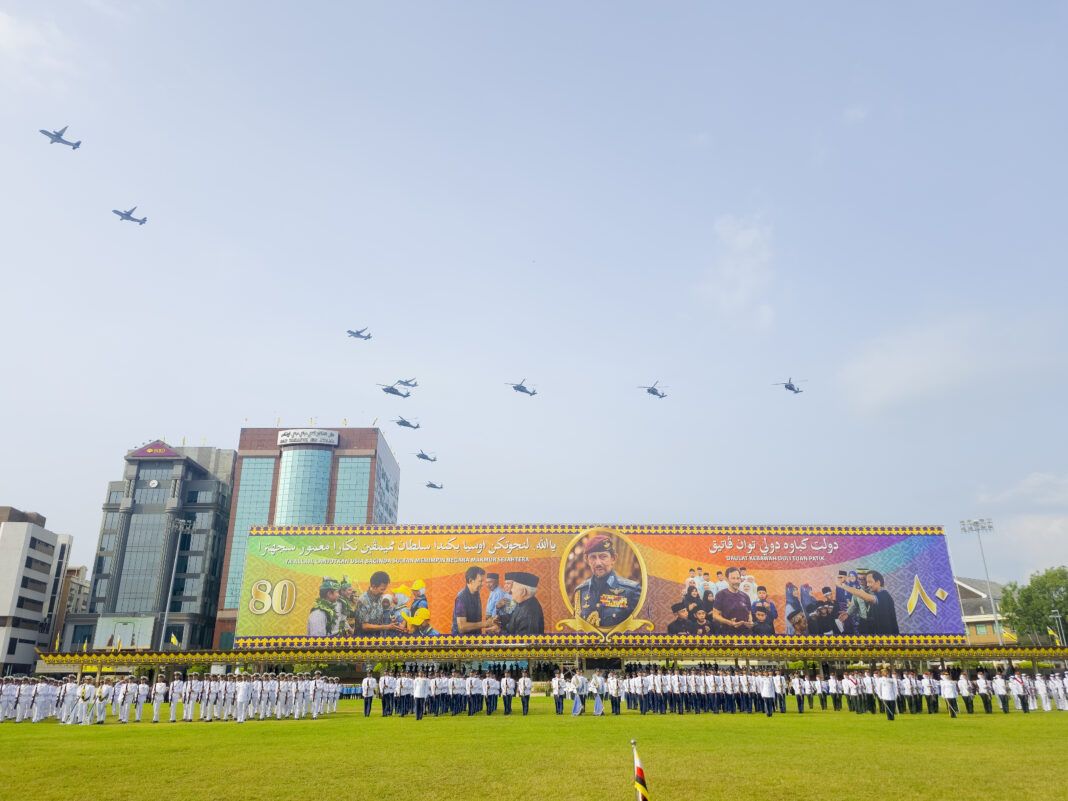
Brunei Darussalam is in the final preparations for one of its most significant state occasions, as the nation readies itself to honour Sultan Hassanal Bolkiah's milestone 80th birthday celebration in 2026. The full dress rehearsal for the ceremonial guard of honour parade took place on Saturday at Taman Haji Sir Muda Omar 'Ali Saifuddien in Bandar Seri Begawan, signalling that months of meticulous planning have reached their crucial closing stages. The successful execution of this rehearsal demonstrates the coordination and precision required for an event that will showcase Brunei's cultural traditions and institutional respect for its revered monarch to both domestic and international audiences.
The rehearsal brought together the highest levels of Brunei's government and ceremonial establishment, underscoring the paramount importance placed on this celebration. Yang Amat Mulia Pengiran Indera Setia Diraja Sahibul Karib Pengiran Anak Idris Pengiran Maharaja Lela Pengiran Muda Abdul Kahar, who holds the prestigious position of Chief of Adat Istiadat Negara—effectively the keeper of the nation's ceremonial protocols and traditions—presided over the proceedings. His dual role as co-adviser to the National Committee for His Majesty's 80th Birthday Celebration for 2026 reflects the intricate weaving of traditional authority with contemporary state administration that characterises Brunei's governance structure.
The involvement of multiple ministerial figures underscores the whole-of-government approach to orchestrating this national celebration. Datuk Seri Setia Awang Ahmaddin Abdul Rahman, in his capacity as Coordinating Minister for Social Policies and Manpower and Minister of Home Affairs, brings oversight of the domestic and social dimensions of the event. Pehin Datu Lailaraja Major General (Rtd) Datuk Paduka Seri Awang Halbi Mohd Yussof, simultaneously serving as Coordinating Minister for National Security and Minister of Defence II, ensures that the military and security apparatus operates with seamless coordination. This layered ministerial engagement demonstrates how state occasions in Brunei activate the entire institutional machinery of government.
The broader governance structure of the celebration reflects Brunei's sophisticated approach to state ceremonialism. Acting as co-chairs of the National Committee, alongside the aforementioned ministers, are Datuk Seri Setia Awang Nazmi Awang Mohamad (Minister at the Prime Minister's Office overseeing Public Service Governance), Datuk Seri Setia Dr Mohd Isham Jaafar (Minister of Health), and Pengiran Datuk Seri Setia Shamhary Pengiran Datuk Paduka Mustapha (Minister of Culture, Youth and Sports). The presence of the health and culture ministries signals an event designed not merely for ceremonial observance but as a comprehensive national celebration touching multiple facets of public life.
For Southeast Asian observers and Malaysian readers particularly, Brunei's meticulous preparation of this royal celebration offers insight into how the region's monarchical states approach the veneration of their sovereigns. The deployment of full dress rehearsals months in advance, the involvement of ceremonial specialists, and the coordination across multiple government portfolios reflects a commitment to ceremonial excellence that remains characteristic of the sultanates. In the Malaysian context, where similar royal occasions punctuate the national calendar, Brunei's systematic approach to preparation provides a useful comparative lens for understanding how different Southeast Asian nations choreograph their most important state events.
The specific venue chosen for both rehearsal and final event—Taman Haji Sir Muda Omar 'Ali Saifuddien—carries symbolic weight within Brunei's national consciousness. This location has long served as a stage for the nation's grandest ceremonial occasions, and its selection for Sultan Hassanal Bolkiah's birthday parade reinforces the continuity of Brunei's institutional traditions. The park's status as a repository of national memory and its spacious configuration suitable for large-scale military and civilian formations make it an ideal setting for a celebration designed to showcase state pageantry.
The actual parade, scheduled for Wednesday morning, will feature a ceremonial guard of honour—a military and civilian formation designed to pay formal tribute to the monarch. Such parades represent more than mere spectacle; they function as visible expressions of state unity, institutional loyalty, and the ceremonial bonds that tie together the security forces, civil service, and broader society around the institution of the monarchy. For Brunei, a nation where Islamic principles inform governance and where the Sultan's role encompasses both temporal and spiritual dimensions, such occasions reinforce these foundational relationships.
The 2026 celebration marking Sultan Hassanal Bolkiah's 80th birthday assumes particular significance given his reign's longevity and his nation's stability. Having ruled Brunei Darussalam since 1967, the Sultan has presided over the nation's transformation into a modern, prosperous state underpinned by hydrocarbon wealth and careful governance. His reaching this milestone provides occasion for national reflection on Brunei's trajectory and the institutional continuity the monarchy has provided. In regional terms, Sultan Hassanal Bolkiah represents one of Southeast Asia's longest-reigning contemporary monarchs, making his birthday celebration noteworthy beyond Brunei's borders.
From a broader Southeast Asian perspective, the thoroughness of these preparations reflects how monarchical states in the region prioritise the symbolic and ceremonial dimensions of governance. Unlike republics, where executive authority derives from electoral processes and constitutional frameworks alone, these states invest significant resources in ceremonial performance as a mechanism for affirming institutional legitimacy and social cohesion. The full dress rehearsal—essentially a complete run-through of the actual event—exemplifies this commitment to achieving ceremonial perfection, where every movement, formation, and gesture has been choreographed and practised to exacting standards.
The National Committee's work, now entering its final phase as the actual event approaches, demonstrates the logistical complexity underlying what appears to observers as seamless ceremonial performance. From coordinating military units and civilian organisations to managing crowds, arranging dignitaries, and ensuring security, such occasions require months of planning across numerous government agencies. The successful rehearsal on Saturday provides confidence that Wednesday's parade will proceed without incident, allowing Brunei to present a polished celebration befitting both the occasion and the stature of its monarch within the sultanate's constitutional and cultural framework.

