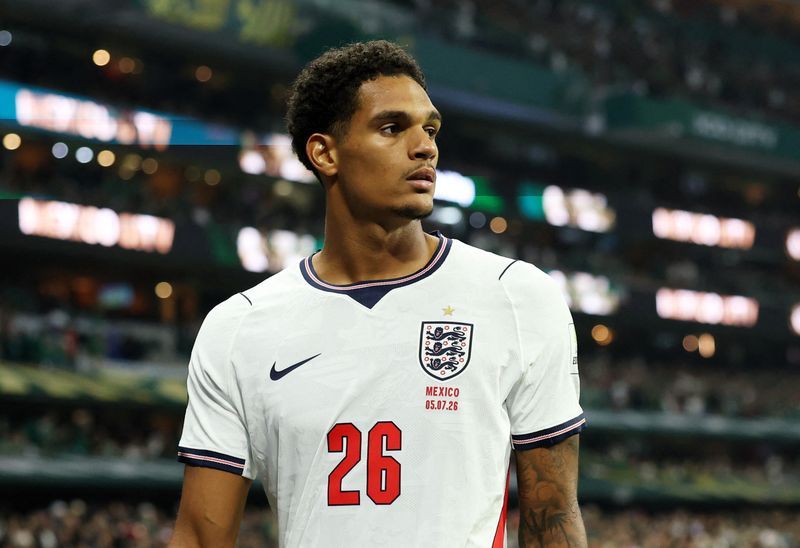
England's football federation faces mounting political pressure to secure World Cup relief for defender Jarell Quansah following FIFA's controversial decision to defer striker Folarin Balogun's suspension, a move that has ignited allegations of undue political interference in the sport's disciplinary apparatus. The controversy emerged publicly on Monday when Labour parliamentarians formally appealed to FIFA president Gianni Infantino to defer Quansah's one-match ban—triggered by a red card in England's 3-2 victory over Mexico at the Azteca Stadium—until the tournament concludes, essentially demanding that the same Article 27 provision applied to Balogun be extended to the English defender in the interest of equitable treatment.
The disciplinary imbroglio has escalated dramatically since U.S. President Donald Trump publicly acknowledged contacting Infantino regarding Balogun's eligibility, effectively placing football's governance under international political scrutiny. While Infantino maintained that FIFA's independent judicial bodies had made the decision autonomously, the Balogun reprieve has triggered fierce criticism from European football authorities and parliamentarians who question whether political leverage has compromised the sport's neutral adjudication standards. The intervention by British lawmakers now represents the first formal attempt to weaponise FIFA's own precedent—the Balogun ruling—as justification for similar relief elsewhere, potentially transforming what FIFA insists was a straightforward judicial determination into a template for preferential treatment that could undermine the credibility of disciplinary processes across international competition.
Labour MPs Noah Law and Melanie Onn articulated their case in separate statements distributed across social media, positioning the argument as one of sporting fairness rather than political favouritism. Law acknowledged the legitimacy of Quansah's original red card but contended that deferring his suspension until after the World Cup would align with the treatment granted to Balogun, while Onn emphasised that maintaining disparate standards for materially identical circumstances would prove virtually indefensible. Both parliamentarians warned that FIFA risked severe reputational damage to its disciplinary framework if it applied its suspension protocols inconsistently, essentially arguing that the Balogun precedent had created an obligation to extend equivalent consideration to other players facing automatic bans during this tournament. The English FA, meanwhile, indicated through sources that it was actively examining appeal options, though the organisation has not publicly committed to pursuing formal intervention with FIFA.
Caroline Dinenage, chair of the House of Commons Culture, Media and Sport Committee, escalated the parliamentary challenge by calling on FIFA to provide urgent and transparent clarification regarding its rationale for suspending Balogun's ban. Dinenage framed the controversy as a fundamental threat to sporting integrity, arguing that FIFA's credibility depends entirely on its capacity to administer rules universally without preferential treatment based on external political considerations. Her intervention carries particular weight given the committee's oversight responsibilities, effectively placing FIFA under parliamentary scrutiny and signalling that the dispute extends far beyond football administration into questions of institutional legitimacy and democratic accountability. The chair explicitly warned that permitting political interference in sporting governance threatens the foundational principle that underpins all competitive athletics—namely, that identical infractions receive identical consequences regardless of a player's nationality or the political relationships between governments and international sporting bodies.
The timing of this controversy—emerging mid-World Cup with England preparing for quarter-final competition against Norway in Miami—underscores the competitive stakes involved in these disciplinary decisions. Quansah's potential absence would directly impact England's defensive capabilities during knockout-stage matches where squad depth becomes tactically decisive. The situation presents FIFA with an uncomfortable choice: either maintain its stated position that judicial independence governed the Balogun decision, risking accusations of arbitrary application, or formally extend equivalent relief to Quansah and potentially open the floodgates to similar requests from other nations, thereby undermining the integrity of its disciplinary framework altogether. This dilemma illustrates how Trump's public acknowledgement of his FIFA communication has contaminated the entire adjudication process, making it nearly impossible for FIFA to manage subsequent cases without inviting allegations that political considerations drive outcomes.
From a Southeast Asian perspective, this controversy carries broader implications for international sporting governance and the vulnerability of FIFA's institutional independence to pressure from powerful nations. Malaysia and other regional nations that participate in FIFA competitions face an implicit question about whether their players and teams will receive equivalent procedural protections when they commit identical infractions, or whether access to high-level political channels determines disciplinary outcomes. The Balogun-Quansah affair demonstrates how FIFA's reputation for neutral governance—already compromised by corruption scandals and governance criticism—faces further erosion when decisions appear influenced by geopolitical considerations. For developing football nations without equivalent political leverage, this precedent suggests a system where disciplinary protection correlates with national power rather than adherence to neutral application of established regulations.
FIFA's silence on the matter—declining to comment on whether Quansah's case would be evaluated under Article 27—compounds the institutional credibility crisis. The world governing body's refusal to engage substantively with parliamentary inquiries and consistent appeals from multiple British politicians suggests either an inability or unwillingness to articulate coherent justification for its decision-making, neither of which reassures stakeholders about the independence of its judicial processes. This communicative vacuum has permitted critics to attribute FIFA's silence to consciousness of impropriety, allowing speculation about political pressure to fill the space where transparent reasoning should exist. Infantino's claim that judicial bodies acted independently rings increasingly hollow when those bodies decline to explain their reasoning or indicate whether precedent will be applied consistently, transforming assertions of independence into unsubstantiated claims unsupported by transparent methodology or public documentation.
The convergence of parliamentary pressure, club federation concerns, and media scrutiny has created conditions where FIFA can no longer manage this controversy through administrative silence. Whether the organisation grants Quansah equivalent relief or declines to do so, its decision will establish either that political intervention successfully influenced a disciplinary outcome, or that FIFA applies identical violations inconsistently depending on the player's nationality and political connections. Neither scenario enhances FIFA's institutional legitimacy or demonstrates the neutral governance structure that international sports administration requires. England's quarter-final preparations now occur against the backdrop of this unresolved disciplinary dispute, introducing psychological and administrative complications into preparations for high-stakes competition and further demonstrating how FIFA's governance failures ripple through the sporting calendar with competitive consequences.

