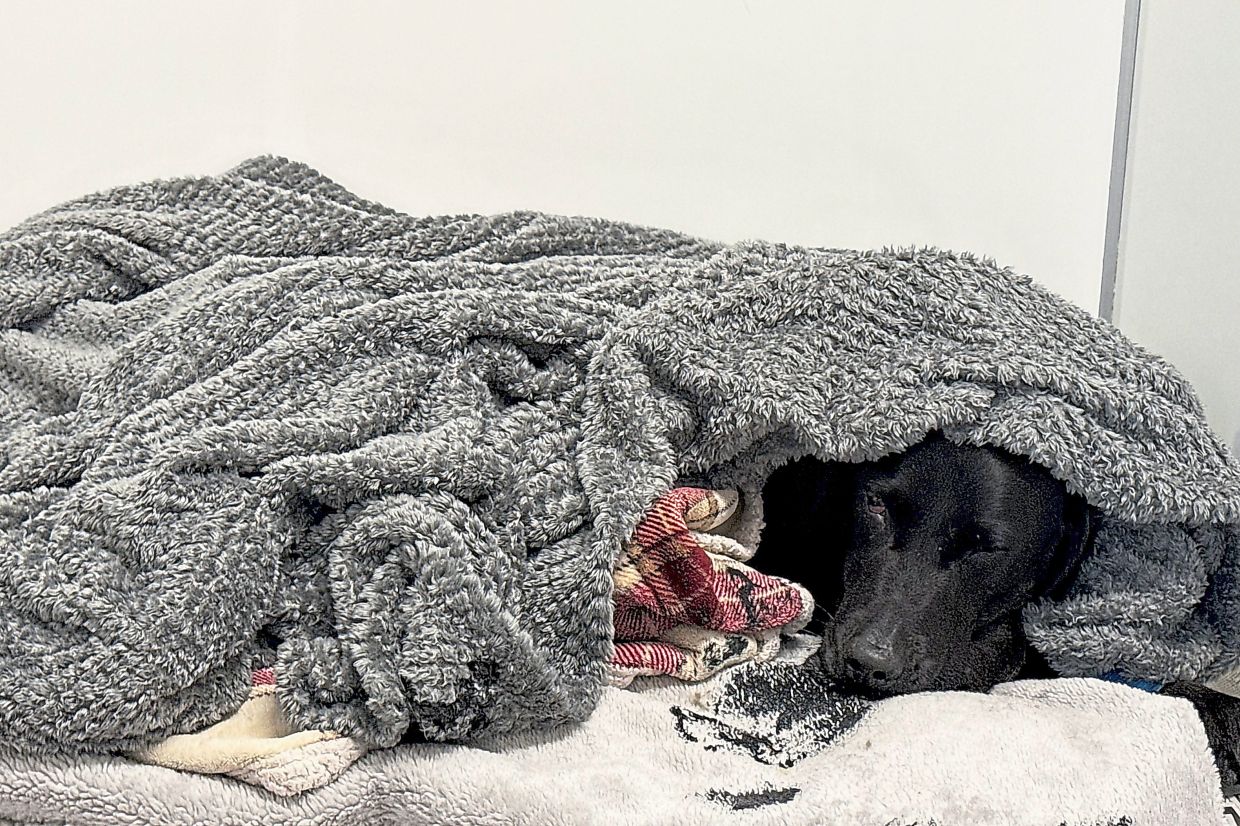
High on the slopes of Britain's tallest mountain, Christina Bluhme found herself facing an unexpected crisis when her five-year-old black Labrador retriever, Tokyo, fell dangerously ill during what should have been a routine summer hike. The dog had apparently consumed cannabis somewhere along the trail on Ben Nevis in the Scottish Highlands, and her condition deteriorated rapidly enough to trigger a full-scale mountain rescue operation on July 5. What began as a family outing transformed into a frightening ordeal that tested both Bluhme's decades of experience as a canine trainer and the resilience of emergency services in one of Britain's most challenging environments.
Bluhme, who has worked professionally with dogs for 25 years, found herself wholly unprepared for what was unfolding. As the trio – Bluhme, her son Magnus, and two dogs – pressed upward toward the 1,345-metre peak, Tokyo began showing alarming symptoms. The dog started to sway unsteadily, her movements resembling those of intoxication, before her condition worsened to the point where she could no longer walk at all. Despite her professional background and familiarity with canine health issues, Bluhme initially could not identify what had afflicted Tokyo, describing the episode as "a very bad trip" and recalling it as a terrifying experience that shattered the safety she normally felt in her knowledge of dogs.
The timing of the emergency could hardly have been worse. The group was more than three hours into their climb when Tokyo collapsed, placing them well above the midpoint of Ben Nevis and dangerously exposed to the mountain's unpredictable weather. The conditions had deteriorated significantly from the clear morning they had started in; rain began to fall and temperatures had plummeted to 5 degrees Celsius, creating hazardous underfoot conditions on the rocky terrain. Recognizing the gravity of the situation and unable to carry an increasingly immobilised 25-kilogramme dog further up the mountain, Bluhme made the difficult decision to abandon their summit bid entirely.
When Magnus called for help, the response proved uncertain. Police initially expressed doubt about their ability to dispatch a mountain rescue crew to their location, leaving the family facing the grim prospect of attempting a dangerous descent in deteriorating weather with an incapacitated animal. Fortunately, rescue came through an extraordinary stroke of timing and coordination. A crew from the all-volunteer Lochaber Mountain Rescue Team was already descending from the peak after assisting in the helicopter evacuation of an injured hiker. Finding themselves in the right place at precisely the right moment, the rescue team immediately transferred Tokyo into their stretcher and began the urgent descent.
The professionalism and speed exhibited by the rescue volunteers proved crucial. Bluhme described the team as moving with almost superhuman agility and pace as they navigated the treacherous downward path, covering in roughly an hour terrain that had taken three hours to ascend. She found herself clinging to the stretcher as the rescuers nearly ran down the steep, slick, rocky descent, their performance leaving an indelible impression on the distressed dog owner. This rapid evacuation was essential – had Tokyo remained on the mountain much longer, the combination of her incapacitation, the worsening weather, and the remoteness of their location could have resulted in tragedy.
Meanwhile, police had coordinated with Crown Vets in nearby Fort William, ensuring that a veterinarian was standing ready when Bluhme arrived at the facility. The initial medical assessment proved inconclusive; veterinarians first suspected a spinal injury or neurological problem. However, a senior veterinarian observed that Tokyo's pattern of drifting in and out of consciousness pointed toward neurotoxin exposure rather than structural injury. When the clinic consulted with a poison control centre, the symptoms aligned precisely with cannabis intoxication – the sway, the lack of coordination, the altered consciousness, all matching the known effects of cannabinoid toxicity in animals.
The diagnosis, while alarming to Bluhme, at least provided a clear path forward. Tokyo was treated with activated charcoal, a standard intervention for toxic ingestion, and kept under observation overnight. The recovery was remarkably swift and complete. By the following morning, Tokyo had returned to normal, showing no residual effects from her ordeal. Bluhme found herself still processing the emotional toll of the experience even as her beloved dog bounced back with the resilience characteristic of young dogs, a stark contrast that highlighted the psychological weight of what she had endured.
The incident illustrates a significant and growing public health concern for pet owners across Britain. Veterinary professionals have observed a marked increase in cases of cannabis toxicity among domestic animals, a trend that reflects both the increasing normalisation of cannabis use in society and the carelessness with which some users dispose of cannabis products in public spaces. The problem extends far beyond Britain; in the United States, cannabis toxicity entered the American Society for the Prevention of Cruelty to Animals' top 10 list of toxins affecting pets for the first time in 2023, indicating that this has become a mainstream veterinary concern rather than an isolated phenomenon.
The financial consequences of Tokyo's rescue and treatment proved substantial. The veterinary bill alone reached £1,000, equivalent to approximately RM5,445, a significant sum for emergency services rendered on short notice. Yet Bluhme reflected that having narrowly avoided losing her dog on a remote Scottish mountainside, the cost seemed immaterial. The experience had forced her to confront her own vulnerability as a pet owner, regardless of professional expertise, and the value of rapid emergency response from both rescue teams and veterinary professionals.
The episode raises uncomfortable questions about public space safety and personal responsibility among recreational drug users. While cannabis remains illegal in the United Kingdom, the increasing casualness with which it is used has created genuine hazards for unsuspecting animals who may encounter discarded cannabis products on popular walking trails. Pet owners who frequent mountain ranges, parks, and other outdoor spaces increasingly must consider not only natural hazards but also human-generated risks from drug residues left behind by others.
Bluhme's experience also underscores the critical importance of well-trained, responsive emergency services in remote areas. The Lochaber Mountain Rescue Team's presence at precisely the moment they were needed, combined with the coordination between emergency services and veterinary professionals, created a perfect convergence that saved Tokyo's life. Had any element failed – had the rescue team not been descending at that moment, had the vet not been standing by, had the diagnosis taken longer to reach – the outcome could have been tragically different.
For Bluhme, the rapid recovery and return to normalcy provided profound relief, yet the psychological impact lingers. The experience has left her with a different perspective on outdoor activities with her dogs and a heightened awareness of the invisible hazards that lurk along Britain's most beloved walking routes. Tokyo's story serves as a cautionary tale for other pet owners and a reminder that in an era of increasing drug normalisation, even beloved natural spaces carry unexpected dangers for our animals.

