An exhausted physician sitting in a hospital administration office in northwest England discovered something profound about human connection when a colleague offered to peel a mandarin orange for her. What might seem like a simple gesture of thoughtfulness triggered a cascade of memories stretching back to her childhood in Malaysia, where food had always been woven into the fabric of how people demonstrated affection and belonging. The moment illuminated a truth that transcends geography: that nourishment, whether physical or emotional, communicates care in a language far older and more universal than words.
The author's relationship with food began in infancy, shaped by patterns of devotion that characterised Malaysian family dynamics. Her paternal grandmother's ritual of cutting, peeling, and salting green apples after meals eventually passed to her mother when her grandmother could no longer perform this duty. Such gestures, though small in isolation, accumulated into a lived experience of being cherished. What struck the physician most acutely, sitting abroad and reflecting on these moments, was the realisation that this particular expression of care—taking responsibility for someone else's nourishment, even when inconvenient—carries the weight of genuine affection. The act of peeling fruit for another person demands attention and time; it cannot be rushed or performed perfunctorily without revealing one's true sentiment.
Food's role in her upbringing extended beyond everyday meals into the realm of accommodation and sacrifice. Her grandmother's solution to her stubborn habit of reading during lunch—hand-feeding her so she could continue reading undisturbed—represented not capitulation to a child's whim but rather a grandmother's creative problem-solving in service of a grandchild's happiness. Similarly, her late father's patient labour of cracking open crabs and extracting flesh for her created a dependency that reflected his willingness to perform tedious, repetitive work simply because it pleased her. The author later reflected that she never learned to crack crabs herself, a detail that underscores how these acts of care can inadvertently shape the architecture of a child's competence and confidence.
Maternal memory became even more poignant when examined through the lens of seemingly trivial preferences. Her mother's persistent inability to remember that her favourite crisps were Mr Potato in tomato flavour, despite repeated corrections, speaks to a different kind of care—the care that persists despite imperfection, that tries and fails and tries again. Yet her mother never stopped buying crisps for her, never abandoned the effort simply because she got the specific flavour wrong. This willingness to keep attempting to please, even imperfectly, forms the bedrock of emotional security that many take for granted when reflecting on childhood.
The intersection of food and festive traditions deepened these patterns across her family's multicultural neighbourhood in Malaysia. During Deepavali celebrations, her aunt demonstrated intentional care by reserving extra potatoes in chicken curry, having observed and remembered her niece's preference for vegetables over meat. This act of remembrance transformed a communal dish into a personalised gift. Even more touching was the annual ritual of her mother's Malay colleague arriving at their doorstep with homemade chocolate moist cake during Deepavali season—a gesture that required no obligation, no return expected, yet performed with consistency year after year. These intercommunal food exchanges reflected Malaysia's multicultural fabric, where boundaries between religious and cultural celebrations dissolved through the simple act of sharing food.
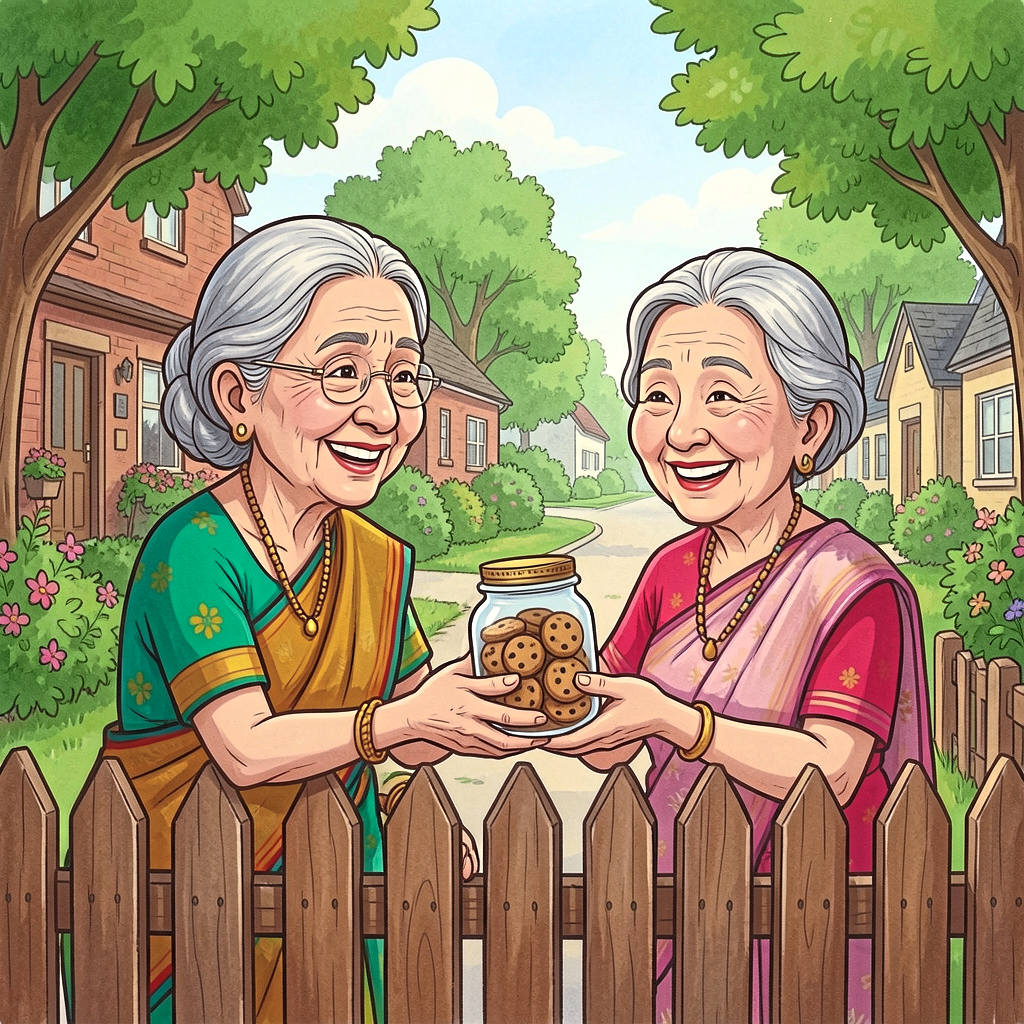
What began as individual family memories crystallised into neighbourhood tradition when the author considered her long-term neighbour of more than fifty years. This neighbour, in a pattern repeated thousands of times across Malaysian residential areas, would call across the dividing fence with containers of home-cooked dishes. The sweet upma she prepared became so emblematic of care that decades later, when the author thinks of this neighbour, the taste of upma floods her memory more powerfully than any other detail. The reciprocal nature of these exchanges—returning containers with homemade items inside—transformed gift-giving into a rhythm of community maintenance, a visible acknowledgement that the relationships binding neighbours together required regular renewal and attention.
The author's observation that these rituals continued long after practical necessity disappeared reveals something essential about human behaviour. Her mother, retired for eight years, continues the annual tradition of delivering cookies to her former colleague during Chinese New Year, even though their relationship no longer exists within a professional context. Her aunt still walks the neighbourhood on Deepavali distributing cookies to Chinese neighbours, perpetuating exchanges that have evolved beyond any measurable economic benefit. These habits persist because they serve a purpose beyond nutrition or gift exchange; they maintain the social and emotional architecture that binds communities together across religious and cultural lines.
Relocating to England forced a reassessment of whether the author's experience of food-as-care represented something distinctly Malaysian or rather a universal human impulse expressed through different registers. The English colleague's simple offer to peel the mandarin orange proved revelatory precisely because it matched the emotional tenor of Malaysian maternal care, despite emerging from a completely different cultural context. This realisation arrived not as an intellectual abstraction but as a moment of recognition, a sense that she had encountered the same emotional grammar in a different language. The specifics differed—peeling techniques, food choices, timing of gestures—yet the underlying message remained comprehensible and deeply moving across geographical and cultural distance.
Considering her experience as a healthcare professional added another dimension to these reflections. In a hospital setting, physicians witness human vulnerability at its most acute, where patients and families grapple with mortality and suffering. Food often becomes one of the few forms of agency remaining to those who have lost control over their bodies and circumstances. A parent smuggling in a sick child's favourite dish, a spouse maintaining a patient's preferred dietary routine despite restricted hospital menus—these acts represent resistance to helplessness and an assertion of continuity during disruption. The physician's own collapse into exhaustion and hunger in the hospital office mirrored countless moments when self-care falls away under professional demands, making her colleague's offer to peel fruit feel like much more than a casual gesture of kindness.
The author's grandmother's stroke and subsequent move away from her long-term home, which prevented her from continuing her practice of cooking for neighbours, added poignancy to the recognition that food-based relationships rely on physical ability and proximity. Yet the memory of her sweet upma persisted independently of the grandmother's continued ability to prepare it, suggesting that food-as-care operates simultaneously as concrete sustenance and as symbol. The grandmother's capacity to nourish others physically had ended, but her presence in the author's memory through taste remained vivid and irreplaceable. This reality confronts anyone reflecting on family and community—that the rituals binding people together eventually end, whether through choice, circumstance, or mortality, yet their emotional imprint endures in ways that transcend their practical function.
Sitting in that English hospital office, the physician arrived at a conclusion that reframed her understanding of home and belonging. What had felt distinctive and even isolating about her Malaysian upbringing—the constant presence of people offering food, the rituals of preparation and sharing, the emotional weight assigned to nourishment—turned out to represent something fundamentally human rather than narrowly cultural. The offer to peel a mandarin orange spoke the same language as her grandmother's hand-feeding during lunch, her father's patient extraction of crab meat, and her mother's repeated attempts to buy the correct flavour of crisps. Across continents and cultures, the message conveyed through such gestures remained constant: your well-being matters to me, your preferences are worth remembering, your nourishment is my concern. In this recognition lay something greater than nostalgia for home—it was an understanding that the capacity to communicate care through food represents one of humanity's most ancient and most reliably comprehensible languages, spoken with individual accents but conveying universal meaning.

