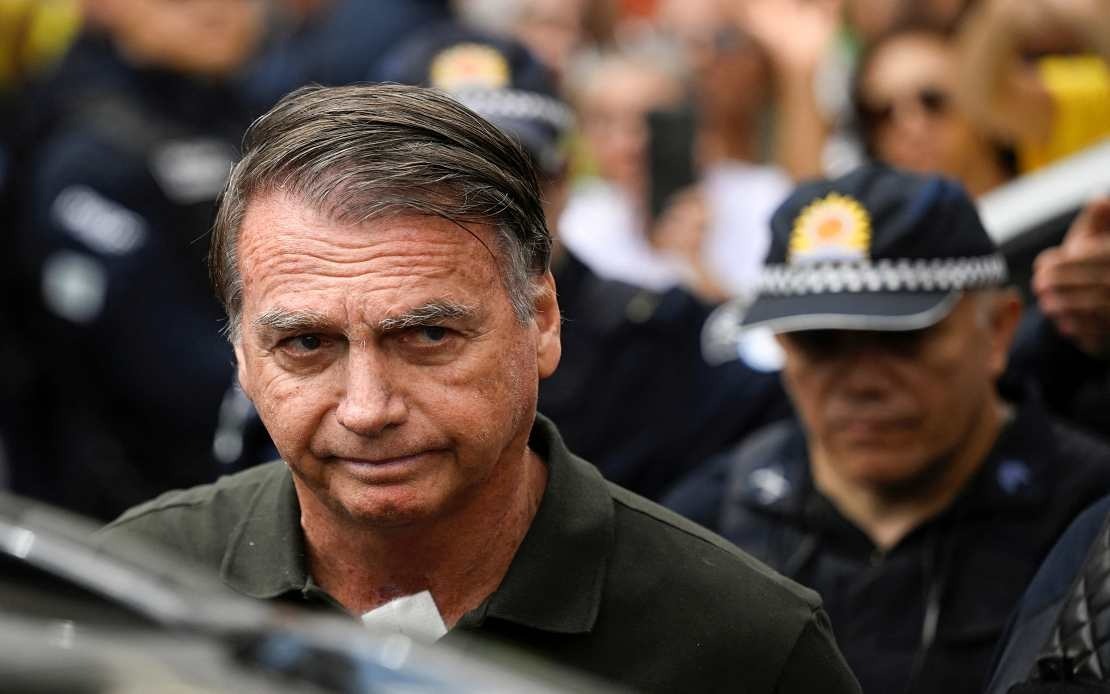
A Brazilian court has rejected Argentine President Javier Milei's request to visit former Brazilian president Jair Bolsonaro, who remains confined to his home under court-ordered house arrest. The decision, handed down by Judge Alexandre de Moraes, came just days after the court imposed stricter conditions on Bolsonaro's detention, effectively preventing any visits of a political character. The denial underscores mounting tension in Brazil's judicial system as the October presidential election approaches, with courts moving aggressively to restrict the movement and influence of figures seen as threats to electoral integrity.
Millei had announced plans to travel to Brazil on July 25 specifically to meet with Bolsonaro at his residence in Brasília and demonstrate backing for Flávio Bolsonaro's presidential campaign. The Argentine leader, himself a leading rightwing voice in South America, sought to use the meeting as a symbolic gesture of solidarity with the Bolsonaro political machine as it prepares for what promises to be a closely contested election. However, Judge Moraes dismissed the Argentine president's request as procedurally moot, effectively closing the door on any face-to-face encounter during this critical period.
The timing of the court's decision reflects a broader pattern of judicial intervention in Brazil's electoral landscape. Just one day before Milei submitted his request, Judge Moraes had substantially tightened the terms of Bolsonaro's house arrest, introducing new prohibitions that specifically target political activity. These restrictions ban Bolsonaro from receiving visitors whose purpose involves political or electoral matters and forbid him from transmitting political communications through intermediaries. The measures directly respond to what authorities viewed as a breach of his existing confinement conditions, triggered by a handwritten letter in which Bolsonaro expressed support for his son's candidacy.
The letter in question was particularly significant because Flávio Bolsonaro chose to publish it on social media, amplifying its reach and political impact. Judge Moraes interpreted this action as deliberate circumvention of house arrest rules designed to prevent the former president from influencing the election campaign from his home. By channelling his endorsement through his son, Bolsonaro appeared to be testing the boundaries of his constraints, and the court responded with punitive measures. The judge's characterisation of the letter as a violation demonstrates how seriously Brazilian authorities are treating attempts to use indirect methods for political influence while under court supervision.
Bolsonaro's legal status represents one of the most contentious issues in Brazilian politics. The 69-year-old former president was sentenced to more than 27 years in prison on charges related to an alleged coup conspiracy, a case that has fuelled intense debate about judicial independence and political persecution. However, he is currently serving his sentence under house arrest rather than in a conventional prison facility, ostensibly for health considerations. This arrangement has become increasingly controversial, with critics arguing it provides him with undue comfort and opportunity to maintain political relevance, whilst supporters contend it represents a reasonable accommodation for a man of his age and health status.
The election that forms the backdrop to this judicial action will pit Flávio Bolsonaro against incumbent president Luiz Inácio Lula da Silva, who is expected to seek another term. This matchup represents the culmination of Brazil's extraordinary political polarisation, with the two principal candidates embodying competing visions of governance and constitutional order. For Malaysian observers and regional analysts, the Brazilian situation illustrates how contemporary democracies are grappling with questions about the proper limits of electoral regulation and judicial authority, concerns that resonate across multiple continents.
The court's decision also carries implications for international relations and diplomatic protocol. By denying Milei access to Bolsonaro, the Brazilian judiciary has effectively constrained the diplomatic movements of a neighbouring head of state, an unusual assertion of judicial power that extends beyond national borders in its practical effect. Whilst countries regularly impose restrictions on their own citizens, blocking official visits by foreign leaders represents a more delicate matter that touches on questions of sovereignty and international courtesy. Milei's situation illustrates how electoral concerns can override conventional diplomatic niceties in contemporary Brazil.
Flávio Bolsonaro's presidential ambitions represent an important continuity within Brazilian rightist politics. Unlike his father, Flávio has not been barred from holding office, making him the primary vehicle through which the Bolsonaro political project can advance at the presidential level. His decision to campaign for the presidency in 2026 represents a calculated effort to maintain family influence and potentially reverse some of the legal judgements that have constrained his father. The involvement of international figures like Milei in supporting this endeavour reflects how the Bolsonaro movement has cultivated relationships with like-minded politicians across South America.
For Southeast Asian readers, the Brazilian court case offers instructive lessons about the intersection of electoral politics and judicial authority. Malaysia and other regional nations have experience with courts playing significant roles in political processes, and the Brazilian example demonstrates both the necessity and the risks of judicial intervention in electoral matters. When courts move to restrict political activity, they must balance legitimate concerns about preserving electoral integrity against concerns about appearing to weaponise the judiciary against particular political movements or figures.
The enforcement of house arrest conditions represents a fundamental challenge for judicial systems worldwide. Courts must determine how to enforce such restrictions without creating the appearance of political persecution, a task that becomes exponentially harder when the confined individual remains a prominent political figure with substantial public support. Bolsonaro's case demonstrates that house arrest is never merely a technical legal arrangement; it becomes a statement about power distribution within a political system and invariably generates intense controversy when applied to figures of his stature.
Moving forward, the question of whether Bolsonaro will attempt further political communication through proxies, and how the courts will respond to such attempts, will shape Brazil's electoral environment in the months preceding October's election. The tightened restrictions signal that Judge Moraes and other judicial authorities are determined to prevent the former president from substantially influencing his son's campaign from his place of confinement. Whether these measures prove effective, or whether they instead generate sympathy for Bolsonaro and his political base, remains uncertain as Brazil navigates one of its most fraught electoral periods in recent history.

