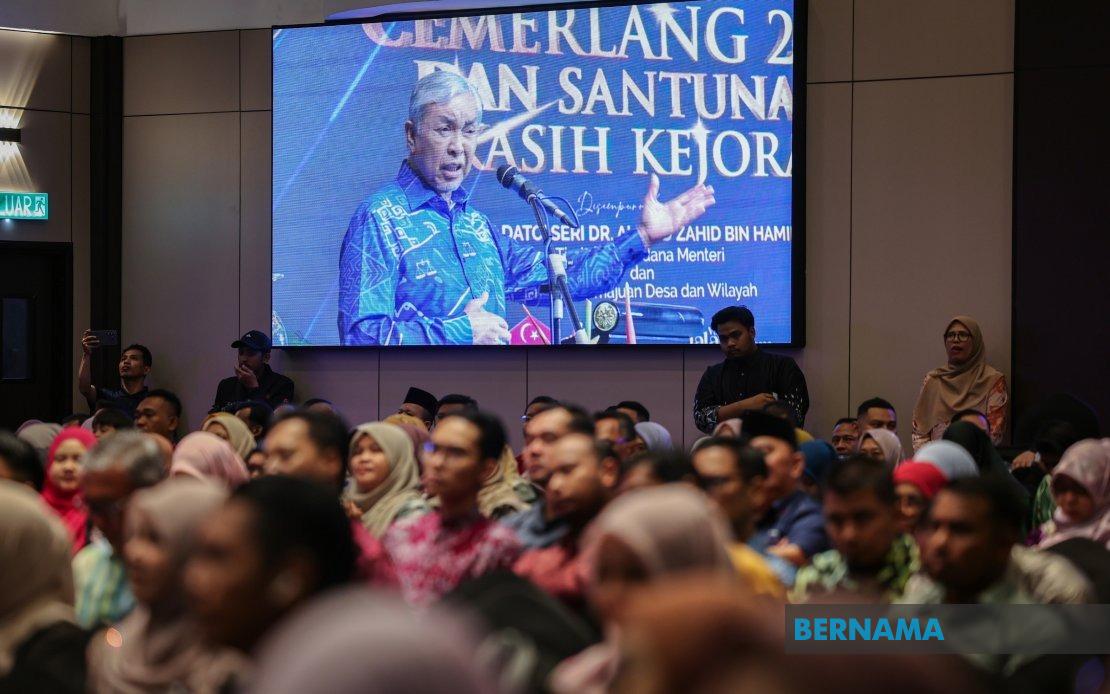
Barisan Nasional leadership has pushed back firmly against suggestions that its machinery is operating at reduced tempo in the lead-up to Johor's state election, framing such assessments as subjective political commentary rather than empirical reality. Speaking in Kota Tinggi on July 2, BN chairman Datuk Seri Dr Ahmad Zahid Hamidi characterised the campaign as actively progressing and dismissed critics' characterisations as reflections of rival coalitions' own political preferences rather than genuine observations about on-the-ground activity.
Zahid's defence of the coalition's campaign effort comes as the Johor contest shapes up to be a critical test of BN's electoral resilience in a state where it has historically dominated. The upcoming poll on July 11 will determine whether the coalition can extend its control beyond the state government already led by Menteri Besar Datuk Onn Hafiz Ghazi, who has presided over what BN characterises as a period of significant administrative achievement. The coalition is contesting all 56 state seats, with victory appearing within reach given polling day's proximity and the absence of obvious headwinds.
One substantive concern raised by political observers has centred on potential voter confusion arising from BN's partnership with Pakatan Harapan at the federal level through the Unity Government framework, which could theoretically alienate traditional BN supporters in Johor who view PH with suspicion or antipathy. Zahid addressed this concern directly, arguing that such confusion represents a non-issue because Johor's state administration was already established before the federal-level cooperation commenced. This sequential reality, he contended, means voters face no fundamental contradiction in supporting BN locally while the party simultaneously partners with rivals nationally.
The deputy prime minister's defence of the coordination between state and federal authorities underscores a larger narrative that BN is positioning around administrative competence and continuity. According to Zahid, the Johor government under Onn Hafiz's stewardship achieved revenue generation of RM2.26 billion in the preceding year, a figure he described as the highest among Peninsular Malaysian states. This financial performance, BN argues, provides tangible evidence of effective governance and justifies voter confidence in the coalition's capacity to implement its development agenda over the subsequent five years.
Zahid's characterisation of rival critiques as matters of political perspective rather than factual observation reflects a broader strategic choice by BN to occupy a position of administrative confidence rather than defensive urgency. Rather than engaging extensively with specific criticisms, the coalition chairman positioned dissenting voices—whether from Pakatan Harapan, Perikatan Nasional, or other challengers—as entitled to their own views while implicitly suggesting such assessments carry less weight than demonstrated governance results. This posture assumes that voters will ultimately prioritise material outcomes and state capacity over abstract political positioning.
Pemarcos Nasional's entry into the contest with 33 candidates, alongside Pakatan Harapan's full slate of 56 candidates and smaller contenders including Bersama, MUDA, and independent candidates, creates a fragmented electoral landscape that may actually benefit BN's consolidation efforts. In multi-cornered contests where opposition votes split across multiple contestants, an incumbent coalition with unified support can secure victories despite failing to achieve clear majority vote shares. Whether this dynamic materialises will depend partly on regional variations in voter sentiment and the degree to which anti-BN sentiment coalesces around a single opposition banner.
Zahid's implicit criticism of Perikatan Nasional president Tan Sri Abdul Hadi Awang's call for voters to reject Pakatan Harapan outright, even where this means supporting BN in certain contests, reveals fissures within the broader anti-government coalition ecosystem. By adopting what he termed a professional approach focused on candidate presentation rather than zero-sum hostility toward potential allies, Zahid positioned BN as the mature, pragmatic force in Johor politics. His suggestion that the ballot box would provide the ultimate arbiter of competing claims reflects confidence in the coalition's capacity to mobilise its supporters effectively.
For Malaysian observers and regional watchers, the Johor election carries significance beyond its immediate state-level implications. The contest provides early empirical evidence regarding whether federal-level cooperation between historically antagonistic coalitions translates into electoral vulnerabilities at state level, or whether voters compartmentalise federal and state-level political preferences. A resounding BN victory would suggest that Unity Government arrangements have not substantially eroded the coalition's core support base, whereas a narrowed margin might indicate emerging complications from the federal partnership.
The election also tests whether BN's administrative performance delivers sufficient electoral return to justify the legitimacy claims the coalition advances. In contemporary Malaysian politics, governance capacity has increasingly become voters' primary consideration, displacing purely identity-based or ideological preferences. By emphasising Johor's financial performance and development trajectory, Zahid implicitly argued that competence remains the most persuasive campaign message available to the coalition, particularly when rivals have not articulated comparably concrete alternative visions.
Early voting on July 7 will provide initial indicators of enthusiasm levels among different voter cohorts, though such data typically requires careful interpretation given variations in turnout patterns across different demographics and constituencies. The full polling process on July 11 will ultimately determine whether BN's confidence in its campaign machinery reflects genuine organisational strength or represents political projection masking underlying vulnerabilities. For Southeast Asian governments watching Malaysia's federal system operate, the Johor result will offer lessons regarding how elite-level political realignments affect grassroots electoral dynamics.
Zahid's strategy of dismissing lacklustre campaign characterisations while simultaneously pointing to administrative achievements suggests BN intends to fight the Johor contest primarily on incumbent performance grounds rather than engaging extensively with opposition messaging or philosophical debate. This approach assumes voter satisfaction with existing governance arrangements and confidence in BN's capacity to continue delivering material improvements. Whether this calculation proves accurate will become apparent once polling concludes and results reveal the actual balance of voter sentiment across Johor's constituencies.

