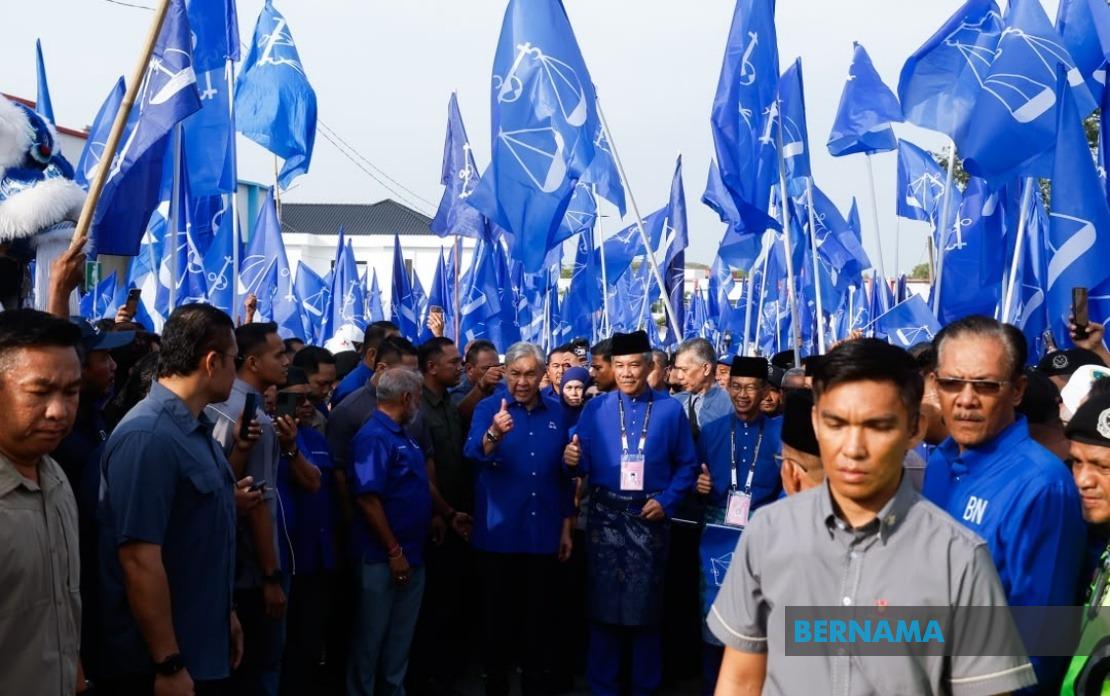
The machinery of Malaysia's longest-serving political coalition shifted into high gear across Negeri Sembilan on Thursday as Barisan Nasional's hierarchy personally escorted candidates through the nomination process for the 16th state assembly election. The visible presence of party heavyweights—from Ahmad Zahid Hamidi down through the organisational ranks—demonstrated BN's determination to maintain its grip on a state it has controlled for decades, whilst also projecting unity at a time when internal party cohesion remains a sensitive political issue nationwide.
Ahmad Zahid Hamidi, who holds the dual positions of UMNO president and BN chairman, arrived at the Dewan Seri Rembau nomination centre at 8.40 am alongside his deputy Mohamad Hasan. The two senior figures witnessed Mohamad's formal submission of nomination papers for the Rantau state seat, a constituency the veteran politician has represented continuously since 2004. This act of solidarity from the national coalition leader carries symbolic weight, underlining the importance BN attaches to retaining Rantau and signalling confidence in Mohamad's electoral prospects despite any internal party considerations.
The coordination across nomination centres throughout the state revealed a choreographed campaign strategy. All eight venues opened simultaneously at 9 am and closed precisely an hour later, a compressed window that required candidates and their supporters to move swiftly through administrative procedures. This tight scheduling, whilst reflecting Election Commission protocols, also meant that party leaders maximised their presence during the visible nomination window, generating photo opportunities and media coverage that reinforced BN's organisational capacity.
In Port Dickson, the party's secretary-general Datuk Seri Dr Zambry Abd Kadir accompanied Datuk Mohd Faizal Ramli through the nomination process for the Linggi seat. Simultaneously, UMNO vice-president Datuk Seri Johari Ghani shepherded Suhaimizan Bizar, the candidate contesting Gemencheh in the Tampin parliamentary constituency. These parallel movements across different parts of the state illustrated BN's determination to demonstrate horizontal strength rather than concentrating leadership presence in a single location.
The Jempol parliamentary constituency witnessed perhaps the most intensive leadership deployment. UMNO secretary-general Datuk Dr Asyraf Wajdi Dusuki personally guided three BN candidates—Datuk Mustapha Nagoor for Palong, Datuk Mohd Zaidy Abdul Kadir for Jeram Padang, and Chong Fui Ming for Bahau—through the nomination procedures. This concentration of senior party machinery in a single parliamentary division suggested particular competitive pressure or strategic significance in that area, with the party keen to project absolute control and organisational discipline.
Beyond BN's coordination, coalition partners also mobilised their leadership structures. PAS, the Islamist party that has worked alongside BN in various state and federal configurations, deployed its president Tan Sri Abdul Hadi Awang to accompany Mohd Fairuz Mohd Isa, who is contesting the Serting seat. This visible partnership reinforced the continuing relevance of the BN-PAS alliance in Negeri Sembilan state politics, even as their relationship at the national level remains complex and frequently tested by competing electoral interests.
Parti Orang Asli Malaysia (ASLI) likewise participated in this nomination day choreography. The party's president Rashid Ka accompanied Dayana Dal, contesting the Jeram Padang seat, also in the Jempol parliamentary area. ASLI's involvement highlights the increasingly fragmented nature of Malaysian electoral coalitions, where smaller parties leverage their specific constituencies—in this case, indigenous voters—to secure nomination day visibility and media attention.
The Negeri Sembilan State Legislative Assembly was dissolved on June 5 following official consent from Tuanku Muhriz Tuanku Munawir, the Yang Dipertuan Besar. This preceded the nomination period by more than a month, allowing all contesting parties adequate time for internal candidate selection and campaign preparation. The August 1 polling date gives candidates approximately two weeks for their election campaign proper, whilst early voting has been scheduled for July 28, potentially allowing shift workers and others with specific scheduling constraints to cast their ballots earlier.
For Negeri Sembilan's 800,000-strong electorate across 36 state seats, this election represents a significant political moment. BN has dominated state politics since independence, but recent years have seen rising electoral volatility across Malaysia as voters increasingly split their support between national and state-level contests. The display of leadership unity on nomination day suggested BN's confidence in its organisational machinery, yet the party's decision to deploy such senior figures also implicitly acknowledged the competitive pressures facing even traditionally secure constituencies in contemporary Malaysian politics.
The staggered approach to nominations—with different leaders accompanying candidates across geographically dispersed centres—served multiple strategic purposes. It prevented any single location from becoming a flashpoint for opposition counter-demonstrations, distributed media attention across multiple constituencies, and allowed party leadership to assess grassroots sentiment in different areas. This tactical sophistication reflects lessons learned from previous state elections where visible campaign errors or coordination failures have damaged BN's carefully cultivated image of administrative competence.
As campaigns intensify over the coming fortnight, the nomination day manoeuvres will likely be analysed for what they revealed about internal party dynamics. The absence of any candidates associated with controversial figures, combined with the smooth administrative flow, suggested BN had resolved internal factional disputes before the public nomination process began. This contrasts with previous election cycles where nomination day revealed unhealed party wounds or leadership disagreements, making Negeri Sembilan's efficient procedure a positive signal for BN's broader organisational health heading into the August 1 contest.

