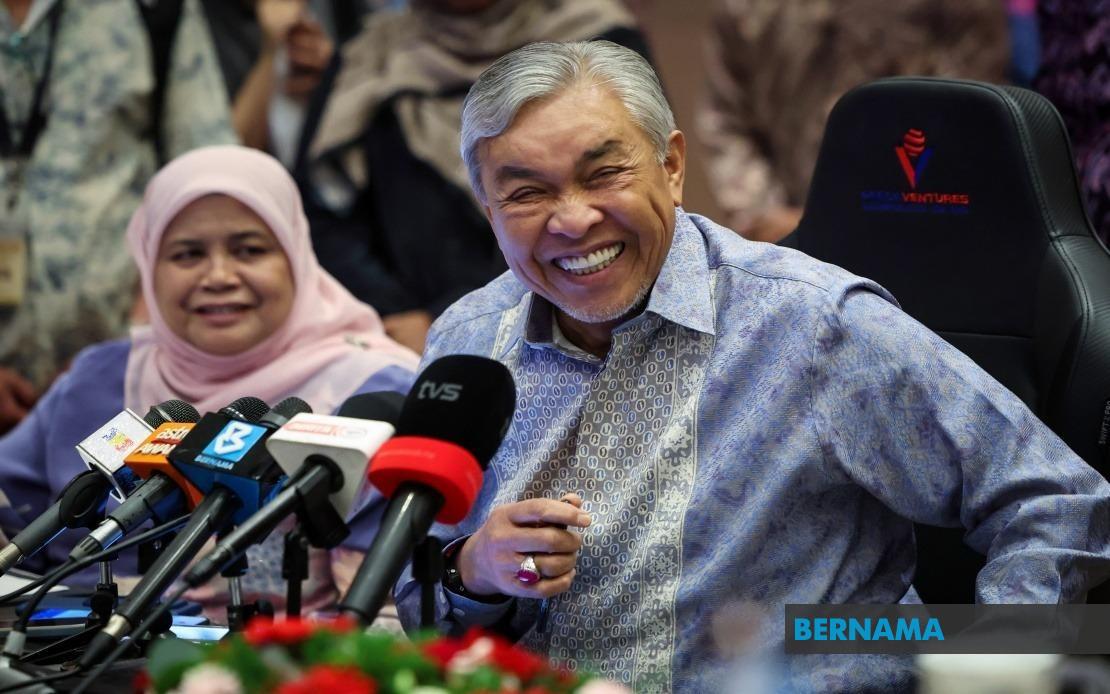
Barisan Nasional has reiterated its unwavering commitment to sustaining the Unity Government coalition through the completion of the 15th Parliament's tenure, with Deputy Prime Minister and BN chairman Datuk Seri Dr Ahmad Zahid Hamidi explicitly rejecting speculation that the bloc intends to orchestrate the administration's downfall under Prime Minister Datuk Seri Anwar Ibrahim.
Ahmad Zahid's declaration came during remarks made at the conclusion of the 61st Coordination Meeting between the Minister of Rural and Regional Development and State Executive Councillors for Rural Development in George Town, where he addressed mounting speculation within political circles about potential defections or destabilising moves. The statement underscores BN's position that its involvement in the Unity Government framework remains anchored in the constitutional directive issued by the Yang di-Pertuan Agong following the 2022 General Election, a foundation the coalition claims has never been compromised despite ongoing political volatility across Malaysian states.
The Deputy Prime Minister's remarks contained a pointed rebuttal to persistent rumours within opposition circles and political commentary that BN might pursue what observers colloquially term "Bangkok Move" or "Dubai Move"—clandestine efforts to orchestrate parliamentary shifts that could undermine the current government's stability. Ahmad Zahid categorically dismissed such possibilities, emphasising that BN's commitment extends from the moment it formally joined the Unity Government framework through to the conclusion of parliamentary proceedings, a position he characterised as absolute and non-negotiable regardless of external speculation or criticism.
This reassurance holds particular significance for Malaysia's political ecosystem, where coalition governments have historically proven fragile. The Unity Government, comprising BN, Pakatan Harapan, and other smaller parties, represents an unprecedented arrangement in modern Malaysian politics designed to provide enhanced stability after decades of intense two-party competition. Ahmad Zahid's emphasis on maintaining this configuration reflects broader concerns within the coalition that public questioning of its commitment could embolden opposition forces or unsettle investor confidence in government continuity, a consideration that extends beyond mere parliamentary mathematics to encompass economic and institutional implications.
The UMNO president acknowledged that divergent campaign positions adopted by coalition partners in state-level contests, particularly the ongoing Negeri Sembilan state election, do not constitute threats to the federal-level unity arrangement. He characterised BN's participation in the Negeri Sembilan campaign as consistent with legitimate competitive politics at the state tier, while the Unity Government partnership remains operative at the national level—a distinction that suggests Malaysian voters may experience coalition partners running against each other in some contests while maintaining governmental cohesion at the federal tier.
Ahmad Zahid also addressed operational complications affecting BN's campaign machinery, specifically the suspension of a polling district centre in Klawang within Negeri Sembilan amid local grievances over candidate selection processes. He indicated that state-level UMNO leadership, under Datuk Seri Jalaluddin Alias, had undertaken remedial discussions to address the facility's closure before the approaching election date. The Klawang contest itself reflects the fractionalised nature of contemporary Malaysian electoral competition, with Pakatan Harapan's Bakri Sawir, Perikatan Nasional's Danni Rais, and Bersatu's Muhammad Adib Musa all contesting the single seat—a configuration that demonstrates how the broader Unity Government framework coexists with genuine three-cornered competition at localised levels.
Separately, Ahmad Zahid dismissed reports suggesting formal negotiations between BN and Perikatan Nasional regarding a potential "Perikatan Barisan Nasional" (PBN) alliance, characterising any such proposals as having emerged only within campaign rhetoric rather than through official diplomatic channels. His statement indicates that while political figures may reference hypothetical configurations during public speeches, substantive coalition realignment requires structured deliberation among party leaderships—a distinction that differentiates serious political repositioning from speculative commentary designed to influence voter perceptions.
The Deputy Prime Minister's engagement with lighter political theatre, responding with a pantun to Prime Minister Anwar's recent verse celebrating unity and discipline, illustrated the performative dimensions of Malaysian political discourse even amid substantive coalition management. This exchange, conducted through traditional Malay poetic form, suggested that personal relationships between senior figures remain cordial despite tactical divergences in state-level campaigns, signalling to observers that competitive positioning on the Negeri Sembilan battlefield does not translate into federal-level antagonism.
For Malaysian stakeholders and regional observers monitoring Malaysia's political trajectory, Ahmad Zahid's statement provides institutional reassurance that the Unity Government framework, despite acknowledged tensions and local-level competitions, maintains foundational cohesion committed to the parliamentary term's completion. This assurance becomes increasingly significant as Southeast Asia's democracies navigate post-pandemic economic pressures and geopolitical complexities that benefit from governmental stability. The ongoing viability of Malaysia's Unity Government experiment holds implications extending beyond domestic electoral considerations to encompass regional perceptions of political reliability and policy continuity at a moment when economic anxieties might otherwise tempt political actors toward destabilising manoeuvres.

