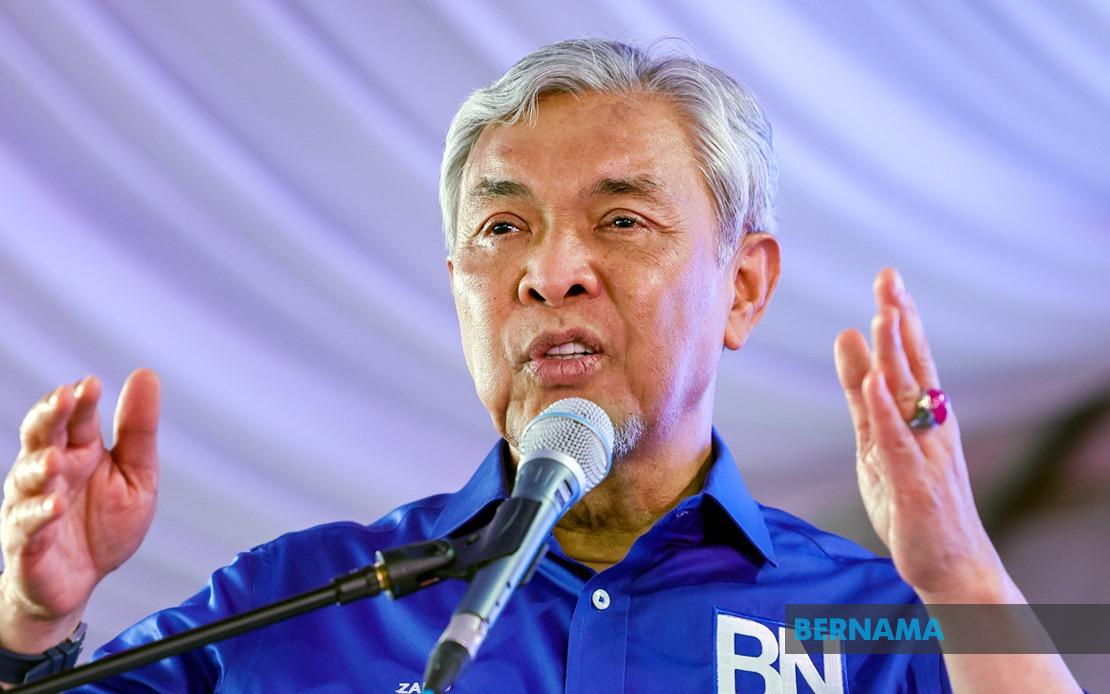
Barisan Nasional chairman Datuk Seri Dr Ahmad Zahid Hamidi has committed to delivering on every pledge contained in the coalition's manifesto should voters grant BN the mandate in the Johor state election scheduled for this Saturday. Speaking at an engagement session with Johor Village Development and Security Committees in Kluang, the Deputy Prime Minister emphasised that translating campaign promises into concrete action represents a fundamental responsibility rather than a mere political formality.
Ahmad Zahid framed the manifesto's implementation as essential to sustaining development momentum and safeguarding living standards throughout Johor. His remarks underscore a broader strategy by BN to differentiate itself from rival coalitions by stressing delivery credibility—a particularly crucial messaging point given voter scepticism regarding unfulfilled campaign pledges across Malaysia's recent electoral cycles. The emphasis on accountability reflects BN's attempt to rebuild public confidence after years of electoral volatility, particularly the dramatic loss of Johor to Pakatan Harapan in 2018 and the subsequent recapture in 2022.
Central to Ahmad Zahid's positioning is the assertion that BN's leadership intends to adopt a supervisory approach to manifesto execution, ensuring pledges do not devolve into rhetorical gestures divorced from practical implementation. He indicated that himself and fellow party leadership would actively monitor progress, signalling institutional commitment beyond individual politicians' campaign cycles. This commitment-monitoring framework addresses a persistent criticism of Malaysian political parties: the tendency for manifestos to serve as election-specific documents that fade once votes are counted.
The Deputy Prime Minister articulated a philosophical perspective on electoral mandates that deserves scrutiny. He cautioned against interpreting voter support as validation for governmental arrogance, instead framing electoral success as a fiduciary obligation to serve constituents. This framing of victory as responsibility rather than entitlement carries particular resonance in Johor, where the coalition must consolidate its 2022 gains while addressing ongoing governance challenges that affect household incomes, infrastructure quality, and economic diversification in an increasingly competitive regional landscape.
Ahmad Zahid's specific invocation of 'Bangsa Johor'—a concept emphasising Johor's distinctive identity and cohesion—represents an attempt to transcend partisan divisions and position BN as custodian of state unity. This rhetorical move acknowledges underlying societal fractures that electoral competition can exacerbate. By appealing to shared Johor identity, BN seeks to establish common ground with opposition voters, potentially softening polarisation that might otherwise impede the formation of an effective post-election government capable of executing policy programmes.
The 16th Johor state election encompasses 56 seats contested by 172 candidates, with approximately 2.7 million registered voters eligible to participate. These figures indicate a moderately competitive electoral environment where seat distribution remains uncertain despite BN's relative organisational advantages. The participation of 172 candidates across 56 seats suggests that smaller parties and independent candidates maintain meaningful presence, potentially fragmenting opposition votes but also introducing unpredictability into final outcomes.
For Malaysian observers and regional analysts monitoring Johor's trajectory, the election carries implications beyond state boundaries. Johor functions as Malaysia's second-largest economy and a crucial political bellwether. Electoral outcomes here influence national coalition dynamics, particularly within the fragmented opposition landscape and among various BN component parties vying for portfolio allocation in any future state administration. The state's status as a major commercial and manufacturing hub means that governance quality and infrastructure investment decisions made in Kota Iskandar will reverberate across Southeast Asia's supply chains and investment patterns.
Ahmad Zahid's manifesto-focused messaging appears calibrated to address voter fatigue regarding unfulfilled promises. Recent Malaysian electoral history demonstrates that voters increasingly penalise parties perceived as failing to deliver on specific, tangible commitments—particularly regarding bread-and-butter issues including public transportation, water supply reliability, healthcare accessibility, and job creation. By pledging comprehensive implementation monitoring, BN attempts to differentiate itself as a pragmatic, delivery-focused alternative to opposition coalitions that voters may perceive as overpromising.
The timing of Ahmad Zahid's statements—immediately before the polling weekend—suggests a carefully orchestrated messaging campaign designed to cement voter intention during the critical final days. His simultaneous emphasis on manifesto delivery and 'Bangsa Johor' unity appears intended to appeal across Johor's diverse demographic segments, from urban professionals prioritising infrastructure investment to rural constituencies seeking enhanced development focus. This dual-track messaging reflects sophisticated political communication that acknowledges Johor's internal heterogeneity.
Looking forward, Ahmad Zahid's explicit commitment to manifesto implementation creates measurable accountability benchmarks that will shape voter perception of BN's post-election performance. Should a BN-led administration subsequently prioritise certain manifesto commitments over others, or encounter budgetary constraints forcing compromise on pledged projects, voters will likely employ Ahmad Zahid's words as evaluation criteria. This creates both opportunity and risk: opportunity to rebuild institutional trust through visible policy delivery, but risk of amplifying public disillusionment if implementation falters, as it frequently does in Malaysian state governments confronting resource constraints and bureaucratic inertia.
The coalition's strategy ultimately depends on translating electoral victory into governance performance that visibly improves Johor residents' daily lives. Infrastructure projects, economic opportunities, and public service quality improvements constitute the true measures by which voters will judge whether BN's manifesto promises represented genuine commitments or predictable electoral rhetoric. Saturday's polling will determine whether voters believe Ahmad Zahid's delivery pledge sufficiently credible to grant BN another five-year mandate to govern Malaysia's southern industrial powerhouse.

