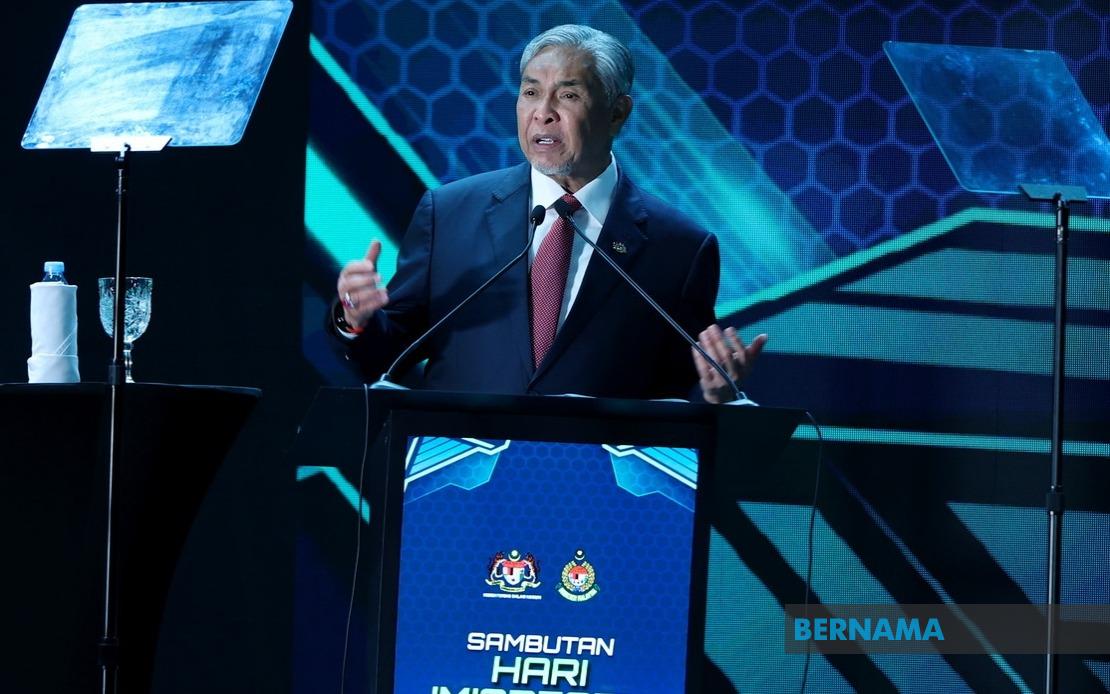
Barisan Nasional has reaffirmed its commitment to remain within the Unity Government framework, with party chairman Datuk Seri Dr Ahmad Zahid Hamidi stating that the coalition intends to honour the stance and resolution adopted at the most recent UMNO General Assembly. Speaking at a press conference following the 2026 Immigration Day celebration in Cyberjaya, Ahmad Zahid—who holds the concurrent positions of UMNO president and Deputy Prime Minister—stressed that the decision reflects the collective will of UMNO's membership and carries binding weight on the party's political direction.
The reassurance from the UMNO leadership comes amid ongoing speculation within Malaysian political circles about the stability of the three-year-old Unity Government coalition. Ahmad Zahid's statement serves as an explicit reminder that BN, UMNO's parent coalition, remains wedded to the power-sharing arrangement that has defined federal governance since mid-2022. The invocation of the General Assembly's authority underscores the hierarchical importance UMNO places on decisions made at its highest decision-making body, signalling that party discipline will be maintained on this strategic question.
In emphasising that "there is no body higher than the General Assembly," Ahmad Zahid effectively closed off any prospect of individual politicians or factions within UMNO unilaterally deviating from the pro-Unity Government position. This language carries particular significance given Malaysia's history of coalition instability and leadership transitions driven by factional manoeuvring. By rooting BN's commitment in an assembly-level resolution rather than relying solely on leadership pronouncements, UMNO has created a formal institutional anchor for its continued participation in the federal government.
The timing of this declaration is noteworthy, arriving just as Malaysian politics enters a period of heightened uncertainty surrounding state elections and coalition positioning. For investors and policymakers watching Malaysian governance, such reassurances from senior government figures attempt to project continuity and reduce anxieties about potential coalition collapse or dramatic political reorganisation. The emphasis on respecting "decisions reached at the highest level" reflects an attempt to discipline party members and prevent individual politicians from using state-level campaigns as platforms to undermine federal coalition arrangements.
Ahmad Zahid separately addressed the scope of Prime Minister Datuk Seri Anwar Ibrahim's authority over cabinet composition and ministerial conduct. He confirmed that appointment and dismissal of cabinet members fall squarely within the Prime Minister's prerogative, a principle fundamental to Westminster-style parliamentary systems. This acknowledgment takes on added weight given reports that Anwar had warned ministers and deputy ministers against using their government positions to attack Unity Government coalition partners during state election campaigns.
The Prime Minister's warning and the implied threat of resignation demands represent an effort to enforce coalition discipline during electoral competition. While coalition governments inherently involve competition between member parties, particularly during elections, Anwar's stance seeks to prevent intra-coalition attacks from escalating into threats to the broader unity arrangement. Ahmad Zahid's explicit endorsement of this Prime Ministerial prerogative effectively backs this disciplinary approach and signals that UMNO will not obstruct the PM's efforts to maintain coalition cohesion through personnel decisions.
For Malaysian readers, these statements carry implications extending beyond immediate federal politics. The Unity Government's stability directly affects policy implementation across sectors ranging from economic management to judicial reform. Persistent uncertainty about coalition durability can deter investment, slow bureaucratic decision-making, and create windows for special interest groups to advance narrow agendas during periods of political distraction. By reaffirming commitment at the institutional level, BN leadership attempts to reduce such friction and maintain momentum on government programmes.
The broader Southeast Asian context adds another dimension to this political positioning. Regional governments and investors increasingly view Malaysia as a test case for managing diverse, multi-ethnic coalitions in competitive democratic systems. Demonstrations of institutional discipline and coalition stability thus carry value beyond Malaysia's borders, potentially influencing how Malaysia is perceived as a location for long-term investment and regional leadership on issues from climate policy to trade integration.
Ahmad Zahid's dual position as Deputy Prime Minister and UMNO president makes him a crucial link between party interests and government administration. His personal commitment to the Unity Government framework, backed by institutional UMNO decisions, provides some reassurance that these two potentially competing roles can be reconciled. However, the very need for such reassurances also underscores ongoing scepticism within political circles about the fragility of the arrangement, suggesting that verbal commitments must be repeatedly renewed and reinforced through senior figures.
The emphasis on respecting institutional decisions and Prime Ministerial authority reflects a deliberate rhetorical strategy aimed at different audiences. For UMNO grassroots members and BN coalition partners, it validates participatory decision-making structures. For federal government partners and international observers, it demonstrates institutional maturity and acceptance of executive hierarchy. For opposition parties, it suggests confidence sufficient to rule out dramatic political reorganisation in the near term.
Looking forward, these statements will be tested by actual political developments, particularly how coalition members conduct themselves during state elections and whether any cabinet changes occur in coming months. The rhetoric of institutional commitment carries weight only insofar as political actors adhere to it when facing competing pressures. Ahmad Zahid's public reaffirmation creates accountability for BN on the Unity Government question—if the coalition fractures, UMNO's leadership will face credibility damage for these assurances. This constraint, while not guaranteeing stability, does raise the political cost of abandoning the current arrangement without substantial provocation.

