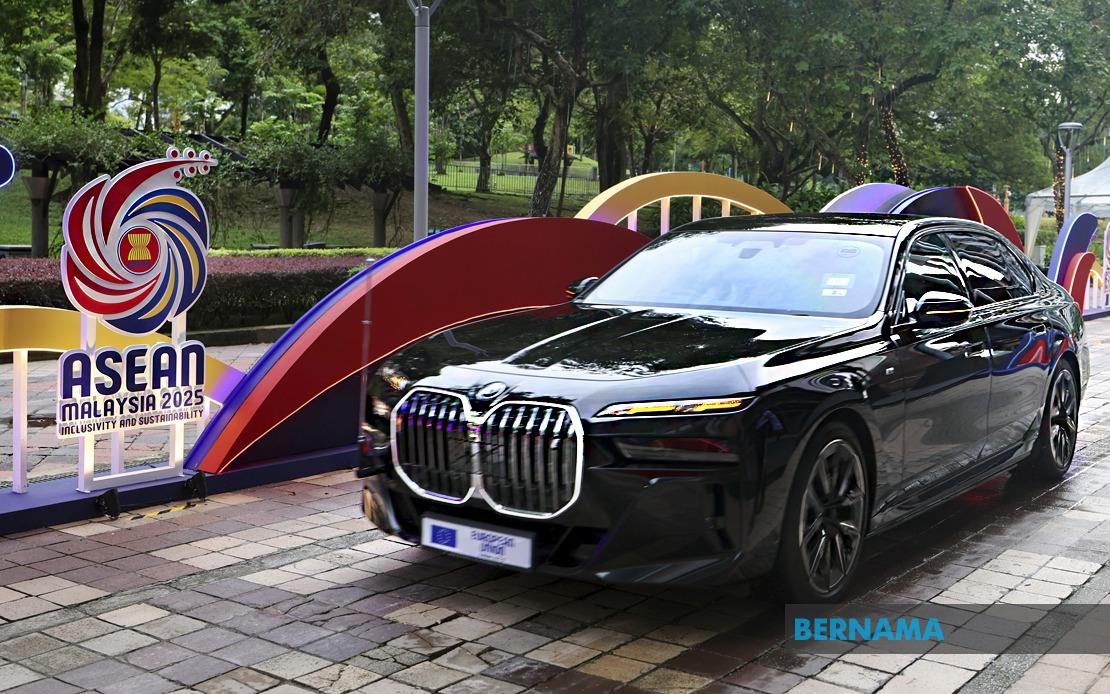
The Prime Minister's Department (JPM) has moved to quell mounting speculation on social media by issuing a formal statement confirming that the BMW luxury vehicle recently spotted in use by Prime Minister Datuk Seri Anwar Ibrahim remains government property rather than a fresh acquisition for the chief executive's personal use.
The clarification, released jointly by JPM and the Ceremonial and International Conference Secretariat Division (BIUPA), underscores that the vehicle has long existed within Malaysia's government vehicle fleet and falls under BIUPA's direct purview. The statement places particular emphasis on the asset's designated purpose, framing it as a specialised logistics tool reserved exclusively for diplomatic and state-level functions rather than routine governmental operations.
The vehicle's operational parameters reflect the demanding security architecture required for hosting international dignitaries of the highest rank. Malaysia routinely welcomes visiting heads of state and heads of government, particularly those holding presidential or prime ministerial rank, and the security protocols governing these visits are governed by internationally established standards and bilateral agreements. The BMW has been specifically engineered and maintained to these exacting specifications, making it fundamentally distinct from standard official vehicles used for regular administrative duties.
The engineering specifications represent a substantial investment in national security infrastructure. The vehicle incorporates armoured plating and ballistic resistance capable of withstanding high-velocity weapons fire, explosive device detonation, and emerging security threats including unmanned aerial systems. These technological enhancements are not decorative upgrades but rather integral structural modifications that classify the vehicle as a specialised security asset comparable to those maintained by security establishments across Southeast Asia and globally.
According to JPM's statement, the vehicle's assignment to the Prime Minister at the present time represents a temporary operational arrangement rather than a permanent change in logistics protocol. This temporary deployment has been directed following a formal security assessment conducted by the Royal Malaysian Police (PDRM), Malaysia's principal law enforcement agency. The decision reflects a dynamic approach to threat evaluation whereby security postures can be adjusted in response to shifting geopolitical circumstances or domestic threat conditions.
The timing of this deployment coincides with the scheduled maintenance and service cycle of the Prime Minister's primary official vehicle. This vehicle, which was gifted to the Prime Minister as a ceremonial gesture by the Yang di-Pertuan Agong, requires periodic technical servicing to maintain operational readiness. The temporary reassignment of the BMW therefore represents a practical solution to maintain continuous security coverage during this maintenance interval rather than an endorsement of permanent fleet restructuring.
The social media speculation that prompted the official clarification reflects a broader phenomenon of heightened public scrutiny surrounding government expenditures and the material symbols of political office. In Malaysia's contemporary political environment, where questions of governance accountability and fiscal responsibility feature prominently in public discourse, the appearance of high-value government assets in official use naturally attracts online commentary. The JPM statement serves as a direct attempt to distinguish between established asset deployment and suspected new acquisitions, thereby preventing the accumulation of unsubstantiated claims.
For Malaysian citizens and regional observers, the distinction carries meaningful implications regarding government procurement practices and budgetary allocation. By confirming the vehicle's status as a legacy asset rather than a recent purchase, JPM deflects concerns about expenditure on luxury vehicles during periods when public resource allocation remains under scrutiny. The emphasis on the vehicle's international security protocol compliance also provides contextual justification for the asset's existence and cost, positioning it as a necessary investment in national dignity and diplomatic capacity rather than executive privilege.
The statement's focus on BIUPA's supervisory authority further reinforces the distinction between personal and institutional asset ownership. BIUPA functions as a specialized administrative division responsible for the logistical dimensions of state visits and international conferences, ensuring that Malaysia presents itself appropriately on the global stage. By anchoring vehicle ownership and deployment within this institutional framework, JPM establishes clear administrative accountability and situates the asset within a broader infrastructure supporting Malaysia's international relations.
The clarification also implicitly addresses the question of transparency in government operations. By voluntarily providing detailed explanation regarding vehicle assignment, security specifications, and the maintenance circumstances necessitating temporary reassignment, JPM demonstrates responsiveness to public inquiry. This proactive communication approach contrasts with the silence that might otherwise permit speculation to flourish unchecked across social media platforms, where factual accuracy often takes secondary importance to narrative engagement and political commentary.
Moving forward, the incident underscores the heightened scrutiny that attaches to the material symbols and practical apparatus of executive authority in contemporary Malaysian politics. Government departments must anticipate that high-visibility assets will generate public interest and prepare clear, factual explanations that address the legitimate concerns underlying such scrutiny. The BMW situation illustrates how apparently straightforward logistical decisions regarding vehicle deployment can acquire political dimensions when insufficiently explained, thereby creating communication vacuums that alternative narratives quickly populate.
For observers across Southeast Asia, Malaysia's approach demonstrates how middle-income democracies navigate the tension between maintaining appropriate governmental capacity for international engagement and public accountability for resource utilization. The formal clarification, rather than appearing defensive, positions Malaysia's government as responsive to constituent concern whilst simultaneously affirming the legitimate operational requirements that necessitate specialized security assets for executive and diplomatic functions.

