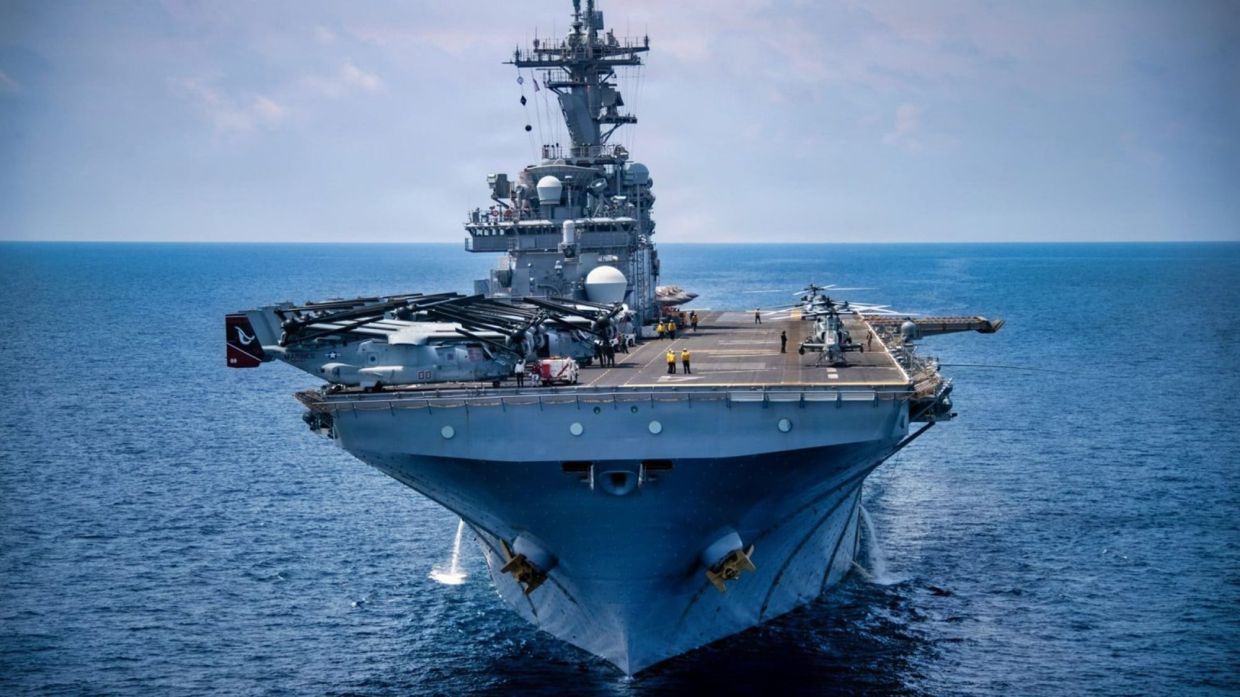
Congress has found rare common ground on China policy as lawmakers from both parties unite behind the fiscal year 2027 National Defence Authorisation Act, a sweeping legislative framework that shapes American military strategy and defence spending priorities. Though the House and Senate versions contain differing provisions, their shared emphasis on constraining Beijing's technological advancement and military capabilities reveals how deeply embedded China competition has become across the entire spectrum of US national security planning. The House has already approved its version, while the Senate races to complete action before its August recess, with formal reconciliation of the two bills required before President Donald Trump can sign the legislation into law.
The 2027 NDAA continues the trajectory established over the past decade, wherein Congress increasingly weaponises annual defence legislation as a tool for geopolitical positioning rather than merely appropriating funds. Bonnie Glaser, managing director of the German Marshall Fund's Indo-Pacific programme, observes that lawmakers now systematically deploy the NDAA to strengthen deterrence architecture across the region, with particular emphasis on fortifying Taiwan against potential Chinese coercion and enhancing cooperative defence relationships with Indo-Pacific partners. This represents a deliberate shift from general policy guidance toward operationalising specific capabilities designed to maintain the status quo that Beijing seeks to overturn.
Taiwan occupies an especially prominent position in both legislative versions, particularly in the Senate's more assertive formulation. The Senate proposal would establish a "War Reserve Stock Programme" for the island—arguably the provision most likely to provoke Chinese retaliation—authorising the pre-positioning of humanitarian aid, ammunition, missiles and other military hardware to enhance Taiwan's readiness should armed conflict materialise. Zack Cooper, a senior fellow at the American Enterprise Institute, characterises this initiative as a sophisticated effort to prepare both Washington and Taipei for extended warfare requiring substantial material reserves. Glaser emphasises the historic significance: Congress is for the first time providing direct statutory authority for such operations, elevating the concept from theoretical planning into concrete operational capability. Though this measure falls short of fundamentally altering Washington's longstanding "one China" policy, it unmistakably signals bipartisan determination to ensure Taiwan can credibly resist any attempt to alter the status quo through military force.
The Senate bill would further expand the "Taiwan Security Cooperation Initiative" and rename it the "First Island Chain Security Cooperation Initiative" to encompass the Philippines as a beneficiary of military assistance. This nomenclatural and substantive expansion reflects a broader strategic vision linking Taiwan's defence to the security architecture of adjacent island nations, implicitly recognising that Taiwan's resilience depends partly on the stability of broader regional security arrangements. The shift acknowledges geopolitical reality: no island exists in isolation, and Taiwan's vulnerability connects directly to vulnerabilities elsewhere along the arc of territory extending from Japan through the Philippines.
Beijing's response has been unambiguously hostile. The Chinese embassy in Washington issued a sharply worded denunciation, declaring that China "strongly deplores and firmly opposes" these Taiwan-focused provisions and warning that any attempt to arm the island "will face grave consequences." Officials characterised the measures as gross interference in internal affairs, accusing Congress of undermining Chinese sovereignty and territorial integrity while destabilising the Taiwan Strait. The embassy specifically warned that enhanced Taiwan defence capabilities would only embolden separatist forces, expose the island's population to dangerous military escalation, and inevitably heighten the risk of direct China-US confrontation. These rhetorical salvos underscore how sensitive Beijing remains to external support for Taiwan, and they raise questions about whether such legislative actions might complicate Xi Jinping's planned state visit to Washington later this autumn.
Beyond Taiwan, both versions prioritise decoupling America's defence industrial base from Chinese suppliers and manufacturers. The House Armed Services Committee explicitly frames the legislation as seeking to "remove China from our defence supply chains," reflecting recognition that military superiority depends not merely on weapons systems themselves but on the security and resilience of the supply networks that produce them. The House bill would ban Department of Defence acquisitions of Chinese-manufactured goods, targeting concrete vulnerabilities within the military-industrial complex. Additionally, the legislation funds workforce development for critical mineral extraction, a direct effort to reduce American dependence on Chinese sources for raw materials essential to advanced manufacturing. This supply-chain dimension reveals how thoroughly China competition now penetrates defence policy, extending far beyond traditional military questions into fundamental questions of economic security and industrial capacity.
Artificial intelligence emerges as another critical battleground embedded throughout both versions. The Senate bill requires annual assessments of how advanced AI chips contribute to China's military capabilities, reflecting congressional anxiety about technological acceleration in Beijing. Crucially, both versions seek to restrict China's access to advanced semiconductor equipment and cutting-edge computing technology, recognising that artificial intelligence represents the next frontier in military competition. Cooper identifies these export-control measures as potentially the most consequential China-related provisions, though he cautions that their survival into the final reconciled bill remains uncertain. The momentum behind such restrictions appears substantial, however, suggesting that preventing Chinese access to advanced computing architectures will feature prominently in the final legislation.
Defence contractors face new restrictions on sensitive technology transfer. The Senate bill prohibits Pentagon funding for entertainment projects connected to the Chinese state, a measure reflecting concern about subtle channels through which sensitive information might leak. More substantively, both versions would strengthen research security frameworks, impose restrictions on collaboration with Chinese academic institutions, and establish new "insider threat reporting" requirements for major AI contractors. These provisions acknowledge that China's competitive advantage increasingly derives not from traditional espionage but from legitimate academic and commercial exchanges that inadvertently transfer sensitive knowledge.
The legislative package demonstrates how thoroughly China competition now permeates American defence policy across multiple domains simultaneously. Rather than constituting a single coherent strategy, the NDAA functions as an accumulation of specific responses to perceived Chinese advantages: Taiwan gets military reserves, supply chains get decoupling initiatives, AI gets export restrictions, contractors get security protocols. This multifaceted approach reflects the complexity of modern great-power competition, where military, technological, economic and informational dimensions blend inseparably. For regional observers including Malaysia, the legislation signals that Washington views China competition as the defining feature of the strategic environment through at least 2027, with bipartisan political consensus providing continuity regardless of which party controls Congress or the presidency.

