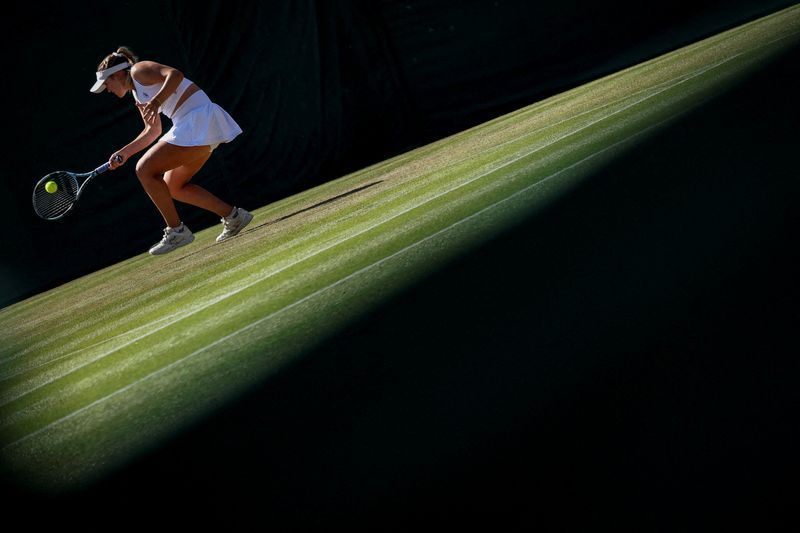
The All England Club guards its 149-year heritage as carefully as it tends the perennial ryegrass carpeting its world-famous courts. Wimbledon, tennis's oldest Grand Slam tournament, maintains an aesthetic rooted firmly in British custom and social refinement. Across roughly 675 matches spanning all categories, the tournament presents a uniform portrait of elegance: players dressed entirely in white, spectators adorned with elaborate millinery, strawberries and cream flowing freely through the stands, and the occasional appearance of members of the royal family adding ceremonial weight to proceedings. This commitment to visual tradition sets Wimbledon apart starkly from other major sporting spectacles—the FIFA World Cup that coincided with this year's championship could hardly have presented a more contrasting visual identity.
Yet beneath this carefully curated exterior beats a competitive heart as fierce and uncompromising as any sporting arena on earth. The traditions and pageantry serve as gilding on an intensely demanding crucible where the world's elite athletes pursue the sport's most coveted prize. The difference between Wimbledon and other Grand Slams lies not in the calibre of competition but in the deliberate separation between the tournament's public face and its inner intensity. Photographers capturing the event found themselves documenting this duality repeatedly: the silent intensity before a serve, the grim determination etched across a player's face mid-volley, the cathartic release of victory, and the hollow devastation of defeat.
Alexandra Eala's moment against third-seeded Iga Swiatek crystallised this underlying ferocity. The 21-year-old Filipino player, facing a six-time Grand Slam champion, embodied the raw competitive spirit that defines Wimbledon's true character. As Eala fell while attempting a forehand return, her expression—teeth gritted, muscles straining—captured the absolute commitment required to compete at this level. Reuters photographer Toby Melville had positioned himself to document celebration but instead captured pure competitive struggle. As Melville later explained, he managed to frame Eala's entire form and the ball in vertical composition just as her fall naturally created a horizontal landscape, a technical capturing of an unguarded human moment that revealed far more about Wimbledon's essence than any trophy presentation could.
These unscripted moments of vulnerability punctuate the tournament throughout. Jaimi Joy's photograph of Otto Virtanen during a hard-fought first-round match revealed a player in the grip of frustration, standing at a courtside barrier appearing to wish himself invisible against the green canvas. In these instances, the genteel exterior dissolves entirely. The rigorous white dress code, the cream teas, the royalty—all fade to irrelevance when a player confronts the possibility of elimination. Wimbledon's traditions exist precisely because they provide a dignified container for these moments of raw human struggle.
Conversely, the tournament also showcased champions thriving under its intense spotlight. Photographer Marko Djurica captured Naomi Osaka crossing Centre Court in a kimono-inspired dress, projecting the fearless confidence that carried her to the quarter-finals, her first such advancement at Wimbledon. Osaka's campaign demonstrated that for certain players, the tournament's weight and history fuel rather than intimidate. The two-time Grand Slam winner seemed energised by the occasion, walking the same courts that have hosted tennis history since 1877 with the assured bearing of someone who belongs among the elite.
Jannik Sinner's journey to the men's championship illustrated this duality even more starkly. Melville's photograph of the Italian champion mid-air during the final against Alexander Zverev—body extended to its absolute limit, one arm stretched impossibly far to reach a forehand return—showed a player operating at the very threshold of human capability. Sinner's elongated shadow in Melville's frame seemed to extend beyond his physical reach, visually representing the mental extension required to compete for and win a Grand Slam title.
The shadows cast across Wimbledon's courts tell stories as significant as the sunlit triumphant moments. Djurica's image of women's doubles champions Guo Hanyu and Kristina Mladenovic embracing after their victory created a shadow that appeared to show a single player with fist raised in triumph—an accidental visual representation of how individual struggle compounds into collective achievement. These shadow photographs suggest that Wimbledon's most profound truths emerge not in bright spotlight but in the spaces between light and darkness, where the real work of professional tennis unfolds beyond spectator view.
The tournament's impact becomes visible long after the final point. Andy Couldridge's time-lapse photography of Centre Court captured the accumulated wear on the grass from thousands of players' footsteps—the physical evidence of 675 matches compressed into a visual record of passage and labour. The worn patches of grass represent the cumulative toll of competition, the literal marks left by athletes pursuing excellence. This imagery carries particular resonance for Southeast Asian readers familiar with tennis's growing prominence across the region, from emerging Malaysian talent to the rising profile of players like Eala representing the Philippines on the Grand Slam stage.
For Malaysian and regional audiences, Wimbledon's significance extends beyond its historical prestige. The tournament demonstrates the gap between aspiring and established tennis nations, yet also proves that regional players can compete and occasionally prevail against the world's elite. Eala's battle against Swiatek suggested that familiarity with Wimbledon's traditions and conditions, combined with fierce competitive determination, can bridge experience gaps. Southeast Asia increasingly produces players capable of competing at the highest levels; understanding Wimbledon's true nature—tradition as frame for competition rather than obstacle to it—matters for developing regional tennis excellence.
The emptying of spectator stands and the rolling away of nets each evening signal the tournament's rhythm: tradition and spectacle by day, competitive intensity always. The perennial ryegrass recovers from daily damage, grounds staff maintain the facilities, and players rest before returning to the courts to resume their battles. Wimbledon endures precisely because it never allows its traditions to obscure the fundamental truth that motivates every player: winning at the All England Club represents the pinnacle of professional tennis achievement. The strawberries and cream remain secondary to the pursuit of excellence.

