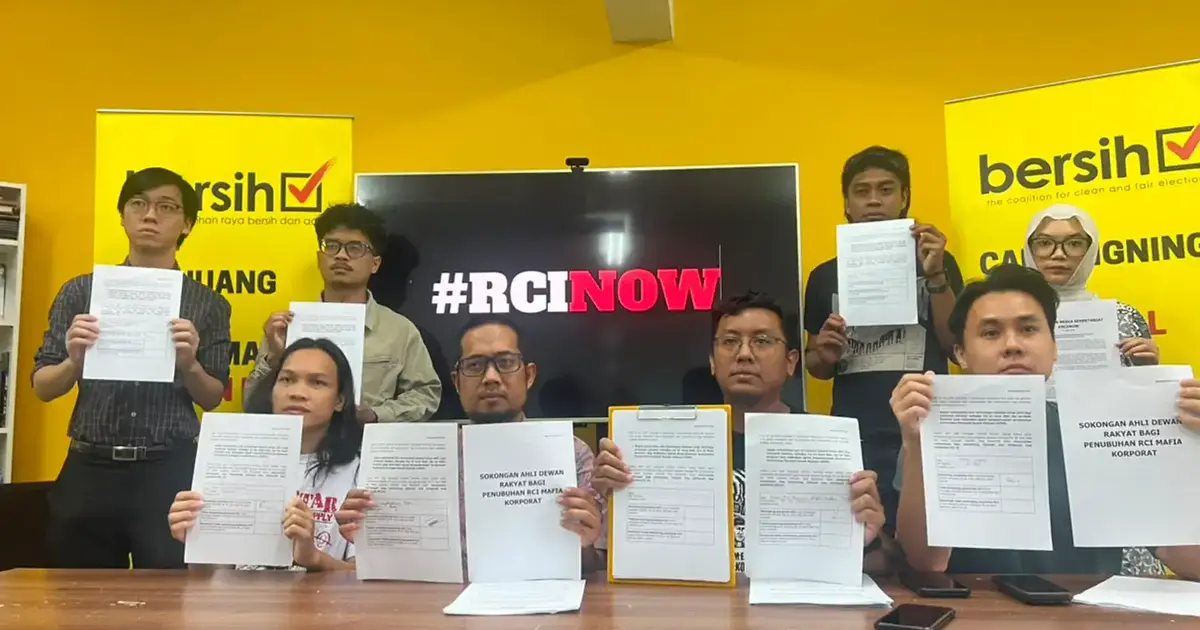
Electoral reform watchdog Bersih has announced that 34 members of parliament spanning multiple political parties have signalled support for establishing a Royal Commission of Inquiry to examine allegations of 'corporate mafia' activities in Malaysia. The cross-party backing represents a rare consensus among lawmakers typically divided along partisan lines, suggesting growing concern about the extent to which organised business interests may be influencing political decision-making at the highest levels.
The coalition of supportive MPs includes representatives from PKR, PAS, DAP and Umno, indicating that the issue transcends the traditional government-opposition divide. This unusual alignment reflects a recognition among legislators from different ideological and political camps that corporate interference in governance poses a systemic threat requiring formal investigation. The breadth of this support signals that concerns about business-driven corruption have reached sufficient prominence to unite disparate parliamentary factions around a shared investigative mechanism.
Bersih's announcement carries particular weight given the organisation's established credibility as an independent electoral and governance watchdog. The group has long championed transparency and institutional reform, positioning itself as a neutral arbiter in Malaysian political discourse. By publicly documenting parliamentary support for the RCI proposal, Bersih effectively creates political pressure on the government to consider the mechanism seriously, framing it as reflecting widespread legislative sentiment rather than isolated advocacy.
The term 'corporate mafia' employed in this context refers to alleged networks of business interests that may operate outside formal legal frameworks to influence political outcomes, secure contracts, and shape policy in their favour. Such arrangements, if they exist, would represent a sophisticated form of corruption that goes beyond individual bribery to encompass entire ecosystems of mutually beneficial relationships between politicians, bureaucrats and private sector actors. Malaysia has experienced multiple high-profile corporate scandals in recent years, from the 1Malaysia Development Berhad affair to ongoing investigations into property development and financial sector misconduct.
The emergence of this proposal reflects mounting frustration within parliament about the apparent inability of existing institutions to adequately investigate and prosecute complex schemes of corporate-political nexus. A Royal Commission of Inquiry, by contrast, would grant investigative powers beyond those available to standard law enforcement agencies, enabling comprehensive examination of financial flows, contractual arrangements, and decision-making processes that might otherwise remain opaque. Such a mechanism could potentially reveal systemic patterns rather than isolated incidents of wrongdoing.
For Malaysia's business community and investor base, clarity on corporate governance standards and the mechanisms for ensuring they are enforced remains crucial to confidence in the market system. International investors particularly scrutinise the effectiveness of institutional safeguards against corruption and corporate malfeasance. An RCI that demonstrates serious governmental intent to address corporate-political collusion could strengthen Malaysia's reputation for governance standards, though conversely, revelations of deep-rooted systemic problems could temporarily unsettle business confidence.
The cross-party nature of this support also reflects demographic and ideological shifts within Malaysian parliament. Newer MPs, particularly from urban constituencies, have demonstrated greater willingness to prioritise governance reform over traditional party interests. Younger lawmakers across the political spectrum recognise that systemic institutional weakness undermines long-term national development and their own political legitimacy. This generational impulse toward reform pressures older party leadership to engage seriously with transparency and accountability agendas.
From a regional perspective, Malaysia's experience with corporate-political interference mirrors challenges confronting other Southeast Asian democracies. Thailand, the Philippines, and Indonesia have all grappled with similar dynamics, where business oligarchs leverage political connections to secure preferential treatment. Malaysia's consideration of an RCI mechanism potentially influences regional thinking about institutional responses to such phenomena. A successful investigation and reform effort could provide a model for neighbouring countries facing comparable governance challenges.
However, translating parliamentary support into actual RCI establishment faces significant practical and political obstacles. The government retains discretion over whether to recommend such a commission to the Yang di-Pertuan Agong, and doing so could provoke backlash from corporate interests with substantial political influence. Officials fear that an expansive RCI might uncover embarrassing connections implicating current political leaders or their associates, creating disincentives for executive action even absent direct financial stakes in the targeted corporate networks.
The RCI proposal also raises questions about investigative scope and mandate definition. Determining what constitutes 'corporate mafia' versus legitimate business-political engagement remains contestable. A poorly defined commission might become entangled in disputes about its own jurisdiction, while an overly broad mandate could be weaponised for political advantage. The challenge lies in constructing investigative parameters robust enough to uncover genuine systemic corruption while remaining sufficiently bounded to maintain institutional credibility and legitimacy.
Bersih's strategic deployment of the 34-MP figure represents effective advocacy framing that transforms parliamentary sentiment into visible political pressure. By publicly documenting support and attributing it to named legislators, the watchdog forces individual MPs to either own or publicly disown their stated positions, increasing the reputational costs of subsequent opposition to an RCI. This tactic leverages parliamentary interdependence and electoral considerations to advance governance reform.

