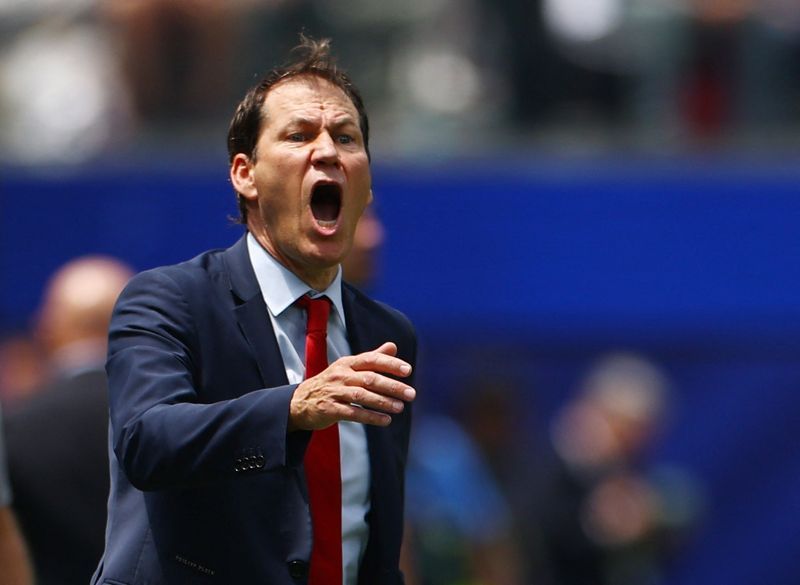
Belgium manager Rudi Garcia's tenure has come under intense scrutiny following his controversial substitution of goalkeeper Thibaut Courtois in Friday's World Cup quarter-final loss to Spain, a decision that has reignited broader questions about his future with the national team. The high-profile move to remove Courtois, widely regarded as one of the world's finest goalkeepers, during a knockout stage match has sparked considerable debate within Belgian football circles about Garcia's tactical judgment and management approach.
Courtois indicated to Garcia that despite experiencing minor discomfort in his leg, he felt capable of continuing in the match. Garcia, however, overruled the goalkeeper's assessment and insisted on the substitution, citing his requirement that all players operate at full physical capacity. The change occurred after 71 minutes, with Senne Lammens taking Courtois's place on the pitch. The consequences proved immediately damaging when Lammens failed to hold a low drive from Pau Cubarsi just 15 minutes later, allowing Mikel Merino to capitalise on the rebound and score Spain's winning goal in an eventual 2-1 victory.
The decision drew particular censure from prominent Belgian commentator Peter Vandenbempt, who expressed bewilderment at Garcia's reasoning. Vandenbempt questioned the logic of removing the planet's elite shot-stopper at such a critical juncture simply because he could no longer deliver long passes at maximum distance. His comments reflected a widespread view among Belgian analysts that Garcia had prioritised an inflexible tactical principle over pragmatic match management, and that a player of Courtois's calibre should have retained authority over his own physical condition during a crucial encounter.
Garcia defended his decision with characteristic firmness, articulating a clear philosophical framework that he has maintained since the tournament's outset. The Frenchman reiterated that his selection policy demands complete physical fitness from every player, with no exceptions or special circumstances. He acknowledged that Courtois's distribution—particularly his long passes to forward options like Charles De Ketelaere and Romelu Lukaku—had been central to Belgium's attacking approach, but argued that protecting the goalkeeper from potential aggravation of his injury took precedence over maintaining that specific tactical element. Garcia explicitly stated that he harboured no regret about the substitution itself, viewing it as consistent with his stated principles.
This incident will inevitably feature prominently when Belgian football federation officials conduct their contractual review of Garcia before the end of the month, when his current agreement expires. The 62-year-old French manager, who secured the Ligue 1 championship with Lille in 2011, accepted the Belgium post at the beginning of 2025 with a mandate to restore vibrancy and cohesion to a squad that had endured what many characterised as a demoralising period under previous coach Domenico Tedesco. Garcia was tasked with stabilising Belgium's Nations League standing, securing World Cup qualification, and navigating the knockout rounds—objectives he achieved before this quarter-final setback.
Garcia's overall record across 20 international matches stands at 12 victories, six draws, and two defeats, a statistical foundation that demonstrates reasonable early success. Yet federation decision-makers must now weigh whether these credentials adequately justify retaining him as the architect of Belgium's challenge for the 2028 European Championship. The review process will inevitably encompass broader concerns about his tactical flexibility, substitution patterns, interpersonal management style, and overall compatibility with a squad that requires rejuvenation and psychological rebuilding after years of underperformance.
Belgium's path through the World Cup tournament itself has invited considerable analysis. The team managed only inconsistent performances during the group stage, drawing matches against Egypt and Iran before edging past New Zealand to secure top seeding. Their narrow survival against Senegal in the round of 32 proved similarly unconvincing, with the team trailing 2-0 before staging an improbable comeback after Garcia withdrew his senior attacking players. While some credited Garcia's tactical adjustments for sparking the recovery, others attributed the reversal primarily to defensive negligence by the Senegalese backline rather than superior management from the Belgian bench.
Yet Garcia can legitimately reference certain tournament highlights to counter criticism. Belgium produced a devastating 4-1 victory over co-hosts the United States that showcased attacking potency and clinical finishing. The manager also demonstrated willingness to integrate younger talents into his plans, with players like Nathan Ngoy and Nicolas Raskin delivering compelling performances that suggested a pathway toward team renewal. These positive elements suggest that Garcia has not merely overseen a doomed campaign characterised by uniformly poor decision-making.
The fundamental challenge confronting the Belgian federation involves determining whether Garcia's philosophical approach and early accomplishments outweigh the negative impressions created by the Courtois substitution and broader tactical concerns. His insistence on unwavering fitness standards, while theoretically sound, may represent a form of rigidity that modern football increasingly demands managers minimise, particularly when elite-level players possess sophisticated self-awareness regarding their capabilities. Whether Belgian officials conclude that Garcia's demonstrated early success warrants continued confidence or view him as an interim solution during transition remains the crucial question facing the federation in coming weeks.

