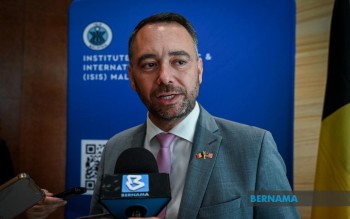
Belgium is making a strategic pitch to Malaysia for cooperation in offshore energy development, positioning itself as a credible partner despite its modest coastline. During a visit to Kuala Lumpur for the 39th Asia-Pacific Roundtable, Belgian Deputy Prime Minister and Foreign Affairs Minister Maxime Prévot underscored the mutual benefits available to both nations as they navigate the global shift towards renewable energy. The overture reflects Brussels' broader ambitions to deepen ties across Southeast Asia and establish Europe as a trusted collaborator in the region's energy infrastructure transformation.
Prévot's pitch is anchored in Belgium's demonstrated success in harnessing offshore wind resources. Despite being constrained by only 60 kilometres of coastline—a fraction of Malaysia's extensive maritime boundaries—Belgium has constructed offshore wind farms capable of generating two gigawatts of electricity. This achievement becomes all the more significant when considering the nation's densely populated landscape and industrial requirements. The Belgian government has announced plans to expand this capacity to between six and seven gigawatts within the coming years, a scaling that would approximate the output of five to seven nuclear power plants. Such expansion carries profound implications for European energy security at a time when geopolitical tensions threaten traditional supply chains and energy stability remains a strategic concern.
Offshore energy represents just one pillar in a broader framework of potential collaboration that Prévot outlined during his discussions in Malaysia. Semiconductors, logistics, clinical trials, biotechnology research and development, and pharmaceuticals all emerged as sectors where bilateral partnership could flourish. This diversified approach acknowledges that Malaysia's economic strengths and regional position create opportunities beyond clean energy alone. For Malaysia, the emphasis on multiple sectors suggests that engagement with Belgium need not be narrowly focused but rather part of a comprehensive economic relationship that leverages complementary capabilities and market access.
The European Union's financial commitment to the region substantially elevates the significance of this partnership initiative. Under the Global Gateway Strategy, the EU and its member states intend to mobilise €10 billion to support the ASEAN Power Grid and facilitate the region's broader energy transition. This substantial investment signals Europe's determination to position itself as a long-term partner in Southeast Asia's infrastructure development, rather than a transactional actor pursuing short-term gains. For Malaysia and other ASEAN nations, such commitments represent opportunities to access capital and technical expertise that might otherwise remain constrained, particularly given competing demands on development financing globally.
Prévot characterised the EU's investment framework as reflecting a commitment to sustainable and locally beneficial development that strengthens regional connectivity and resilience. This framing carries particular resonance for Southeast Asian policymakers concerned about ensuring that energy infrastructure serves national interests while contributing to broader regional integration. The emphasis on resilience—a concept that encompasses not only technical reliability but also economic sovereignty and strategic independence—addresses long-standing concerns that external energy partnerships might compromise decision-making autonomy. By positioning the ASEAN Power Grid as a vehicle for enhanced regional cooperation rather than dependency on external actors, the Belgian minister sought to alleviate such apprehensions.
The strategic alignment between European decarbonisation objectives and ASEAN's energy transition creates a natural partnership space. Prévot argued that by synchronising strategies, Europe and ASEAN could catalyse sustainable growth while reinforcing regional resilience. This framing suggests that clean energy cooperation extends beyond environmental compliance to encompass economic development, industrial competitiveness, and geopolitical positioning. As Southeast Asian nations increasingly recognise their capacity to influence global energy markets and set standards for technology deployment, partnerships with experienced actors like Belgium offer opportunities to shape outcomes rather than simply respond to them.
Prévot's visit represents his first sojourn to Malaysia since assuming office in February 2025, underscoring the priority attached to establishing early diplomatic foundations with the country. The timing and focus of such inaugural visits typically signal where a government intends to concentrate diplomatic capital and which regions it considers strategically significant. Belgium's choice to emphasise energy cooperation during this inaugural engagement suggests that Brussels views Malaysia not merely as a destination for traditional diplomatic courtesy but as a key partner in Europe's evolving Asia strategy.
Bilateral economic ties between the two nations already demonstrate substantial momentum. Total bilateral trade reached RM9.74 billion in 2025, with Malaysian exports comprising RM6.85 billion and imports totalling RM2.89 billion. This trade profile reveals Malaysia's current competitive advantage in manufacturing and resource-based industries, while suggesting potential for expansion in Belgian specialities such as pharmaceuticals and advanced technology sectors. The significant trade flow indicates that both nations already recognise mutual economic benefit, providing solid foundation upon which energy partnership discussions can be constructed.
Belgium's investment footprint in Malaysia reflects growing corporate interest in the country as a manufacturing and innovation hub. As of 2025, a total of 67 projects involving Belgian participation had received approval, representing investments worth RM5.1 billion and projected to generate 4,605 employment opportunities. These figures demonstrate that Belgian companies view Malaysia as an attractive destination despite global competition for manufacturing investment and capital allocation. Expansion into offshore energy cooperation could further deepen this investment commitment, as Belgian firms establish regional operations to service growing renewable energy projects across Southeast Asia.
For Malaysia, the Belgian overture arrives at a consequential moment in the country's energy planning. As the nation pursues its own renewable energy targets and seeks to balance growing electricity demand with decarbonisation commitments, partnerships with technologically advanced European nations become increasingly valuable. Offshore wind technology, while less developed in Southeast Asian contexts than in European waters, could eventually contribute meaningfully to Malaysia's energy portfolio, particularly given the nation's extensive maritime resources. The combination of European technical expertise, substantial EU financing, and Malaysia's geographic and economic advantages creates conditions for mutually beneficial collaboration that extends beyond traditional aid relationships or unbalanced technology transfer arrangements.
The broader context of Belgium's Malaysia engagement reveals evolving European strategy towards Southeast Asia. Rather than approaching the region primarily through established multilateral frameworks or traditional bilateral channels, European nations increasingly seek to identify specific sectors where competitive advantages and complementary needs align. By emphasising offshore energy alongside semiconductors, logistics, and biotechnology, Belgium is signalling that Europe views Southeast Asia not as a development challenge requiring aid but as an advanced economic region with which sophisticated partnerships can be constructed. This reframing carries significant implications for how Malaysia and other ASEAN nations conceptualise their relationships with European actors and the kinds of partnerships they choose to prioritise in coming years.

