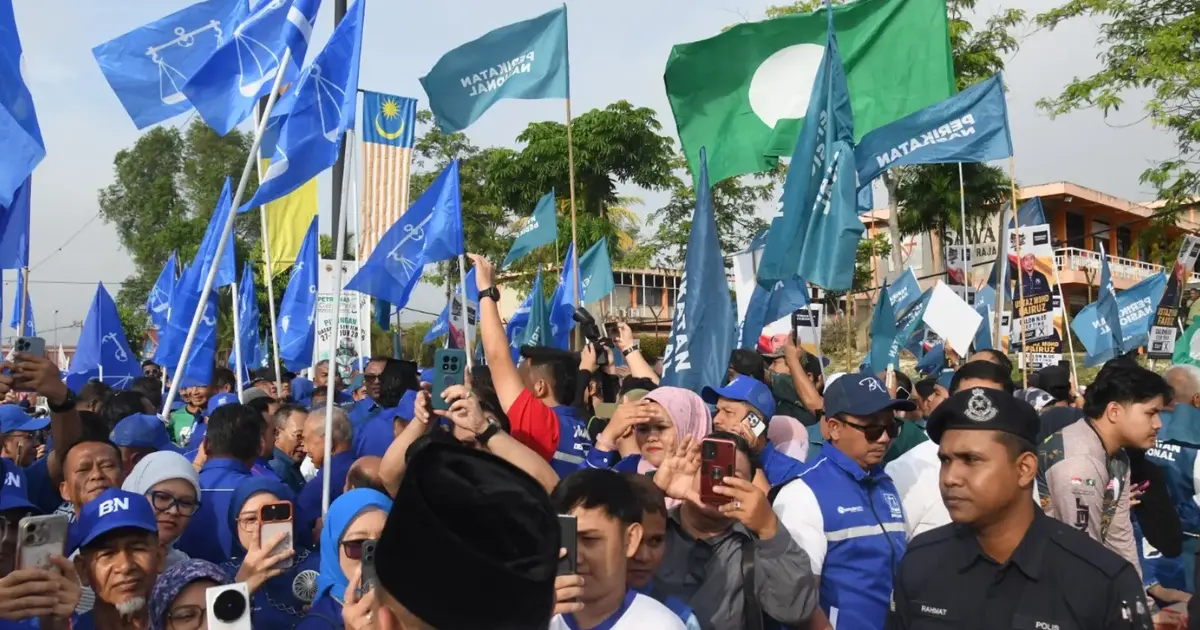
Political analyst Azmi Hassan has cast doubt on the capacity of Barisan Nasional to compensate for Bersatu's withdrawal from its working relationship with Perikatan Nasional in Selangor, suggesting that the ruling coalition's structural limitations will fundamentally constrain PAS's electoral ambitions in Malaysia's most urbanised state. The assessment comes as opposition parties navigate shifting political alliances ahead of upcoming contests that will reshape the country's electoral landscape.
Hassan's analysis centres on the distinction between having formal political partnerships and possessing the organisational muscle and grassroots mobilisation networks required to translate coalition agreements into tangible electoral gains. Bersatu, despite its recent turbulent history and shifting loyalties, had developed specific capabilities within Selangor's diverse constituencies that proved instrumental during the previous state election cycle. These advantages extended beyond vote-counting to encompass community engagement, voter identification systems, and localised campaign infrastructure that BN has not demonstrated it can readily replicate.
The broader context involves Malaysia's intricate federal and state political dynamics, where national political fortunes do not automatically translate into state-level success. Selangor, accounting for roughly one-quarter of the country's economy and home to over five million people spanning urban centres, industrial zones, and satellite towns, presents unique electoral challenges that differ substantially from peninsular states with more homogeneous demographics. The state's electorate comprises sophisticated urban voters, middle-class professionals, industrial workers, and migrant communities with distinct political preferences and voting patterns.
Bersatu's previous role in strengthening PAS's electoral position derived from tactical seat allocations, voter mobilisation in specific demographic communities, and the party's capacity to frame religious and developmental messaging in ways that resonated across constituencies. The party operated as a bridge between PAS's core messaging and segments of the electorate that might not naturally gravitate towards strict Islamic political positioning. Bersatu's own base, drawn partly from former Malaysian United Indigenous Party structures and urban Malay-Muslim professionals, provided electoral penetration into communities where traditional PAS support had plateaued.
Barisan Nasional's contemporary composition and organisational capacity presents structural limitations for fulfilling an equivalent function. The coalition, predominantly anchored by the United Malays National Organisation alongside smaller component parties, carries different political baggage and different voter perception profiles compared to Bersatu. UMNO's lengthy tenure in government and associated corruption scandals, together with public dissatisfaction over governance failures during its recent tenure, have created voter reservations that cannot be overcome through simple coalition mathematics. Moreover, UMNO's organisational apparatus in Selangor has atrophied significantly following electoral defeats and defections of prominent figures to rival parties.
The analyst's observation reflects a wider pattern in Malaysian politics where coalition partners bring distinct advantages beyond merely adding names to a ballot. Each political entity cultivates distinct voter constituencies, operates within specific geographic strongholds, and commands particular types of trust or brand recognition among target demographics. When one coalition partner exits or withdraws its support, replacing that partner with an alternative entity does not automatically preserve the electoral value originally contributed. The loss creates a vacuum that structural reorganisation alone cannot necessarily fill, particularly when competing within a state as politically contested and sophisticated as Selangor.
PAS's pursuit of Selangor control has long represented a strategic priority, given the state's economic significance, large Muslim-majority areas, and symbolic value as Malaysia's industrial heartland. However, the party faces persistent headwinds in expanding its appeal beyond core supporters. Opposition to PAS rule in some quarters stems from concerns about governance competence, perceived ideological rigidity, and anxiety about religious imposition in a state with substantial non-Muslim communities. These voter anxieties operate independently of which coalition partners PAS engages, meaning that BN alignment does not automatically neutralise electoral resistance.
Furthermore, BN's own political standing has undergone significant erosion, particularly among younger, urban voters who comprise disproportionate shares of Selangor's electorate. The coalition's association with decades of corruption allegations, institutional decay, and governance failures creates political liabilities that PAS cannot simply absorb through closer association. In Malaysian politics, guilt by association remains a potent electoral force, and aligning too tightly with BN risks alienating reform-minded voters whom PAS requires to expand beyond its traditional base.
The exit of Bersatu from supporting Perikatan Nasional at state level, whether voluntary or circumstantial, removes a component that had successfully bridged certain electoral gaps. Bersatu presented itself as a reform alternative to UMNO while maintaining credibility on religious matters, offering PAS partners with fresher political standing and less historical baggage. These qualities cannot be readily transferred to BN through conventional coalition negotiations, as they reflect accumulated voter perceptions developed over years of political positioning.
For Malaysian politics observers, Hassan's analysis underscores a fundamental reality: electoral success in increasingly sophisticated, diverse states like Selangor depends on much more than simply assembling adequate parliamentary numbers. The organisational capabilities, voter trust, demographic reach, and ideological positioning of coalition partners matter substantially. As Perikatan Nasional recalibrates its approach to state-level politics and evaluates potential partnerships, the limitations of simply substituting one coalition partner for another will likely constrain its expansion prospects in politically crucial states where voter sophistication and political engagement run high.
The implications extend beyond immediate state electoral calculations. Malaysia's political trajectory increasingly depends on whether opposition coalitions can assemble functional partnerships that combine organisational capacity with voter appeal. If Barisan Nasional cannot fill the gap left by Bersatu's reduced role, Perikatan Nasional will confront genuine structural barriers to expanding its control in key states, potentially reshaping the broader competitive landscape and altering assumptions about Malaysia's medium-term political direction.

