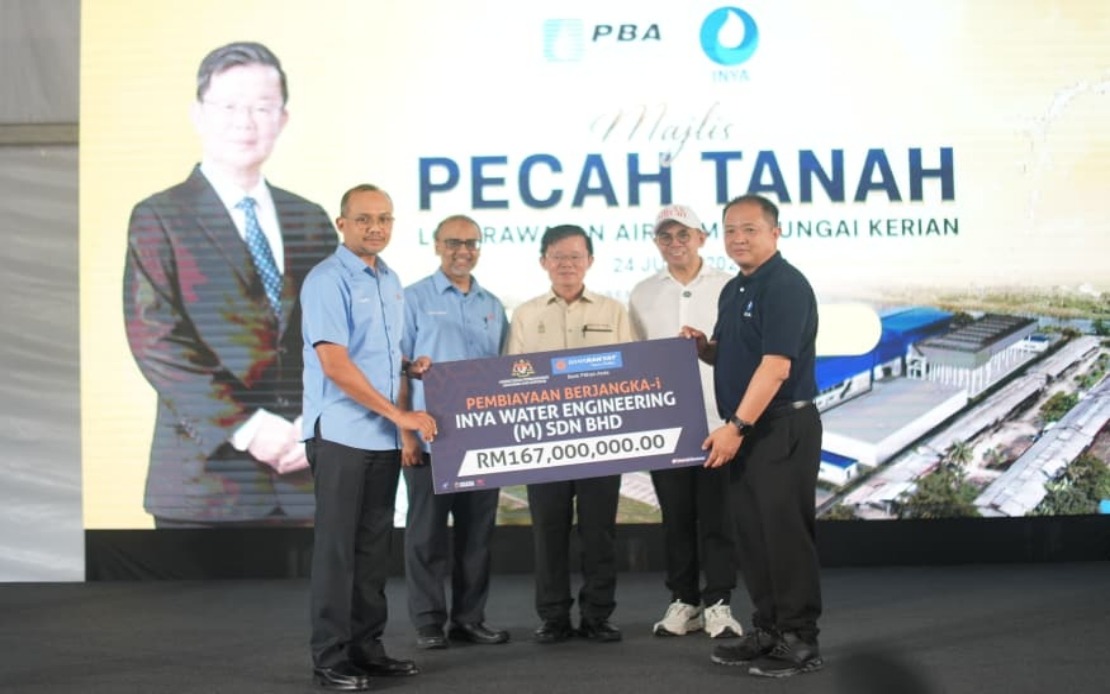
Bank Rakyat has committed RM167 million in financing for the Sungai Kerian Water Treatment Plant in Seberang Perai Selatan, underwriting 80 per cent of the entire construction outlay for what marks a significant shift in how Penang finances critical water infrastructure. The decision extends the development bank's traditional lending mandate beyond small enterprise support into large-scale public utilities, signalling the institution's expanded role in bankrolling strategic national assets.
Entrepreneur and Cooperatives Development Minister Steven Sim framed the financing as emblematic of Bank Rakyat's broader strategic pivot toward infrastructure investment alongside its core mission of supporting micro, small and medium enterprises. In a statement, Sim positioned the RM167 million commitment as an investment in Penang's economic future, emphasising that stable water supply underpins industrial competitiveness and creates wider commercial opportunities for the state and nation. The minister stressed that the financing reflected a deliberate institutional choice to channel capital into foundational assets that benefit the wider population rather than narrow commercial interests.
The total project, budgeted at over RM209 million, will construct a water treatment facility capable of processing 80 million litres daily through conventional treatment technology. Bank Rakyat will provide 15-year financing and has sweetened its offer with a two-year grace period—a concession aimed at easing the initial financial burden on Penang's water authority during the critical construction and early operational phases. These terms provide crucial breathing room as the project ramps up, allowing cash flow to stabilise before repayment obligations begin in earnest.
Penang Chief Minister Chow Kon Yeow, who opened the project's groundbreaking ceremony, described the facility as the state's inaugural water supply venture operating under a Build-Operate-Transfer structure. Under this 30-year arrangement, Inya Water Engineering will construct the plant and manage its daily operations and maintenance before transferring ownership to Penang Water Supply Corporation (PBAPP) at the agreement's conclusion. This outsourced model insulates the state authority from capital expenditure while delegating operational risk to a specialised private contractor.
The operational launch is targeted for mid-2027, positioning the facility to deliver an additional 80 million litres of treated water daily to roughly 223,000 residents across Seberang Perai Selatan and Seberang Perai Tengah. For a state grappling with rising population pressures and industrial water demands, this capacity injection addresses immediate supply constraints without requiring PBAPP to undertake construction financing independently. The timeline offers Penang approximately three years to complete the facility before water demand peaks further during the monsoon transition periods when supply variability historically complicates distribution.
The BOT model represents an institutional innovation for Penang's water sector, though such arrangements have become commonplace across Malaysian infrastructure development. Rather than PBAPP absorbing construction costs directly onto its balance sheet, the private operator bears that burden and recovers investment through a service contract. PBAPP commits to purchasing treated water at an opening rate of RM0.98 per cubic metre from 2027, with five-yearly price adjustments baked into the agreement. This structure converts a capital expenditure problem into a manageable operational expense spread over the contract term.
PBAP's board chairman contextualised the 80 million litre daily addition within broader system capacity, noting it represents merely 6.6 per cent of the corporation's total 2024 treated water production of 1,208 million litres daily. While supplementary, this increment proves strategically timed to meet projected demographic and industrial growth across the Seberang Perai municipalities. The modest percentage gain also means PBAPP can absorb the water purchase costs for two years as an operating expense without triggering immediate tariff adjustments, preserving political stability and household affordability during the facility's ramp-up period.
Chow committed that Penang's water tariff rates will remain unchanged in 2027 and 2028, shielding consumers from immediate price pressures as the new facility commences supply. This pledge carries weight given that Malaysian water tariffs have become increasingly sensitive political terrain, with rate hikes occasionally sparking public backlash. By absorbing the initial procurement costs internally, PBAPP absorbs the transition shock, providing a soft landing for household budgets while the new facility proves operational efficiency and long-term viability.
The Sungai Kerian project reflects broader tensions within Malaysia's water sector regarding infrastructure financing. Conventional approaches require state authorities to either raise capital independently or depend on federal allocation, both constrained options in a fiscally pressured environment. The BOT model sidesteps these constraints by enlisting private capital and operational expertise while maintaining public ownership and control over strategic assets. For other Malaysian states facing similar water supply deficits, this precedent suggests alternative financing pathways beyond traditional public budgeting mechanisms.
Bank Rakyat's willingness to finance a RM209 million water infrastructure venture also signals institutional confidence in the sector's revenue predictability. Water utilities generate steady, non-discretionary demand—households and industries require continuous supply regardless of economic cycles. This contrasts with cyclical commercial lending, making infrastructure finance attractive for development institutions seeking lower-risk, longer-duration returns. The bank's 15-year financing window aligns with operational cash generation timelines, suggesting careful structuring to ensure borrowing capacity matches revenue streams.
For Southeast Asia's wider water development agenda, the Sungai Kerian precedent matters. Regional cities face intensifying supply pressures from urbanisation and industrial expansion, yet many state authorities lack budgetary capacity or technical expertise to expand treatment and distribution networks autonomously. Publicising successful BOT arrangements with development bank backing potentially catalyses replication across comparable jurisdictions, unlocking private capital and operational know-how for infrastructure challenges that have resisted traditional public solutions.
The project's environmental and governance undertakings—emphasised by Minister Sim—establish implicit performance benchmarks. Penang has committed to environmental preservation and good governance alongside construction quality and safety, suggesting the state recognises stakeholder concerns regarding infrastructure's ecological footprint. As Malaysia's water sector increasingly confronts constraints related to source availability and climate variability, projects like Sungai Kerian must demonstrate that infrastructure expansion proceeds sustainably rather than simply transferring scarcity risks downstream.
Ultimately, the RM167 million Bank Rakyat commitment illuminates how development finance, private operational efficiency, and public authority stewardship can combine to address infrastructure deficits without overburdening government balance sheets. As Southeast Asian states confront intensifying pressure to expand water, energy, and transport systems amid fiscal constraints, such hybrid models may become less exceptional and more standard, reshaping how the region finances and manages critical services.

