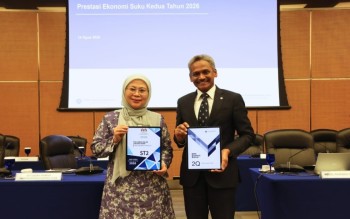
Bank Negara Malaysia remains committed to its 2026 gross domestic product growth forecast of 5.0 percent, with Governor Datuk Seri Abdul Rasheed Ghaffour signalling no immediate need for downward revisions despite acknowledged global uncertainties. Speaking after the central bank announced second-quarter growth figures, Ghaffour indicated that any material adjustments to the official projection would typically be reserved for the Budget announcement cycle, suggesting the monetary authority views current economic conditions as supportive of maintaining the existing baseline forecast.
The optimism stems partly from Malaysia's outperformance in recent quarters, with the economy expanding at 6.0 percent in the second quarter of 2026, surpassing the Department of Statistics Malaysia's advance estimate of 5.8 percent. This acceleration across multiple consecutive quarters has provided the central bank with confidence that underlying momentum remains intact, even as regional and global headwinds accumulate. The stronger-than-expected outturn reflects the durability of economic fundamentals and suggests that current growth drivers remain potent enough to support the 5.0 percent medium-term assumption.
Domestic demand has emerged as the primary engine propelling Malaysia's growth trajectory, with household consumption particularly resilient at 4.8 percent growth in the second quarter. This performance is noteworthy given that consumption is typically considered vulnerable to inflation, rising interest rates, and tightening financial conditions. According to Ghaffour, income expansion, accumulated savings, and government fiscal support measures have combined to sustain consumer spending momentum, with household borrowing playing only a marginal role in financing consumption. This composition suggests that current growth is built on relatively stable foundations rather than debt-fuelled excess, a distinction that carries important implications for the sustainability of the expansion.
The external sector has provided crucial supplementary support, particularly during the first quarter, offsetting any concerns about over-reliance on domestic sources of growth. Critically, export expansion has demonstrated diversification rather than concentration, with both electrical and electronics (E&E) and non-E&E segments recording positive momentum. This breadth stands in contrast to Malaysia's historical export profile, which has often been vulnerable to cyclical swings in global semiconductor demand. The emergence of contributions from information and communications technology services represents a structural shift toward higher-value activities, potentially supporting more stable long-term growth trajectories.
Nevertheless, Ghaffour acknowledged that the global economic environment presents mounting challenges that could alter Malaysia's growth path going forward. Geopolitical tensions and unpredictable macroeconomic conditions abroad may eventually constrain demand for Malaysian exports and investor sentiment toward the region. The central bank's decision to maintain rather than upgrade the forecast reflects prudent risk management, recognising that the present outperformance may not necessarily persist indefinitely. This measured stance balances optimism about current momentum with appropriate caution regarding external vulnerabilities beyond Malaysia's control.
El Niño weather patterns present a distinct domestic risk that the central bank has flagged for closer monitoring. While Ghaffour characterised the direct economic impact as primarily confined to the agricultural sector, with effects typically materialising with a time lag, he emphasised the importance of proactive adaptation by businesses and households. Given Malaysia's significant agricultural export base and the role of the sector in rural employment and incomes, agricultural disruptions could create broader economic ripple effects. The central bank's communication appears designed to encourage preparedness without triggering alarm, reflecting the inherent uncertainty surrounding El Niño's ultimate severity and duration.
For Southeast Asian observers and policymakers, Malaysia's resilience offers mixed signals. The diversification of growth drivers and strength of domestic consumption suggest that the region's larger economies can sustain expansion despite global headwinds, provided they maintain disciplined macroeconomic management. However, the central bank's cautious posture on revisions underscores that the current benign environment should not be taken for granted. Regional currencies, capital flows, and export demand remain vulnerable to shifts in global risk sentiment or unexpected geopolitical escalation.
The absence of a forecast upgrade, despite superior actual performance, reveals important thinking within Bank Negara's leadership about the nature of current momentum. Rather than extrapolating recent outperformance, the central bank is treating the 5.0 percent assumption as an appropriate equilibrium rate anchored to medium-term potential, with quarterly deviations viewed as temporary variations rather than signals of permanently elevated capacity. This framework provides consistency for longer-term planning while preserving the flexibility to adjust if structural conditions materially change. From a communication standpoint, this approach manages expectations and credibility more effectively than repeatedly revising forecasts in response to short-term data surprises.
Investors and businesses planning capital allocation will note that Malaysia's official growth assumptions remain grounded and conservative relative to recent outturns. This positioning leaves room for pleasant surprises if both domestic and external conditions hold, while anchoring inflation expectations and wage-setting behaviour to a sustainable long-term growth rate. The central bank's emphasis on the breadth of growth drivers and the stability of consumption financing provides additional reassurance regarding the resilience of the expansion. Policymakers in the region closely track Malaysia's economic indicators and policy signals given the country's role as a regional bellwether and its interconnectedness with ASEAN supply chains and financial systems.

