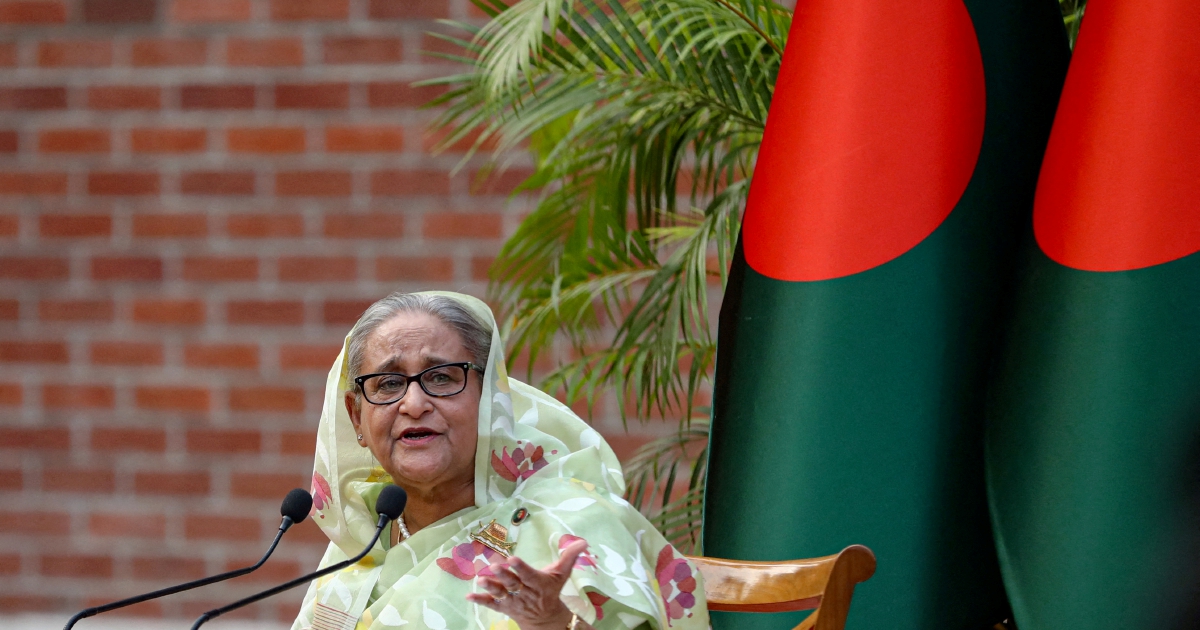
Bangladesh has moved to consolidate its interim administration by confiscating approximately 760 billion taka, equivalent to roughly US$6.2 billion, in assets traceable to former Prime Minister Sheikh Hasina, her immediate family, and a network of 10 major business groups aligned with her regime. This sweeping seizure represents one of the most substantial asset recoveries undertaken by the country's transitional government since Hasina's departure from power.
The confiscation underscores the extent to which accumulated wealth became concentrated among a narrow circle of political elites and their commercial enterprises during Hasina's tenure. The involvement of multiple business entities suggests a complex web of financial interests that extended well beyond the immediate family, encompassing corporate holdings, real estate, financial instruments, and other valuable properties. Such interconnected business structures are not uncommon in South Asian political economies, where ruling parties often benefit from preferential access to government contracts, licensing arrangements, and regulatory favours that accumulate into vast fortunes.
For Malaysian observers, Bangladesh's asset recovery initiative carries significant implications for how regional democracies manage post-transition periods. Malaysia has its own experience with investigating and recovering proceeds from politically exposed persons, most notably through the 1Malaysia Development Berhad (1MDB) scandal and subsequent asset tracing efforts. The Bangladeshi approach demonstrates both the potential for large-scale financial restitution and the complex legal and administrative machinery required to identify, document, and ultimately secure seized assets across multiple jurisdictions and ownership structures.
The interim government in Dhaka has prioritised transparency and accountability as cornerstones of its legitimacy. Announcing these confiscations publicly signals to domestic constituencies and international observers that the new administration intends to dismantle the patronage networks that sustained the previous regime. Such declarations also serve a practical function: they establish legal grounds for asset seizures and provide documentation that may prove essential if international cooperation becomes necessary to freeze or repatriate funds held overseas.
The scale of the operation reflects broader concerns about capital flight and wealth concealment in South Asia. Many analysts suspect that portions of assets accumulated through rent-seeking and corruption find their way into offshore accounts, property purchases in major financial centres, or complex investment vehicles designed to obscure beneficial ownership. Identifying and quantifying such holdings demands sophisticated forensic accounting, international coordination, and access to banking records that remain challenging to obtain even under the most cooperative circumstances.
International precedent suggests that recovering stolen assets is frequently a protracted undertaking. Former Indonesian strongman Suharto, Philippine president Ferdinand Marcos, and numerous African leaders saw decades-long legal battles over their ill-gotten fortunes. Even when seizures are announced with fanfare, converting them into usable funds often proves frustratingly slow. Bangladesh may face similar complications, particularly if assets held abroad trigger legal challenges from family members, corporate entities, or creditors claiming legitimate interests.
The targeting of ten business conglomerates alongside Hasina and her family indicates that the interim government is taking a holistic view of political corruption. In many developing democracies, the distinction between state power and private wealth blurs considerably. Business groups gain access to monopolies, procurement contracts, and regulatory exemptions in exchange for providing financial support to ruling parties. This symbiosis creates layers of complexity that make it difficult to separate personal enrichment from institutional corruption.
For Southeast Asia more broadly, Bangladesh's actions will likely influence how other governments—particularly those navigating democratic transitions or accountability processes—approach similar challenges. Regional peers including Myanmar, Thailand, and potentially Cambodia face questions about managing the assets of displaced leaders and their networks. How Bangladesh executes its recovery programme, whether seized funds are transparently managed, and whether affected parties receive procedural fairness will set important precedents.
The interim government's success in implementing these confiscations will depend substantially on institutional capacity. Bangladesh's financial intelligence unit, tax authorities, and asset recovery mechanisms must coordinate effectively to secure holdings, prevent concealment, and defend against legal challenges. Bureaucratic capacity remains uneven across South Asia, and Bangladesh faces particular constraints given its recent political upheaval and the administrative burden of simultaneously managing government operations and investigating financial crimes.
Longer-term questions loom regarding how confiscated assets should be deployed. Some jurisdictions have established special recovery funds dedicated to development priorities; others have redirected proceeds into general revenue. Bangladesh's interim authorities will face pressure from civil society advocates, international donors, and domestic constituencies to ensure that recovered wealth ultimately benefits national development rather than being absorbed into parallel forms of patronage.
The announcement also carries diplomatic dimensions. The scale of the confiscations may influence Bangladesh's standing with international creditors, development partners, and anti-corruption watchdogs. Demonstrating serious commitment to accountability can strengthen relations with major donors and multilateral institutions while potentially complicating relations with any external actors that benefited from the previous regime's patronage networks.
Ultimately, Bangladesh's asset seizure initiative represents both a symbolic assertion of accountability and a pragmatic effort to replenish state coffers. Whether it succeeds in recovering the full value of identified assets, preventing further concealment, and channelling proceeds toward public benefit will determine its significance as a governance milestone. For Malaysia and other regional democracies, the Bangladeshi experience offers valuable lessons about the technical, legal, and political complexities inherent in addressing the material legacies of authoritarian or corrupt rule.

