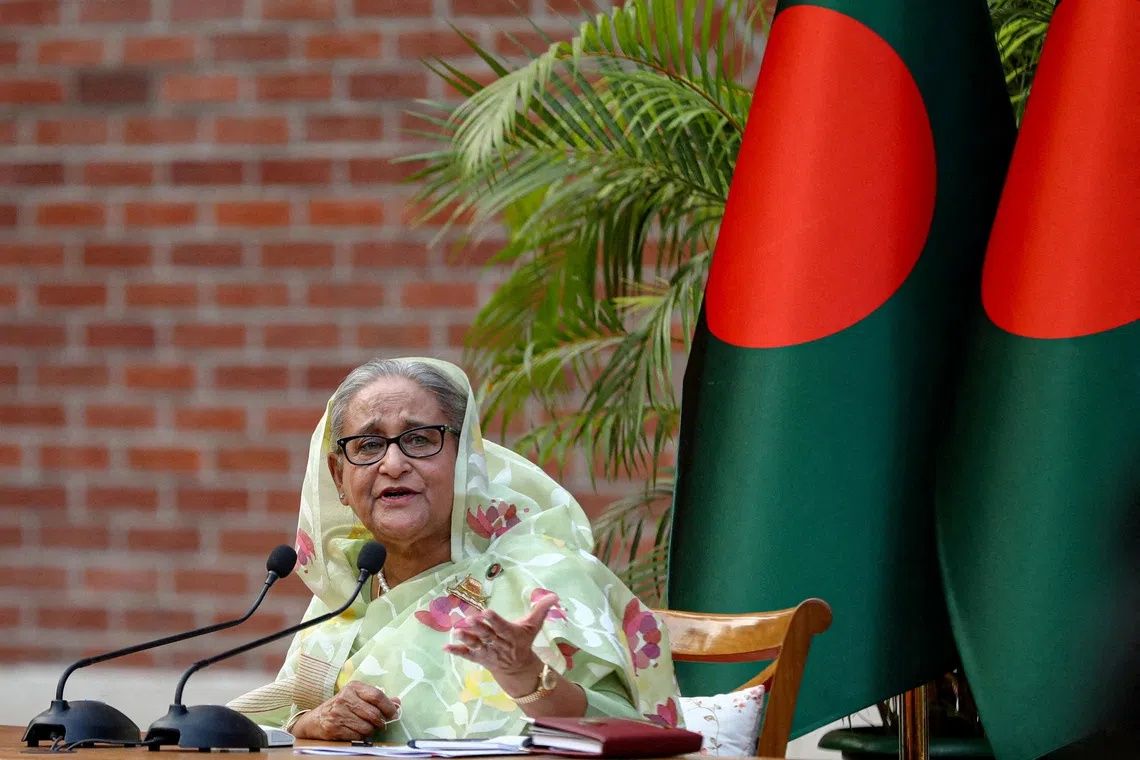
Bangladesh has formally asked India to explain its official stance regarding exiled former prime minister Sheikh Hasina's scheduled virtual appearance at a New Delhi event, signalling concern that allowing her to engage in political discourse from Indian territory could undermine the diplomatic progress both nations have recently achieved. The request marks Dhaka's first formal diplomatic response to Hasina's planned participation in an August 5 gathering organised by the Foreign Correspondents' Club of South Asia, which will commemorate the second anniversary of the student-led uprising that precipitated her government's collapse in August 2024.
State Minister for Foreign Affairs Shama Obaed Islam articulated Bangladesh's position during a briefing on Monday, emphasising that Dhaka has consistently communicated its reservations to New Delhi regarding Hasina and other senior Awami League figures conducting political activities from Indian soil. The diplomat stressed that Bangladesh's approach towards India remains forward-looking and development-oriented, but underscored that tangible progress in bilateral relations could be compromised if such activities proceed without clear governmental guidance from New Delhi.
The underlying tension reflects the complicated diplomatic challenge facing both nations as they attempt to normalise relations following the dramatic political upheaval in Bangladesh. Since Hasina fled to India in August 2024, she has become an ongoing point of contention between Dhaka and New Delhi, with Bangladesh consistently pressing for her extradition while India has maintained a cautious diplomatic approach to the matter. The situation has become more delicate following the political transition in Bangladesh, where Tarique Rahman's government took office after February's elections, signalling a potential recalibration of bilateral ties.
Hasina, now 78 years old, will participate in the New Delhi event via video link alongside her son Sajeeb Wazed Joy and other speakers, according to the Foreign Correspondents' Club of South Asia. Despite facing multiple legal cases in Bangladesh—including a death sentence imposed in 2025 for crimes against humanity related to the 2024 security crackdown—Hasina has publicly stated her intention to return to Bangladesh by December. She has rejected the death sentence as legally invalid, framing the proceedings as politically motivated rather than legitimate judicial determinations.
Islam's intervention reflects a broader diplomatic concern within Bangladesh's government about the precedent that could be established if India permits exiled political figures to maintain active public profiles while residing on Indian territory. Dhaka has reminded New Delhi that India had previously indicated it expected fugitive individuals to refrain from engaging in political activities whilst based in India, creating an expectation that this principle would be consistently applied. The statement suggests that Bangladesh views the potential speech as a test case for whether India's stated policy regarding fugitives will be honoured in practice.
The crackdown that precipitated Hasina's downfall resulted in what the United Nations estimated as up to 1,400 deaths, making it one of the region's most significant humanitarian catastrophes in recent years. The uprising represented an extraordinary moment of social mobilisation, with students leading a broad coalition demanding accountability and systemic change. Hasina's departure marked the end of a political era in Bangladesh, and questions surrounding her potential return have remained contentious despite the change in government.
Bangladesh has signalled it would be prepared to escalate the matter through formal diplomatic channels if necessary, though officials have refrained from making explicit threats or ultimatums. The country's preference appears to be securing India's voluntary compliance with its concerns before resorting to more confrontational diplomatic approaches. This measured tone reflects a recognition that Bangladesh cannot afford to antagonise India, a crucial strategic and economic partner, even while pursuing its government's stated objectives regarding accountability for past events.
The Indian Ministry of External Affairs has not yet publicly responded to Bangladesh's representations, maintaining an official silence that itself carries diplomatic implications. India's reluctance to make immediate statements may indicate either a genuine internal deliberation about its policy position or a deliberate strategy to avoid appearing either pressured by Dhaka or complicit in restricting the rights of an exiled former leader. The lack of response also leaves ambiguity about whether the event will proceed as scheduled or whether India might quietly encourage modifications to its format or content.
The episode illuminates the persistent complexities within India-Bangladesh relations, which have oscillated between cooperation and tension depending on the political composition of both governments. Whilst recent signs suggest both countries' current administrations favour improved engagement and expanded developmental cooperation, legacy issues such as Hasina's presence in India demonstrate how historical grievances and political uncertainties can resurface to challenge bilateral progress. The situation also reflects broader regional patterns whereby neighbour states sometimes harbour exiled political figures, creating recurring diplomatic friction over questions of sovereignty, accountability, and the appropriate boundaries of diplomatic hospitality.
For regional observers, the matter represents a test of whether India can balance its traditional role as a sanctuary for regional political figures with the expectations and sensitivities of its neighbours. Bangladesh's diplomatic approach—respectful but firm—suggests a government attempting to resolve the matter through established channels rather than public confrontation. Whether India ultimately permits the speech to proceed unchanged, encourages modifications, or intervenes more directly will provide insight into the trajectory of India-Bangladesh relations under current leadership and the extent to which diplomatic progress can withstand such politically charged complications.

