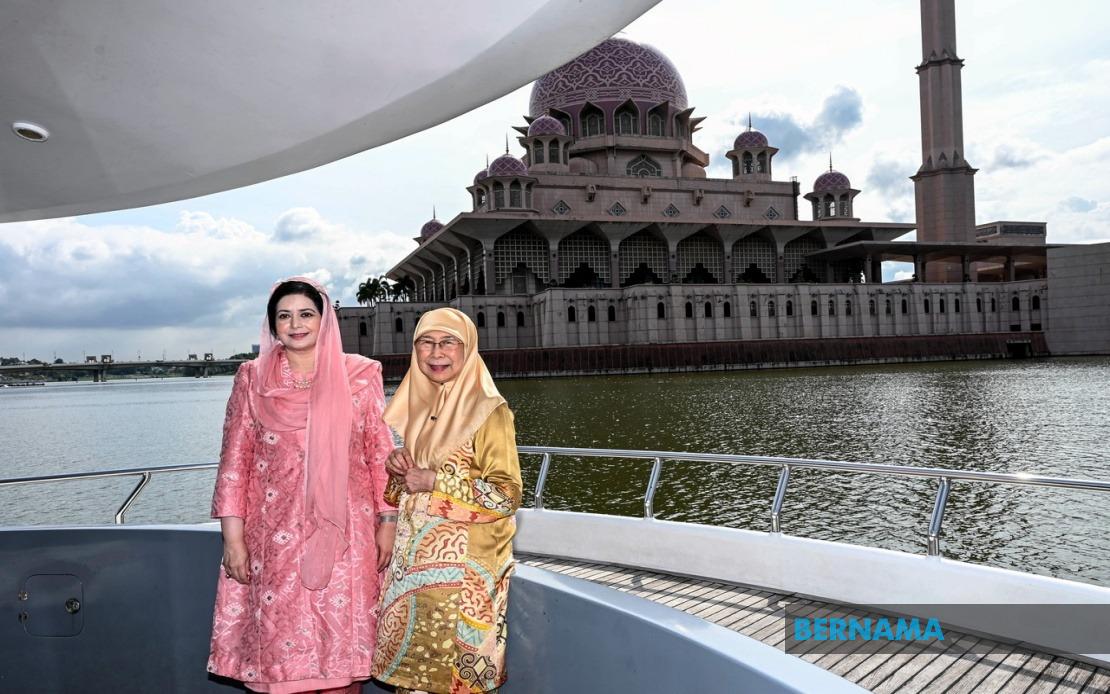
Dr Zubaida Rahman, wife of Bangladesh Prime Minister Tarique Rahman, spent the morning of June 22 cruising across Putrajaya Lake, soaking in panoramic vistas of Malaysia's administrative capital from the water. The leisurely boat excursion offered her a firsthand perspective of the carefully planned federal territory's distinctive architectural and landscaping achievements, presented to her by her Malaysian hosts as a showcase of regional governance and urban planning.
Datuk Seri Dr Wan Azizah Wan Ismail, spouse of Prime Minister Datuk Seri Anwar Ibrahim, and Hannah Yeoh, Minister in the Prime Minister's Department (Federal Territories), welcomed Dr Zubaida upon her arrival at 9.30 am. The three women shared approximately an hour together aboard the vessel, conversing while observing the waterfront vistas that frame Putrajaya's most recognisable institutions and monuments. Such cultural and social exchanges form part of the protocol through which visiting dignitaries are introduced to host nations, building personal rapport among the spouses and families of political leaders.
The lake cruise represented one component of a broader bilateral engagement that commenced when Bangladesh Prime Minister Tarique Rahman and Dr Zubaida arrived in Malaysia on Sunday evening. Their presence marks a significant moment in Bangladesh-Malaysia relations, as this constitutes Tarique's inaugural official bilateral visit abroad following his assumption of the prime ministership in February 2026. The timing underscores Dhaka's strategic intent to prioritise regional partnerships as it consolidates its new administration.
The visit itself was undertaken at the explicit invitation of Anwar, reflecting the two nations' shared commitment to strengthening their partnership. Both governments view this engagement as an opportunity to deepen existing collaborative frameworks and to identify fresh domains where bilateral cooperation might be expanded. Such high-level state visits typically encompass structured bilateral meetings, sectoral discussions, and cultural exchanges designed to demonstrate commitment to mutual prosperity.
From a commercial standpoint, the bilateral relationship carries considerable weight for both nations. Bangladesh currently ranks as Malaysia's 28th-largest trading partner globally, with bilateral commerce valued at RM12.18 billion. More significantly within the Asian context, Bangladesh occupies the position of Malaysia's second-most-important trading partner throughout South Asia, trailing only India in that regional classification. These figures underscore the economic interdependencies that underpin the political rhetoric of strengthened ties.
The relationship between Malaysia and Bangladesh reflects broader Southeast Asian engagement with South Asia, a region increasingly central to Malaysian foreign policy and economic strategy. As Malaysia seeks to diversify its international partnerships and reduce reliance on any single trading bloc, ties with major South Asian economies assume heightened importance. Bangladesh, with its substantial population, growing industrial capacity, and strategic location in the Bay of Bengal, offers Malaysian businesses significant opportunities across multiple sectors including textiles, manufacturing, and services.
Cultural diplomacy of the sort exemplified by Dr Zubaida's Putrajaya tour serves practical functions beyond mere symbolism. When the spouses of national leaders participate in such activities, they contribute to building interpersonal connections that can facilitate smoother governmental relations. These informal channels often prove valuable when formal negotiations encounter difficulties, as trust established through social interaction can help bridge diplomatic impasses.
For Malaysian audiences, visits such as this reinforce the nation's role as a regional diplomatic hub and showcase destination within Asia. Putrajaya itself, as the modern administrative centre chosen to represent contemporary Malaysian governance, benefits from international exposure through such high-profile visits. The deliberate inclusion of scenic Putrajaya experiences in bilateral visit itineraries communicates Malaysia's confidence in its institutional development and urban achievements.
The broader trajectory of Bangladesh-Malaysia relations also reflects changing regional dynamics in South and Southeast Asia. As both nations navigate complex geopolitical circumstances, economic competition, and developmental challenges, bilateral engagement offers mutual benefits. Bangladesh looks to Malaysia's experience in industrial development and governance; Malaysia views Bangladesh as both a market and a partner in regional stability initiatives.
Looking ahead, the substantive outcomes of this visit—whether announced through joint statements, memoranda of understanding, or other diplomatic instruments—will indicate the practical scope of renewed bilateral commitment. Beyond the ceremonial aspects of state visits lie concrete negotiations addressing trade facilitation, investment frameworks, educational exchanges, and possibly security cooperation. These technical dimensions ultimately determine whether high-level visits translate into sustained improvement in bilateral relations or remain primarily ceremonial occasions.