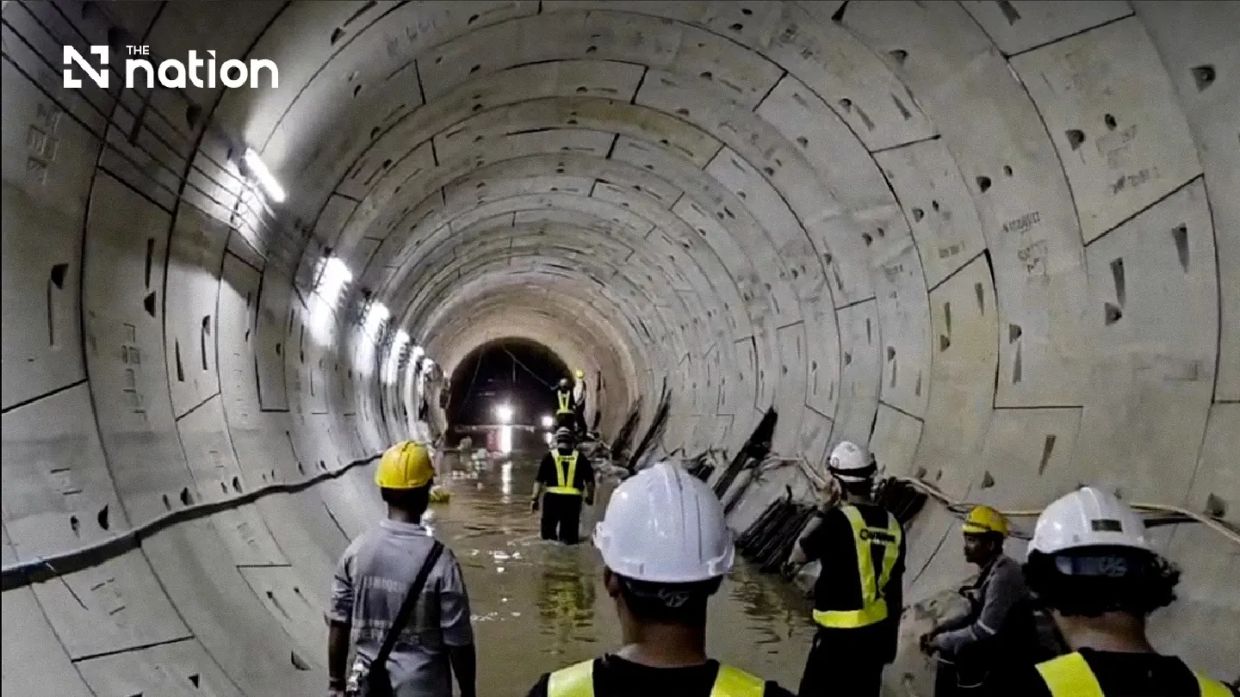
Prime Minister Anutin Charnvirakul rushed to Wongwian Yai late on Wednesday, July 8, following reports that sustained heavy rain had forced water into an underground construction shaft along the southern Purple Line project. The incident marked a fresh test of Thailand's metro infrastructure safety systems, coming at a time when public confidence in such megaprojects remains fragile following previous failures. Water seeped into the worksite located beneath the Tao Poon–Rat Burana section, also known as the Kanchanaphisek Ring Road extension, as rainfall levels spiked throughout Bangkok during the day. Rising water inside the construction area triggered an immediate mobilisation of senior government officials and engineering teams to assess structural integrity and prevent further deterioration.
The emergency response showcased the hierarchy of Thailand's transport administration, with Deputy Prime Minister and Transport Minister Phiphat Ratchakitprakarn arriving first, followed shortly by three deputy transport ministers and the Deputy Interior Minister. Their collective presence underscored the gravity with which officials treated the situation, particularly given lingering memories of the Vajira Hospital incident that occurred in late September 2025, when a tunnel collapse caused dramatic ground subsidence and raised serious questions about contractor competence and regulatory oversight. By midnight, the Prime Minister himself was on-site, signalling political commitment to preventing a repeat of that catastrophic failure.
Mass Rapid Transit Authority of Thailand Governor Gardphajon Udomdhammabhakdi and Prasong Suviwattanachai, the executive chairman and managing director of Unique Engineering and Construction Public Company Limited, conducted the technical inspection alongside government ministers. The contractor, UNIQ, currently operates Contract 4 of the broader southern Purple Line expansion project, which spans the Saphan Phut–Dao Khanong section. This particular contract, valued at 14.982 billion baht or approximately US$447.3 million, requires tunnel excavation and the construction of substantial retaining walls—both technically demanding operations vulnerable to water infiltration during heavy precipitation.
Deputy Transport Minister Phattharaphong Phatraprasit declared that initial assessments indicated the situation remained manageable, though he issued stern directives to both the MRTA and the contractor. They were instructed to establish continuous monitoring systems, conduct comprehensive technical evaluations, and identify the precise origins of the water incursion without delay. This methodical approach reflected lessons learned from previous infrastructure incidents, where delayed investigations and inadequate transparency had fuelled public scepticism. The ministry also demanded that corrective actions commence immediately to mitigate potential structural damage, safeguard public welfare, and prevent any derailment of the project timeline. Regular progress reports became mandatory, with all remedial work subject to stringent engineering and safety protocols.
Prime Minister Anutin framed the government's response as strictly evidence-based and engineering-focused, distinguishing the Wongwian Yai situation from the Vajira Hospital disaster. He emphasised that officials had detected the leak early and were actively sealing it while closely monitoring whether water levels continued rising. Unlike the Vajira collapse, which involved sudden structural failure beneath an active roadway, this incident allowed for proactive intervention. He stated that work had commenced since morning and that officials had successfully contained the water level with no signs of further escalation. The water accumulation had not yet reached thresholds that would necessitate closing nearby roads or displacing residents, providing a measure of reassurance to the public.
The MRTA had coordinated the placement of sophisticated monitoring equipment throughout the surrounding area to detect any unusual ground movement or structural shifts in nearby buildings and infrastructure. The Prime Minister noted that no abnormal readings had been recorded thus far, though heightened surveillance would continue indefinitely. He also indicated that the inspection and remediation process would likely conclude relatively quickly, reflecting confidence in the engineering response and the contractor's capacity to rectify the problem without prolonged disruption. This optimistic timeframe, however, remained contingent on findings from ongoing technical assessments and the effectiveness of initial sealing operations.
When asked whether his midnight visit reflected anxiety about another catastrophic collapse like Vajira Hospital, Anutin acknowledged that the September 2025 incident had delivered harsh lessons and catalysed much sharper alertness across government to preparedness, public communication, and timely assistance. He reiterated that public safety remained the paramount concern, overriding all other considerations including project schedules and cost implications. This statement carried significance for Malaysian readers, given that several Southeast Asian nations are pursuing similar metro expansion projects and face comparable risks of contractor failures and inadequate geological assessment. The Vajira Hospital experience had demonstrated how quickly infrastructure crises can escalate into national embarrassments that undermine investor confidence across the region.
Following consultations with the MRTA governor, consulting engineers, and UNIQ's representatives, all parties reached consensus that water ingress could be successfully controlled through accelerated repairs. The contractor committed to restoring normal conditions as rapidly as possible, though specifics regarding timeline and remediation techniques were not disclosed publicly. This reflects a broader pattern in Thai infrastructure governance where technical details often remain opaque to the media and public, creating information asymmetries that can breed mistrust. For Malaysian observers of Bangkok's metro expansion, such opacity raises uncomfortable questions about accountability mechanisms and whether affected communities receive adequate warning systems before crisis situations escalate.
Anutin's explanation regarding the rapid assembly of multiple ministers—simply noting that he had informed them via a group chat before proceeding to the scene—provoked mild scepticism among journalists who recognised this as describing reactive rather than planned crisis management. When pressed whether this represented the coordination model he desired, the Prime Minister suggested that such multi-agency responses happened routinely and that his primary motivation was ensuring proper handling before secondary issues arose. This characteristically vague response typified how Thai officialdom often deflects scrutiny by emphasising intent rather than process or measurable outcomes. For observers across Southeast Asia monitoring infrastructure governance standards, such exchanges underscore why transparent communication protocols and pre-established crisis response hierarchies remain insufficiently developed in the region.
The Purple Line tunnel water leak episode carries broader implications for Bangkok's ongoing metro expansion and for regional infrastructure development patterns. Each incident, whether successfully resolved or catastrophic, accumulates evidence regarding contractor reliability, regulatory effectiveness, and geological assessment adequacy. UNIQ's performance throughout this incident and subsequent remediation will substantially influence how international and local investors evaluate Thai infrastructure contracts going forward. The company's previous work record, the robustness of its contingency planning, and the speed with which it implements corrective measures will all become critical variables in determining whether this proves a routine setback or a harbinger of deeper systematic problems. Malaysian stakeholders monitoring such developments should note these patterns, particularly as domestic metro expansion proceeds and similar geological and climatic challenges arise.
The incident also highlights the seasonal vulnerability of underground construction works in Southeast Asian tropical climates, where monsoon rainfall can rapidly overwhelm conventional water management systems. Contractors operating across Thailand, Malaysia, Vietnam, and other regional nations routinely underestimate precipitation intensity and infiltration rates during their initial designs and planning phases. The Wongwian Yai situation, while apparently contained before serious damage occurred, represents a cautionary reminder that even well-resourced and ostensibly competent contractors require contingency buffers and proactive monitoring systems throughout tropical construction periods. For Malaysian audiences following similar metro projects in Kuala Lumpur and other cities, these Bangkok experiences provide invaluable lessons regarding the specifications and oversight mechanisms necessary to prevent cost overruns and safety compromises.

