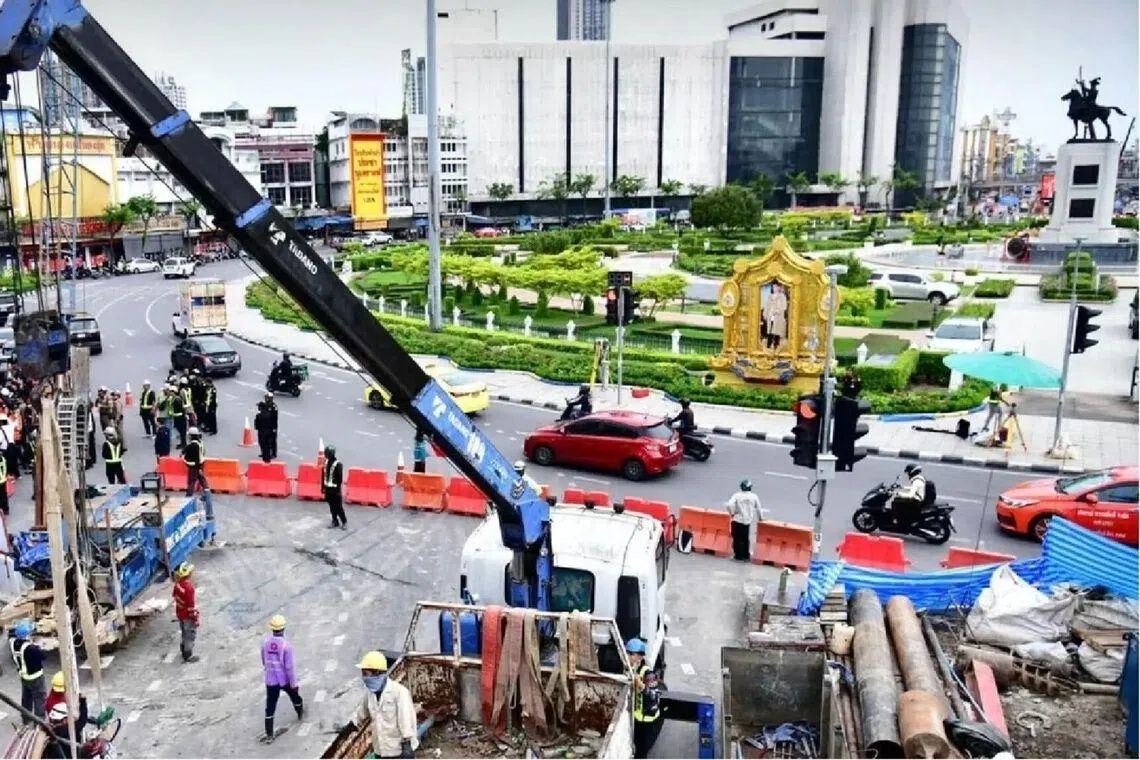
Bangkok has launched a major emergency response after water infiltration in a drainage system at the southern Purple Line construction site triggered ground subsidence that forced the evacuation of about 60 residents from nearby commercial buildings. The incident, which occurred near Wongwian Yai, has prompted authorities to implement comprehensive monitoring and stabilisation measures while residents are expected to spend approximately one week in temporary accommodation arranged and funded by the project contractor.
The root cause of the emergency lay in water seepage entering a drainage sump positioned at the lowest point of the underground tunnel network. As water accumulated in spaces it should not occupy, the surrounding soil began migrating into the subsurface cavity, a process that gradually destabilised the ground above. The cumulative effect manifested as visible subsidence of both the earth and the paved road surface, creating structural risks for the three commercial buildings situated within 30 metres of the affected zone. This mechanism is a well-documented hazard in major tunnelling projects, particularly in urban areas with complex subsurface conditions.
Bangkok Governor Chadchart Sittipunt personally visited the site on July 9 alongside Deputy Governor Wisanu Subsompon and Deputy Permanent Secretary Kanokwan Iamlim to assess the situation. By the time of inspection, authorities reported encouraging signs that both water levels and the rate of ground movement had stabilised, though officials emphasised that round-the-clock surveillance would persist until engineers confirmed complete safety. This stabilisation, however, did not eliminate the immediate threat to nearby structures, necessitating the precautionary evacuation.
The three affected buildings have been declared temporarily uninhabitable, and all occupants have been relocated to hotels and other temporary facilities. The Mass Rapid Transit Authority of Thailand's contractor has assumed full financial responsibility for accommodation, compensation payments, and all associated expenses during what officials project will be a one-week displacement period. Before residents can return, a comprehensive engineering assessment must verify that structural integrity has been restored and that surrounding infrastructure poses no secondary hazards.
To prevent further catastrophic movement, authorities have deployed an advanced monitoring system centred on two Rescue Guardian units installed on buildings near the subsidence point. These sophisticated sensors continuously measure building tilt and structural displacement, transmitting real-time data to a centralised monitoring system that automatically triggers alarms if abnormal movement patterns emerge. The sensors focus particularly on areas within 30 metres of visible road cracks, allowing rapid identification of any reactivation of ground movement that could signal deteriorating conditions.
The response coordination has expanded beyond routine emergency management, with engineers from Thailand's national Urban Search and Rescue team joining inspections to evaluate structural safety and ensure all interventions meet national engineering standards. The Department of Disaster Prevention and Mitigation deployed generators, lighting apparatus, and specialised machinery to sustain overnight operations. Rescue foundations and volunteer units have been positioned on standby to provide medical assistance or emergency patient transfers if required. A forward command centre near the subsidence point serves as the coordination hub for the Bangkok Metropolitan Administration, the MRTA, the contractor, district authorities, police, and emergency response teams.
Engineers have prioritised sealing the source leak and preventing additional soil migration into the tunnel structure. Continuous instrumental monitoring tracks road surface elevation, subsurface soil movement, water leakage rates, and the structural condition of neighbouring buildings. This comprehensive surveillance approach aims to detect any trend reversal that might indicate renewed instability before visible consequences emerge.
The incident reflects persistent challenges with the Purple Line extension programme. This particular subsidence site lies along the same southern alignment as an earlier road collapse near Vajira Hospital, though the present section is managed by a different contractor. The pattern suggests systemic vulnerabilities in tunnel construction methodology or site investigation procedures that extend beyond a single operator's performance.
Prajadhipok Road has been sealed in both directions for approximately 200 metres between Ban Khaek intersection and Wongwian Yai, with all outbound lanes closed to eliminate traffic vibrations that could further destabilise weakened soil or structurally compromised buildings. Temporary arrangements redirect outbound traffic into converted inbound lanes, while motorists from Memorial Bridge or Phra Pok Klao Bridge are advised to divert via Ban Khaek intersection and use alternative routes along Itsaraphap, Lat Ya, or Somdet Chao Phraya roads. This reconfiguration will persist until engineers confirm structural stability.
The closure impacts traffic flow through a major urban bottleneck, particularly affecting large schools including Suankularb Wittayalai School and Suksanari School in the vicinity. Governor Chadchart has signalled that Bangkok may implement measures previously adopted following the Vajira Hospital subsidence, potentially including expanded school shuttle services to reduce parent vehicles entering the congested zone. The precise duration of road closure and any additional traffic management measures will be announced once officials determine timeline requirements for full structural remediation and safety clearance.
Authorities have established clear criteria for normalisation: restrictions will be eased only after engineers formally certify that affected buildings, the road surface, and surrounding infrastructure meet safety standards. This phased approach prioritises public safety over rapid traffic restoration, acknowledging that premature reopening before structural risks have been definitively eliminated could expose residents and commuters to ongoing hazard. The incident underscores broader infrastructure challenges facing Bangkok as major underground transit projects intersect with dense urban development, requiring sophisticated risk management systems and transparent emergency coordination.

