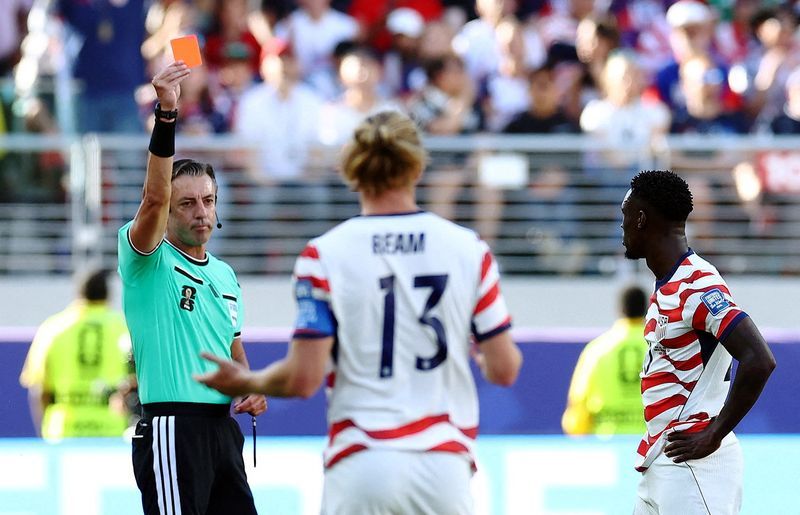
The controversy surrounding American forward Folarin Balogun's eligibility to play in the World Cup despite receiving a red card has prompted serious concerns from England's football establishment about the integrity of international football governance. Howard Webb, head of the Premier League's refereeing operations, and chief executive Richard Masters have both flagged the incident as potentially corrosive to public confidence in how the sport manages discipline and officiating standards. Their warnings carry particular weight given their positions overseeing professional football in England's top division, which begins its new campaign this week with heightened expectations around fair play and consistent rule enforcement.
Balogun's suspension was rescinded following a chain of events that included public intervention by U.S. President Donald Trump, triggering accusations that FIFA's decision-making process lacked transparency and was compromised by external political pressure. The American striker's original dismissal represented one of the tournament's most divisive moments, and the manner in which FIFA subsequently handled his case has raised fundamental questions about how such decisions are made and whether proper procedures were actually followed. Critics noted that the process used to lift Balogun's ban appeared to have been improvised specifically for this situation, raising doubts about whether consistent standards are applied across different cases and nations.
Webb's primary concern extends beyond whether the original red card decision itself was correct. He emphasised that his disquiet stems from the wider message conveyed by how the situation was subsequently managed. The admission that political pressure from a sitting head of state influenced FIFA's handling of the matter represents, in Webb's assessment, a troubling precedent that undermines the principle that sporting decisions should be insulated from governmental interference. This perception becomes particularly damaging in an era where online discourse rapidly amplifies allegations of corruption, with social media enabling unsubstantiated claims about official misconduct to spread instantaneously among millions of users globally.
The ripple effects of such incidents extend well beyond international tournaments into domestic competitions. Webb articulated his concern that the Balogun case provides fuel for those predisposed to view controversial decisions as evidence of systemic corruption rather than genuine mistakes or matters of professional judgment. In the current information environment, where conspiracy theories flourish and bad-faith actors exploit ambiguity to advance their narratives, the legitimacy of football's governing institutions depends heavily on transparent, consistent, and demonstrably independent decision-making processes. When high-profile cases appear to breach these standards, the damage to institutional credibility proves difficult to repair.
Masters lamented that the World Cup discourse has become overshadowed by administrative and political controversy rather than celebrating the quality of football actually displayed. He noted that attention should have remained focused on the Spanish team's compelling performances and England's dramatic semi-final elimination, yet instead the tournament's legacy has become entangled with questions about off-field governance failures. This represents a broader challenge for international football: when disciplinary and administrative matters dominate headlines, they inevitably distract from the sport's fundamental appeal and displace discussion of athletic achievement.
The Premier League executive identified a specific structural weakness in FIFA's disciplinary framework that the Balogun situation exposed. Unlike many domestic competitions, FIFA's regulations contain no mechanism allowing for review and reversal of red card decisions through legitimate procedural channels. This absence created a governance vacuum that essentially forced FIFA to improvise a solution, resulting in a process that appeared makeshift and lacked institutional legitimacy. Masters observed that this regulatory gap made the Balogun controversy essentially incomprehensible to observers accustomed to transparent appeals processes in established sporting bodies. The inability to overturn decisions through proper channels yet somehow managing to do so anyway through opaque means inevitably generates suspicion.
For the Premier League specifically, the timing of this controversy could not be less convenient. As English football's top division prepares to implement an unprecedented set of new laws designed to accelerate play and reduce time-wasting, officials face intensified scrutiny over every marginal decision. Webb acknowledged that with each refereeing and VAR call during the coming season likely to face intense critical examination online and in media coverage, the residual distrust generated by international football's handling of the Balogun case could prove particularly problematic. Fans primed by recent examples of apparent political interference in officiating may interpret even routine enforcement of new rules through a lens of suspicion.
The new regulatory framework Webb outlined involves significantly lower tolerance thresholds for various offences, resulting in more penalties being awarded throughout matches rather than allowing greater latitude for player contact. This shift in enforcement philosophy requires players to adjust their tactical approach substantially, and referees must actively police behaviors that were previously tolerated as normal play. Webb projected that once players adapt their conduct to the stricter standards, the actual frequency of penalisable offences should decline. However, the immediate implementation period will inevitably generate controversy as established patterns of play are disrupted and previously permissible challenges suddenly result in fouls and free kicks.
The challenge for Webb and his refereeing team is maintaining public confidence that penalty awards reflect genuine commitment to the new regulations rather than representing inconsistent application influenced by external factors or biased decision-making. In an environment where trust in official impartiality has been fractured by recent international incidents, every contentious decision will be subjected to intense scrutiny. The Balogun case provides a problematic template: observers will look for patterns suggesting that decisions might be influenced by factors beyond the rules themselves, including the nationalities of teams involved, the prominence of players, or pressure from external actors.
For Malaysian and Southeast Asian observers, these issues carry particular relevance given the region's aspirations toward higher standards of football governance and international competition. The credibility challenges facing FIFA and established football institutions demonstrate how institutional integrity depends fundamentally on transparent processes and demonstrated independence from external pressure. As Asian football develops, building robust regulatory frameworks with clear appeals mechanisms and insulating decision-making from political interference becomes increasingly important for establishing legitimacy. The Balogun controversy offers a cautionary illustration of how shortcuts and improvised solutions, regardless of the intentions behind them, can fatally undermine public confidence in an institution's fairness and independence.
Webb's broader point about the corrosive effect of allowing speculation about corruption to flourish also applies universally across sports and governance contexts. Once suspicion about official impartiality takes root, restoring faith requires not merely demonstrating current integrity but fundamentally restructuring processes to prevent even the appearance of impropriety. The World Cup's disciplinary process, as currently constructed, failed this test. Moving forward, FIFA faces significant pressure to implement genuine reforms that provide transparent mechanisms for addressing exceptional cases while remaining demonstrably insulated from political intervention. Without such changes, each controversial decision will continue to damage the institution's credibility and provide fresh ammunition to those questioning whether football's governance structures can be trusted.

