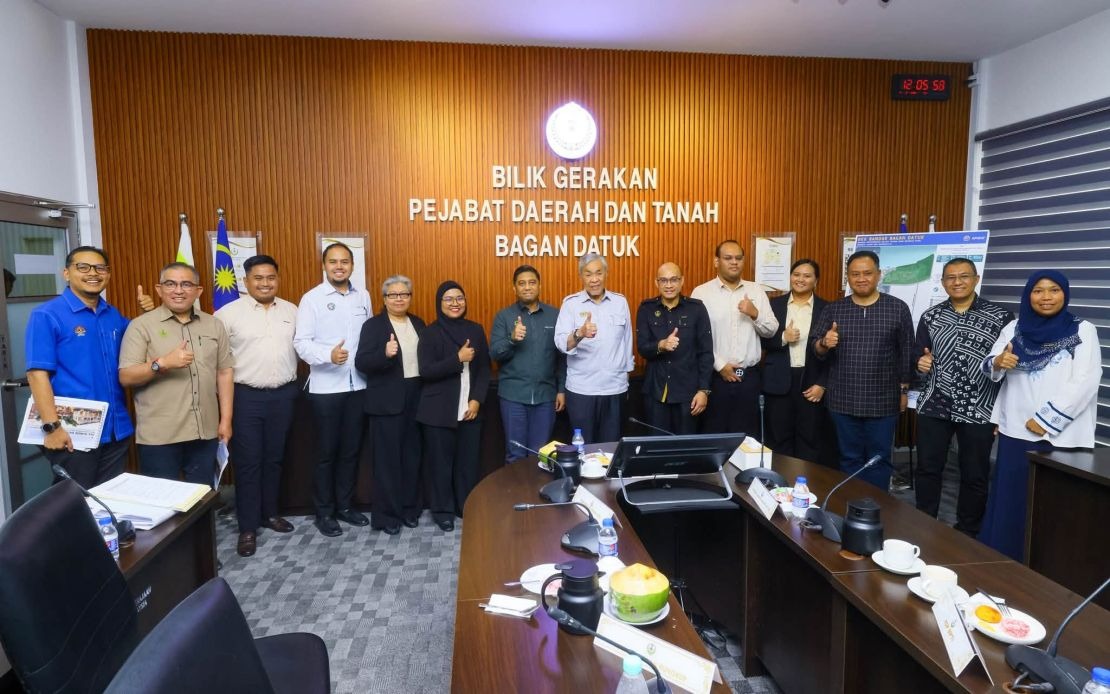
Deputy Prime Minister Datuk Seri Dr Ahmad Zahid Hamidi has laid out a comprehensive vision for transforming Bagan Datuk into a modern, prosperous administrative town that balances urban development with environmental quality. Speaking in Ipoh on August 14, Zahid, who represents Bagan Datuk as Member of Parliament, described the constituency as possessing significant untapped potential that remains crucial to the broader growth trajectory of Perak and the northern region.
Zahid's remarks came during a strategic planning session where he reviewed the special area plan report for Bagan Datuk with representatives from the Teluk Intan Municipal Council, the Bagan Datuk District Office, and the Land Office, alongside the consulting team responsible for the development study. This collaborative approach signals an intention to ground future initiatives in empirical research and multi-stakeholder consensus rather than ad-hoc decision-making. The involvement of multiple governmental bodies suggests the ambition extends beyond cosmetic improvements to encompass systematic urban planning at the district level.
Central to Zahid's vision is the concept of creating what he terms an "administrative town in a park"—a phrase that encapsulates contemporary urban design philosophy emphasizing green spaces, livability, and environmental stewardship. This framing indicates awareness of how modern towns are increasingly evaluated not merely on economic output but on quality of life indicators including public amenities, recreational facilities, and environmental preservation. For Bagan Datuk, a constituency in Perak Darul Ridzuan that has historically been overshadowed by larger urban centres, such positioning could represent a meaningful repositioning within the state's development hierarchy.
The comprehensive development agenda outlined encompasses several interdependent pillars. Infrastructure enhancement stands as the foundational element, recognizing that modern livability depends on functional transport networks, utilities, and digital connectivity. Alongside this, Zahid emphasized the importance of broadening economic opportunities, suggesting intent to diversify beyond traditional sectoral reliance and attract investment that generates sustainable employment. The emphasis on good facilities indicates planned investment in public spaces, healthcare, education, and commercial amenities essential for attracting both residents and businesses.
As a native of Bagan Datuk, Zahid positioned himself as an insider advocate for the district's interests, framing development not as imposed external vision but as fulfilling the genuine aspirations of local communities. This rhetorical stance carries political significance in a Malaysian context where perceived neglect of constituency-level concerns frequently generates electoral discontent. By publicly committing to listen to community needs and ensure planning reflects local priorities, Zahid attempts to preempt criticism that development serves political or corporate interests at the expense of ordinary residents.
The special area plan under review represents a tangible expression of planning ambitions at the district level. Such comprehensive plans typically address land-use zoning, transportation corridors, commercial and residential clusters, environmental protection areas, and infrastructure sequencing. For Bagan Datuk, the development of such a document suggests maturation from ad-hoc projects toward systematic, coordinated urban development. The plan's focus on distinctive character indicates recognition that success in attracting and retaining investment increasingly depends on differentiation—positioning Bagan Datuk as offering something unique within the competitive landscape of Malaysian towns.
From a broader Southeast Asian perspective, initiatives like Bagan Datuk's development plan reflect regional trends toward mid-tier city revitalization. Across the region, secondary cities are receiving increased attention from governments and investors seeking alternatives to congested megapolitan cores. Malaysia's experience with developments like Putrajaya, Cyberjaya, and Iskandar Malaysia demonstrates both the possibilities and pitfalls of managed urban growth. Whether Bagan Datuk can learn from these precedents—avoiding pitfalls such as incomplete implementation, premature commercialization, or social displacement—will largely determine the plan's ultimate success.
Zahid's commitment to ensure that development potential translates into tangible community benefit addresses a legitimate concern in Malaysian development discourse. Numerous projects have generated impressive infrastructure yet failed to deliver proportionate improvements in resident welfare, employment, or social cohesion. The articulation of this principle suggests at minimum an awareness of such critiques, though translating commitment into implementation requires sustained political will and effective coordination across multiple governmental levels and private sector partners.
The timing of this development initiative carries contextual significance within Perak's political landscape. The state has experienced considerable political volatility in recent years, and demonstrating concrete development achievements serves broader strategies of political consolidation and legitimacy-building. For constituents of Bagan Datuk, the promise of planned, comprehensive development may offer tangible reassurance that their district will not remain marginalized within state and national development priorities.
Looking forward, several critical questions will determine whether Bagan Datuk's development ambitions materialize into reality. The adequacy of allocated funding, the clarity and enforceability of planning regulations, the coordination between Teluk Intan Municipal Council and state authorities, and mechanisms for genuine community participation in implementation will all prove essential. Furthermore, the plan's resilience to political changes and economic fluctuations will test whether such initiatives can survive beyond the tenure of individual champions like Zahid.
The evolution of Bagan Datuk from a traditional constituency into a competitive administrative centre would represent significant transformation for the district and its residents. Success would position the town as a model for planned mid-tier urban development in Malaysia, demonstrating that regions beyond the Klang Valley and George Town can attract investment and talent through strategic planning and intentional community-oriented development. Conversely, implementation challenges or compromised execution could reinforce skepticism about whether comprehensive development plans represent genuine commitments or principally serve as political narrative tools. The coming years will reveal which trajectory Bagan Datuk ultimately follows.

