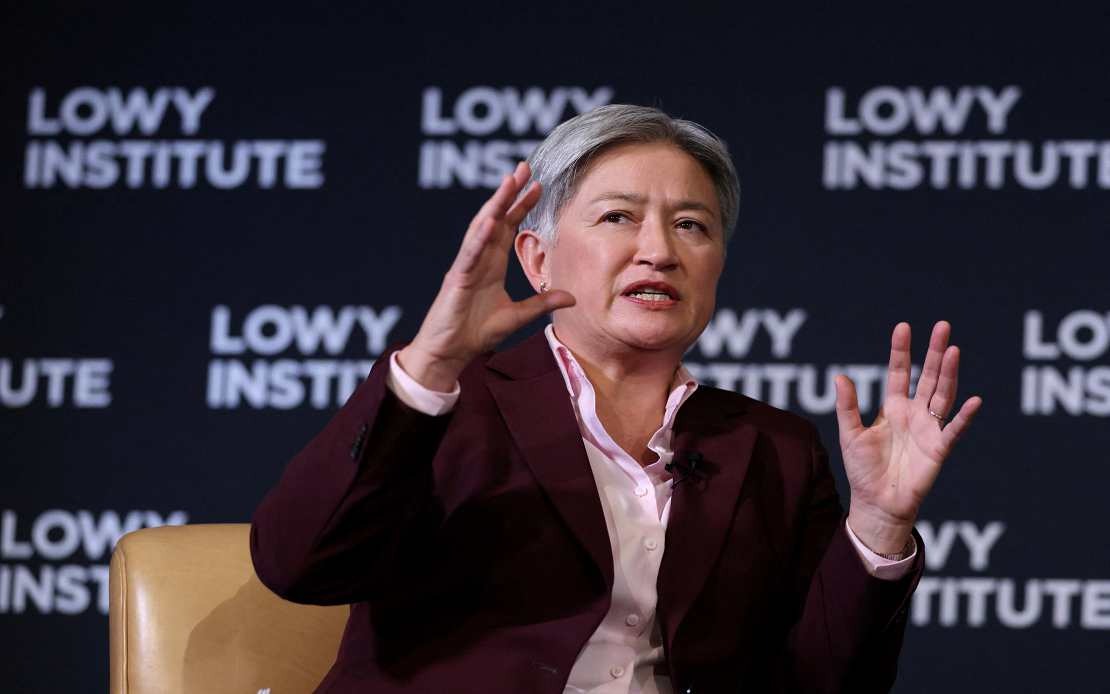
Australia's Foreign Affairs Minister Penny Wong has issued a stark warning that embracing monoculturalism would fundamentally undermine the nation's strength and prosperity, delivering her rebuke during a keynote address at the Lowy Institute in Sydney on Friday. The speech represents a direct challenge to populist Senator Pauline Hanson, whose One Nation party has been gaining considerable traction among Australian voters amid broader concerns about immigration and globalisation.
Wong's core argument rests on the proposition that Australia's entire history has been defined by multiculturalism, making any retreat toward ethnic or cultural homogeneity a betrayal of the country's foundational character. She framed the pursuit of monoculturalism as a "melancholic fantasy," suggesting it reflects a nostalgic and ultimately destructive impulse rather than a coherent governing philosophy. The Foreign Minister warned that such policies would transform Australia into a more divided and unwelcoming society, corroding the social cohesion that has enabled the nation to thrive economically and diplomatically.
The practical implications of Wong's concern become apparent when examining One Nation's stated agenda. Hanson's party has committed to dramatically curtailing immigration levels, slashing foreign aid allocations, and withdrawing from multilateral institutions should it secure electoral victory in the 2028 federal election. These positions represent a fundamental reorientation of Australia's strategic posture in the Asia-Pacific region, shifting away from engagement and toward insularity. For Malaysia and other Southeast Asian neighbours, such a withdrawal would have profound consequences for trade relationships, security cooperation, and regional stability.
Wong's assertion that monoculturalism represents "a call for Australia to curtail our choices and to cut off our connections" speaks directly to Australia's economic interdependence. By looking inward and abandoning international partnerships, Australia would forfeit access to crucial export markets, investment opportunities, and the collaborative frameworks that underpin regional prosperity. In the context of Southeast Asia, where Australia has positioned itself as a partner in economic integration and security arrangements, such retrenchment would create uncertainty and potentially invite competitors to fill the vacuum.
Electoral momentum appears to be shifting decisively in One Nation's favour. A YouGov Australia poll conducted in July revealed that 26 percent of voters now intend to support the party at the next general election, representing a quadrupling of its actual vote share from the 2025 election, when it secured just 6.4 percent nationally. This dramatic surge in polling support suggests that Hanson's messaging around immigration restriction and cultural preservation is resonating with a substantial segment of the Australian electorate, even if actual electoral performance may differ from survey responses.
The political landscape has shifted against the established parties. The governing Labour Party, which won the 2025 election with 34.5 percent of the vote, has seen its support erode to 28 percent according to the July YouGov poll. The conservative Coalition has suffered even steeper losses, falling from 31.8 percent to just 20 percent. This fragmentation of traditional political alignments suggests voters are actively seeking alternative voices and policy platforms, with One Nation successfully positioning itself as an outlet for discontent.
Underlying this electoral volatility is genuine anxiety within the Australian community regarding immigration levels. The annual Lowy Institute poll released in June found that 55 percent of Australians believe the current rate of migration is excessive, compared to 53 percent who held this view in 2025 and 48 percent in 2024. This steady annual increase in negative sentiment toward immigration represents a critical trend that explains One Nation's rising appeal. Rather than dismiss such concerns, Wong's remarks suggest the government must articulate a clearer case for the economic and social benefits of multiculturalism while addressing legitimate anxieties about infrastructure strain and social integration.
The tension between Wong's defence of multiculturalism and the hardening public opinion on immigration highlights a fundamental political challenge facing Australia. While the Foreign Minister emphasises the historical and economic case for openness, substantial portions of the electorate feel their concerns have been inadequately addressed by mainstream political parties. One Nation has effectively weaponised this gap, offering straightforward answers to complex questions about immigration, cultural change, and national identity, even if those answers may rest on questionable premises.
For Malaysia and Southeast Asian nations more broadly, the trajectory of Australian politics carries significant implications. Australia has long positioned itself as a regional power committed to open trade, military cooperation, and diplomatic engagement. A One Nation electoral victory would upend these arrangements, potentially leading to Australian withdrawal from trade agreements, reduced defence cooperation, and diminished commitment to regional security mechanisms such as AUKUS and the Quad. Malaysian policymakers must monitor these developments closely, as a more insular Australia would fundamentally alter the regional balance of power and economic relationships.
Wong's framing of monoculturalism as a weakness rather than a strength attempts to reestablish the positive narrative around Australia's multicultural identity. She argues that diversity generates resilience, economic dynamism, and diplomatic influence—qualities essential for navigating an increasingly complex global environment. Yet this elite perspective may struggle to gain traction with voters who feel culturally unsettled or economically displaced by rapid demographic change. The challenge for the Australian government lies in validating these concerns while defending the multicultural settlement that has served the nation well historically.

