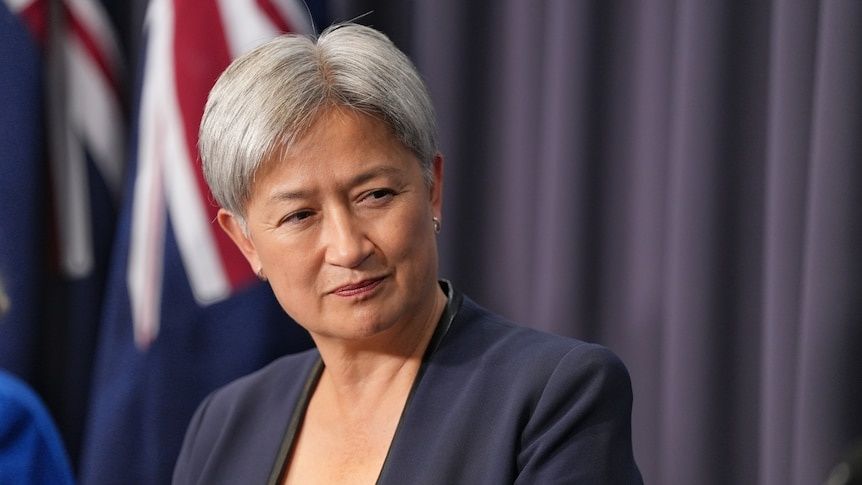
Australia's Foreign Minister Penny Wong will deliver a robust defence of multiculturalism on Friday, positioning it as fundamental to the nation's prosperity and international standing while directly challenging the ascendant far-right One Nation party. Wong, who holds the distinction of being Malaysia's first Asian-Australian to reach federal ministerial rank, plans to tell the Lowy Institute in Sydney that a homogeneous "monoculture" would weaken Australia's strategic position globally and domestically. The speech represents a pointed counteroffensive against rising political pressure from One Nation, which has emerged as Australia's most popular political party according to recent polling and holds potential kingmaker status in the 2028 federal election.
The empirical foundation for Wong's argument rests on demographic reality. Census data demonstrates that half of all Australians were either born overseas or have at least one parent born outside the country, a figure that underscores the nation's fundamentally multicultural composition. Wong will emphasise that "multicultural Australia is the only Australia that has ever existed," framing the nation's diversity not as a recent phenomenon requiring defence but as an established historical constant. This rhetorical positioning proves significant for Southeast Asian observers, as it reframes the debate away from whether multiculturalism represents an aberration and toward whether abandoning it constitutes a fundamental rejection of Australian identity itself.
One Nation's surge in political popularity reflects broader anxieties about immigration, housing affordability, and economic pressures affecting Western democracies. Party leader Pauline Hanson has explicitly advocated for a "monoculture" and has drawn international comparisons to political figures like Donald Trump and Marine Le Pen. Her rhetoric has periodically touched explicitly on Australia's historical White Australia policy, which restricted non-white immigration until the 1970s. This invocation of Australia's discriminatory immigration past has generated significant controversy and underscores the stakes of the contemporary debate about national identity and belonging.
Wong's address will connect Australia's multicultural character directly to its international security interests and economic competitiveness. She plans to argue that pursuing a monoculture would constitute "a call for Australia to curtain our choices and cut off our connections," fundamentally constraining the nation's ability to navigate an increasingly contested strategic environment. This framing proves particularly relevant for Malaysia and the broader Southeast Asian region, where Australia's engagement depends substantially on its credibility as a neighbour committed to inclusive values and regional connectivity rather than ethnic or cultural insularity.
The foreign minister will also highlight concrete examples of multicultural success, pointing to refugees who have established thriving businesses and achieved recognition in sport. These examples serve both an immediate rhetorical purpose and a deeper analytical function: they demonstrate that immigration and diversity generate demonstrable economic and social benefits rather than merely representing an ideological commitment. For regional audiences, Wong's emphasis on practical outcomes rather than abstract principles may prove more persuasive than purely values-based arguments about tolerance and inclusion.
Wong's warning about "external and internal forces" seeking to divide Australia carries particular resonance in the current geopolitical climate. Middle powers like Australia face mounting pressure to choose strategic alignment as great power competition intensifies. Wong plans to argue that Australia's capacity to maintain strategic autonomy and defend its interests depends precisely on the cohesion and resilience that multiculturalism provides. A fragmented society vulnerable to ethno-nationalist or monoculturalist appeals might prove more susceptible to external pressure or manipulation, a concern that extends beyond Australia to affect regional stability across the Indo-Pacific.
The Australian government's broader policy approach seeks to acknowledge legitimate public concerns about housing, economic opportunity, and service provision without capitulating to divisive rhetoric. Prime Minister Anthony Albanese has stated that immigration levels are declining from recent peaks and will be further reduced, but has explicitly rejected approaches that "vilify people" or attempt to divide communities. This positioning represents an attempt to govern the centre while marginalising far-right populism, though polling suggesting One Nation's continued electoral strength indicates the strategy faces significant headwinds.
The government's recognition of genuine economic concerns reflects an understanding that One Nation's political gains stem not merely from xenophobia but from real anxieties about affordability, opportunity, and rapid social change. Immigration policy adjustments therefore represent not capitulation but targeted governance responding to measurable challenges. For Malaysia, where immigration debates also intersect with housing costs and economic pressures, the Australian approach offers instructive parallels about how governments might respond to popular concerns while maintaining commitment to inclusive principles and regional engagement.
Wong's Malaysian heritage adds another dimension to her intervention in this debate. As the first Asian-Australian federal minister, she embodies the reality of successful Asian-Australian integration and leadership that contradicts monoculturalist narratives. Her personal background provides powerful testimony to the argument that multicultural Australia extends opportunities to talented individuals from diverse backgrounds and that this openness constitutes a source of national strength rather than vulnerability. For Southeast Asian audiences evaluating Australia's commitment to regional engagement and partnership, Wong's position and her willingness to defend multiculturalism against far-right pressure offers reassurance about Australia's underlying orientation toward the region.
The timing of this debate carries significance for Australia's regional relationships. Across Southeast Asia, democratic governments face their own challenges from populist movements questioning immigration, religious minorities, and multicultural governance. Australia's articulation of a coherent defence of multiculturalism—connected explicitly to national security, economic prosperity, and international standing—provides a model for regional partners navigating similar political pressures. Conversely, if One Nation's brand of ethno-nationalism continues gaining traction in Australian politics, regional confidence in Australia's commitment to engagement based on shared principles rather than ethnic or religious affinity might erode significantly.

