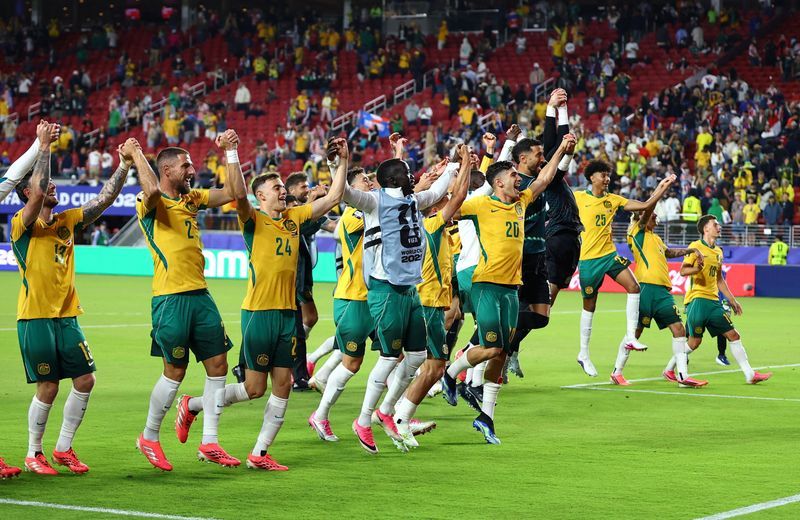
Australia have advanced to the World Cup's round of 32 following a tense, defensive stalemate with Paraguay on Thursday evening in the San Francisco Bay Area, establishing themselves as one of the tournament's more resilient performers despite an underwhelming attacking display. The goalless result at the American venue confirmed the Socceroos as Group D runners-up behind tournament co-hosts the United States, marking their third appearance in the knockout phase since Asia's premier footballing nation began competing in the competition on a regular basis.
The match itself reflected the cautious approach both managers adopted in what amounted to a high-stakes encounter where defensive solidity took precedence over creative ambition. Paraguay, searching for their own pathway through to the next round, mounted an increasingly forceful challenge as the contest progressed, yet Australia's defensive organisation and goalkeeper Mat Ryan's assurance meant the South American side never seriously threatened the Australian goal despite enjoying extended periods of possession in the latter stages. For Paraguay, the result leaves their advancement hopes dependent on whether they can secure a spot among the competition's eight best-performing third-placed teams, a prospect that hinges on results from Friday's concluding Group E and F matches.
Australian coach Tony Popovic signalled his attacking intentions through an ambitious team selection, introducing six changes to the starting lineup that included the energetic Nestory Irankunda and forward Cristian Volpato. The alterations suggested Popovic intended to seize the initiative against opponents he may have viewed as beatable, yet Australia's execution in the final third betrayed their aspirations throughout the ninety minutes. The early period saw the Socceroos dominate territorial possession and create the match's clearest opportunities, with Jackson Irvine firing waywardly when well-positioned inside the box following a Volpato assist, while right-back Jordan Bos, reprised in his unfamiliar position to accommodate the injured Jacob Italiano, drew saves without generating genuine pressure on Paraguay goalkeeper Orlando Gill.
Paraguay's early passivity gradually transformed into purposeful attacking once the interval arrived. Coach Gustavo Alfaro's introduction of Mauricio, a Brazilian-born attacker, at the beginning of the second half signalled a shift in tactical direction, and the South Americans subsequently threatened with greater regularity through the mercurial Julio Enciso, whose darting runs repeatedly carved openings in Australia's defensive structure. Enciso's ability to glide past defenders created the clearest opening for the Paraguayans when his low shot in the eightieth minute whistled narrowly wide of the left post, a miss that proved to represent Paraguay's most authentic scoring opportunity in an otherwise closely-contested encounter.
The closing stages descended into an increasingly frantic, end-to-end affair typical of matches where neither side possessed sufficient confidence or attacking clarity to press for victory. Bos momentarily galvanised the Australian contingent in the crowd when he burst forward from right-back in the eighty-ninth minute, charging past two defenders before dispatching his effort across the goal mouth and beyond the far post. Mauricio provided one final examination of Australian goalkeeper Beach when granted space on the edge of the penalty area, though his tame, rolling shot presented no genuine difficulty for the goalkeeper to claim safely.
Australia's progress to the knockout stage for the first time since their last-sixteen appearance in Qatar four years ago represents a significant achievement for the nation's football programme, particularly given the competitive quality evident throughout this tournament. The Socceroos will now confront the runners-up from Group G, a pool that remains genuinely competitive heading into Friday's fixtures. Egypt and Iran will contest one decisive encounter, whilst Belgium and New Zealand also harbour genuine expectations of progressing, ensuring the Australian side faces a genuine examination of their capabilities in the round of 32.
For Paraguay, uncertainty rather than celebration characterises their position following the draw. The 2010 quarter-finalists, who previously demonstrated their capacity to compete at football's highest levels, must now rely on results elsewhere determining their fate. Should third-placed teams from Groups E and F accumulate fewer than four points, Paraguay's single-point advantage would prove sufficient for advancement. However, the mathematical reality means the South American delegation faces a potentially agonising wait across Friday evening and into the following day as other groups complete their fixtures. The contrast between Australia's definitive progression and Paraguay's precarious standing underscores how closely matched lower-ranked nations remain in modern tournament football, where marginal differences in execution can prove decisive.
For Southeast Asian football observers, Australia's qualification offers encouragement regarding the region's capacity to compete on the global stage. The Socceroos' progression reaffirms that disciplined, tactically mature football can succeed against higher-ranked opposition, a lesson particularly relevant for emerging footballing nations throughout Asia seeking to enhance their competitive standing. Australia's ability to secure advancement whilst playing uninspiring football demonstrates that contemporary international tournaments increasingly reward pragmatism and collective organisation rather than exclusively rewarding attacking flair, suggesting pathways exist for determined nations willing to prioritise defensive solidity and strategic thinking.

