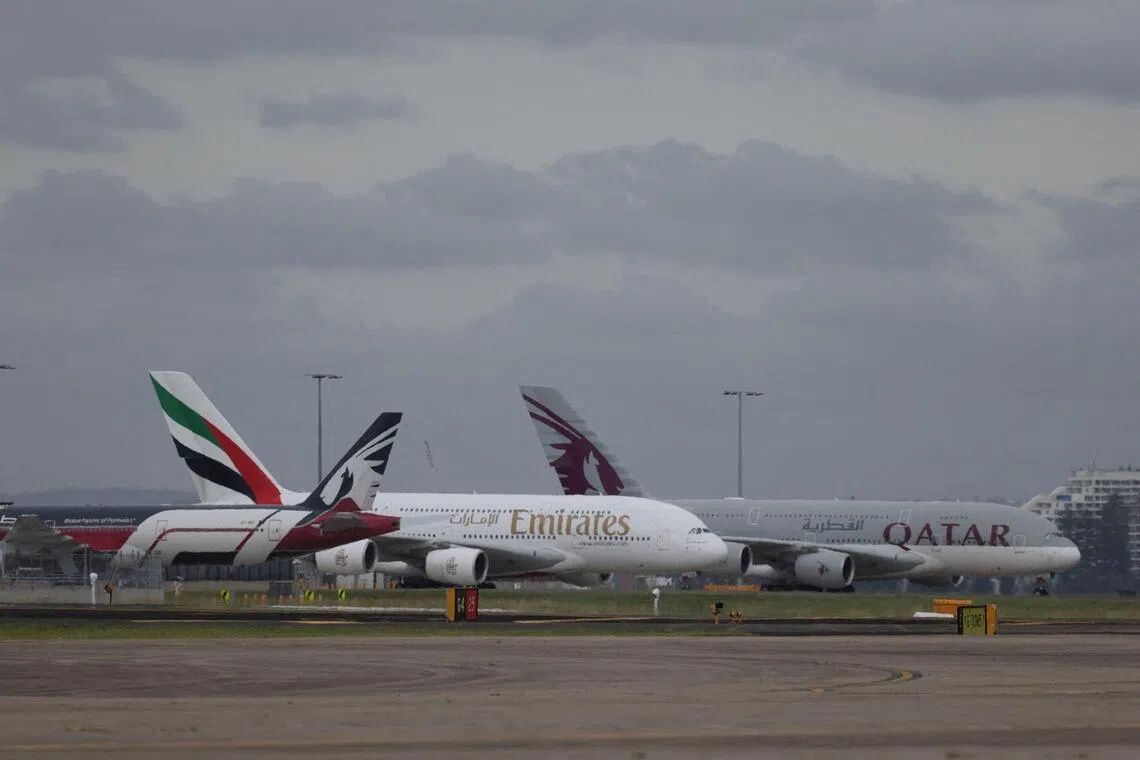
Australia's transport authorities have launched a formal investigation into three serious near-miss incidents at Sydney Airport over a fortnight, underscoring mounting concerns about runway safety and the adequacy of air traffic control operations at one of the country's busiest aviation hubs.
The incidents involved major carriers including Virgin Australia, Qantas, Jetstar, and Qatar Airways. In the most serious event on August 9, a Virgin Australia Boeing 737 was cleared for take-off when its crew spotted a Qantas aircraft crossing the runway directly ahead. The Virgin Australia flight crew executed an emergency stop approximately one kilometre from the other plane, which had also received clearance from air traffic control to taxi across the active runway. Earlier that same morning, a Jetstar pilot was forced to brake abruptly to prevent a collision with a Qatar Airways aircraft. The twin incidents on a single day are particularly alarming, suggesting a potential systemic breakdown rather than isolated human error.
These recent occurrences follow an earlier near-miss involving two Qantas planes on July 27, both of which had been authorised for take-off when they narrowly avoided collision. The compressed timeline of three potentially catastrophic incidents within fourteen days has prompted serious questions about whether Sydney Airport's air traffic control systems are operating safely at current capacity levels. For Malaysian readers familiar with Kuala Lumpur International Airport's operations, the scenario illustrates how even world-class facilities can face critical safety challenges during periods of operational stress.
Angus Mitchell, Chief Commissioner of the Transport Safety Bureau, acknowledged the gravity of the situation while attempting to reassure the flying public. He stated that investigators would examine organisational and systemic factors that may have contributed to the incidents, conducting a thorough analysis of multiple variables. Specifically, Mitchell indicated that the investigation would scrutinise operational intensity at the time of each incident, staffing levels in the control tower, and the broader resource allocation within air traffic control operations. This multi-dimensional approach reflects recognition that such near-misses rarely result from single points of failure but typically stem from converging operational pressures and procedural breakdowns.
One significant concern emerging from the incidents relates to the delayed reporting of safety violations. Questions have surfaced regarding why there was an apparent gap between when the incidents occurred and when they were formally reported to investigators. Mitchell revealed that a supervisory or training situation was underway on August 9, potentially explaining some procedural irregularities on that date. This disclosure raises implications about how training activities interact with live operational traffic, a critical safety consideration that extends beyond Sydney Airport to regional aviation systems across Southeast Asia.
Staffing pressures appear to be a central factor in the investigation. Mitchell acknowledged that Australia is currently experiencing a significant expansion phase in air traffic control recruitment, training, and controller qualification. As international travel demand rebounds strongly across the Asia-Pacific region following pandemic-related disruptions, airports from Sydney to Singapore to Bangkok are facing simultaneous pressure to expand their controller workforce. The challenge of rapidly training and certifying new controllers while maintaining safety standards is becoming a defining issue for regional aviation authorities. Under-resourced training programmes or inadequate supervisory oversight during the onboarding process could create precisely the conditions that preceded these Sydney incidents.
Prime Minister Anthony Albanese has joined the investigation call, elevating the political significance of the safety concerns. In Australia's federal system, aviation safety is a national issue with direct implications for public confidence in essential infrastructure. The involvement of the Prime Minister's office signals that government is taking the matter with appropriate seriousness, though it also suggests that political pressure may now accompany the technical investigation. For Malaysian aviation stakeholders, watching how Australian authorities respond to these incidents provides a case study in how regional peers handle runway safety crises during growth periods.
The incident profile raises particular concern because modern commercial aviation is designed with multiple redundancy systems specifically to prevent runway collisions. That three such incidents occurred within fourteen days, despite both crews and control systems being trained to prevent exactly these scenarios, suggests either degradation in training effectiveness, fatigue among existing staff, or procedural gaps that have not been adequately addressed through recent operational changes. The fact that all three incidents involved aircraft that had received explicit clearance from air traffic control makes the problem more complex than simple controller error—it points toward potential conflicts in clearance procedures or communication protocols.
For the broader Asia-Pacific aviation region, the Sydney incidents carry cautionary lessons. Rapid growth in air traffic, particularly along high-density routes connecting major Asian business hubs with Australian cities, is placing unprecedented demands on regional air traffic management systems. Malaysia's aviation authorities managing the Kuala Lumpur-Sydney route and similar long-haul corridors benefit from Sydney's transparency about these safety challenges. The investigation findings will likely be disseminated through International Civil Aviation Organization channels, influencing how other regional airports review their control tower operations and controller workload assessments.
The investigation will need to determine whether the incidents represent a temporary aberration during a period of staffing transition or whether they signal deeper structural issues with Sydney Airport's air traffic management capacity. If the latter proves true, it could necessitate capacity restrictions during peak periods, reduced flight scheduling, or accelerated investment in air traffic control technology and personnel. Each option carries implications for airlines operating through Sydney and passengers transiting to and from Southeast Asia. Mitchell's commitment to examining all evidence comprehensively suggests the Transport Safety Bureau is approaching the investigation with appropriate rigour, though results may take months to emerge as investigators reconstruct the precise sequence of decisions and communications leading to each incident.

