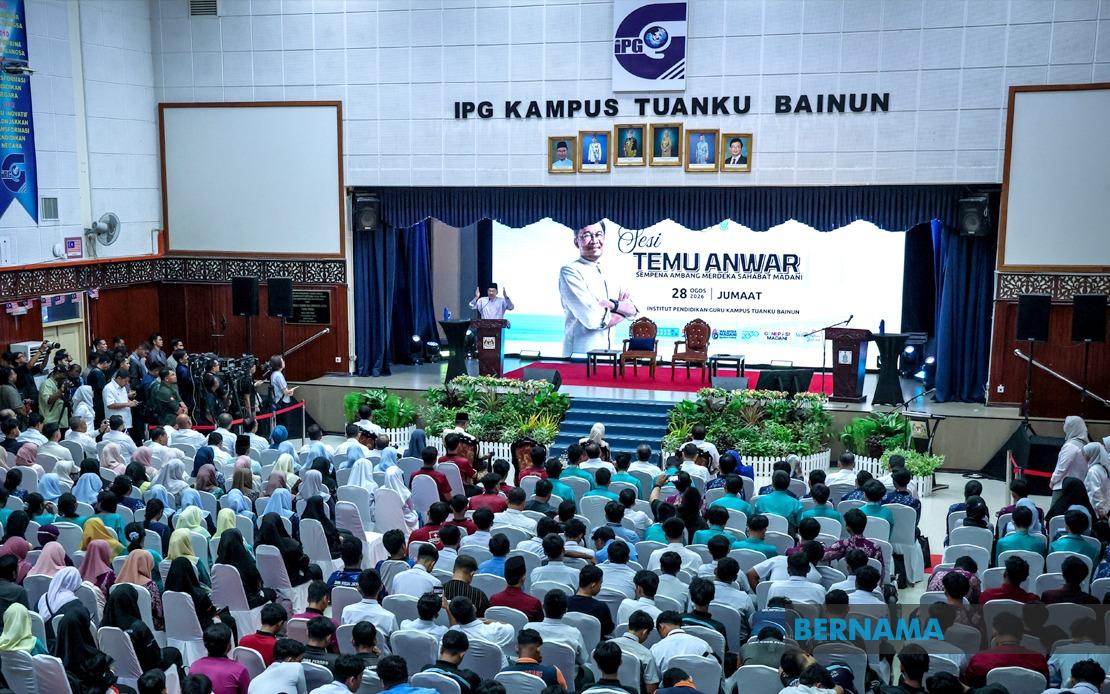
Prime Minister Datuk Seri Anwar Ibrahim has justified the government's decision to repeal the Universities and University Colleges Act 1971 (AUKU) as essential for empowering the nation's youth, emphasising that the decades-old legislation had become incompatible with modern democratic values. Speaking during a Temu Anwar session in Bukit Mertajam on August 28, Anwar argued that the complete abolition of the Act represents a significant shift in the government's approach to higher education governance, removing longstanding restrictions that have constrained student activism and political engagement on campuses since the legislation was first enacted over five decades ago.
The Prime Minister contended that restricting the freedom of expression for university students, who are at least 18 years old and possess voting rights, is fundamentally contradictory to democratic principles. His reasoning reflects a broader philosophical stance that young Malaysians who participate in national elections should equally possess the liberty to articulate their perspectives within academic institutions. By drawing this parallel between electoral participation and campus speech rights, Anwar framed the AUKU repeal not merely as a procedural reform but as a correction of an institutional anomaly that treated legal adults differently within university walls than in the broader political sphere.
Central to the government's rationale for dismantling the AUKU is the conviction that unrestricted student expression serves as a catalyst for intellectual development. Anwar emphasised that fostering creativity, independent judgment, and critical thinking among university students requires an environment where ideas can be openly contested and examined without fear of administrative punishment. This perspective aligns with educational theory suggesting that democratic participation in campus discourse prepares students for informed citizenship and enhances their capacity to analyse complex policy questions affecting Malaysia and the region.
The Prime Minister acknowledged during the interaction with students that permitting free expression does not guarantee the accuracy or wisdom of every statement made. Rather, he framed student freedom as part of a learning process where younger Malaysians develop discernment through exposure to diverse viewpoints and reasoned debate. This nuanced position distinguishes between protecting the right to speak and endorsing the content of speech, a distinction that matters considerably for institutions navigating the transition away from AUKU restrictions.
The historical context of the AUKU cannot be overlooked in evaluating this policy reversal. Enacted during a period when the government prioritised institutional stability and social cohesion above pluralistic debate, the legislation reflected the political assumptions of 1971. Anwar's rhetorical question—why impose restrictions on citizens already permitted to vote—underscores how the regulatory framework has become increasingly misaligned with Malaysia's contemporary governance expectations. The repeal signals that policymakers now view student activism and political engagement as potentially constructive rather than inherently destabilising.
Education Minister Datuk Seri Fadhlina Sidek's presence at the Temu Anwar session underscores the cross-cabinet support for this initiative. Her attendance suggests that the Education Ministry has aligned itself with the Prime Minister's vision of reforming campus governance structures. This institutional cohesion is significant because implementing the AUKU repeal will require coordinated effort across multiple levels of university administration, from policy reinterpretation to staff training on new expectations for student conduct and academic freedom.
The implications for Malaysian universities extend beyond administrative procedures. The removal of restrictions previously imposed on student political organising, campus publications, and public demonstrations may reshape the dynamics of student life and institutional culture. Universities could experience increased political discourse, more visible student organisations with explicit political affiliations, and greater student participation in national policy debates. These developments carry both opportunities and challenges that institutional leaders will need to navigate thoughtfully.
For Southeast Asia more broadly, Malaysia's decision to dismantle the AUKU joins a regional conversation about the proper relationship between state authority and student autonomy in higher education. Countries across the region maintain varying approaches to campus governance, with some maintaining restrictive frameworks and others embracing greater institutional autonomy. Malaysia's move toward liberalisation may influence regional discussions about balancing national stability concerns with the educational benefits of unfettered intellectual exchange.
The student who posed the question during the Temu Anwar session about entering politics exemplifies precisely the type of civic engagement the Prime Minister wishes to encourage. By demonstrating receptiveness to such inquiries and articulating a clear vision for student political participation, Anwar signals that the government views young people's political aspirations not as threats to be suppressed but as natural expressions of citizenship that merit institutional support and facilitation. This reframing of student activism as potentially legitimate and valuable represents a meaningful departure from the regulatory philosophy embedded in the AUKU.

