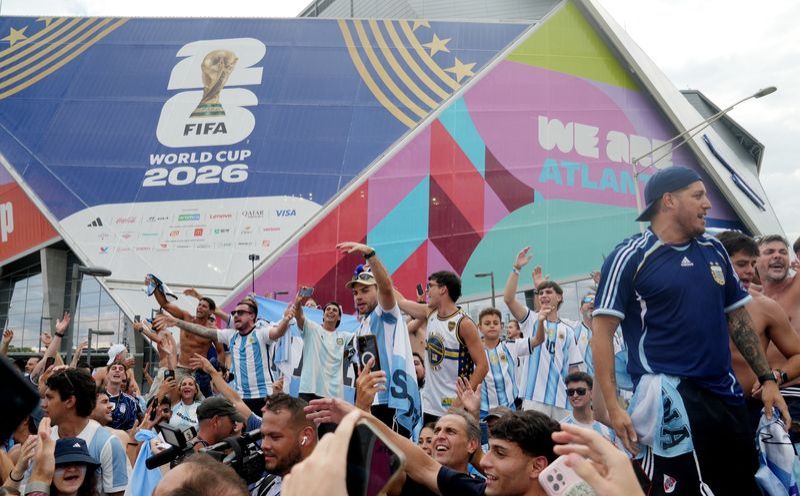
The month-long FIFA Women's World Cup transformed Atlanta into a global football celebration, with the southeastern city playing host to eight fixtures spanning group play through to the semi-finals. From Cape Verde's tournament debut to England's dramatic victory over DR Congo, and Argentina's pair of comeback performances that eventually propelled them to the final, Atlanta witnessed some of the competition's most compelling moments. The final semi-final on Wednesday delivered particular drama when Argentina staged a memorable rally to overtake England, etching another unforgettable chapter into the tournament's Atlanta narrative.
For a metropolis renowned globally as a epicentre of hip-hop culture and music, the World Cup temporarily rewrote the city's soundtrack. In place of the urban beats that typically define Atlanta's streets, supporters from across the world introduced a kaleidoscope of chants, songs and pageantry that transformed public spaces and the football stadium itself. This collision of cultures and sporting passion created an atmosphere that resonated well beyond the stadium walls, fundamentally altering how both visitors and long-time residents experienced their city during those weeks.
Atlanta's trajectory toward hosting this prestigious tournament began years earlier. In July 2017, Dan Corso, president of the Atlanta host committee, received an email inviting the city to pursue World Cup hosting rights. Rather than deliberate extensively, the committee moved with remarkable speed. "We had a couple of quick meetings and jumped right in," Corso recalled in an interview. This decisive action reflected the city's existing credibility as a football destination and its institutional capacity to execute major international events.
The foundation for Atlanta's successful bid rested significantly on the emergence of Atlanta United as a Major League Soccer franchise. Established nine years before the World Cup, the team had transformed local sporting culture and elevated the city's profile within global football circles. Arthur Blank, owner of both Atlanta United and the NFL's Falcons, invested substantially in football infrastructure, donating $50 million to the U.S. Soccer National Training Center located just outside the metropolitan area. This combination of professional excellence, community engagement and institutional commitment positioned Atlanta as a credible candidate among competing American cities.
Atlanta United's on-field success proved particularly persuasive during FIFA's selection process. The club's championship victory in 2018, combined with its consistent leadership in MLS attendance figures, demonstrated that football genuinely resonated with local audiences. "Not to mention the fact that they lead the MLS in attendance every year. That really raised our soccer profile and I think that resonated with FIFA when we were going through the selection process," Corso explained. Furthermore, U.S. Soccer's decision to establish its national governing body base in Atlanta added another dimension to the city's football credentials, signalling institutional commitment alongside grassroots enthusiasm.
Atlanta's experience hosting major international sporting events provided additional confidence in its capability. The city previously hosted the 1996 Olympic Games, though it missed selection as a venue for the 1994 FIFA Men's World Cup. The Super Bowl returns to the city's stadium in 2028, marking the fourth occasion Atlanta will stage the NFL's championship game. This recurring role as a premier international sports destination demonstrates the city's organisational sophistication, venue quality and logistical capacity to manage complex multi-week events with global audiences.
The World Cup's local impact extended far beyond match days. Over 19 days, the official Fan Fest attracted more than half a million attendees, creating extended engagement opportunities for those unable to secure match tickets. More than 2,000 Atlantans and Georgians volunteered throughout the tournament, representing substantial community participation and investment in the event's success. These figures underscore how thoroughly the competition permeated Atlanta society, transforming it from an outsider's spectacle into a shared civic experience.
Across eight matches that collectively drew 544,516 spectators, the tournament delivered consistently engaging football. The knockout rounds progressively elevated competitive intensity, culminating in Wednesday's semi-final thriller where Argentina's comeback against England provided the sort of dramatic narrative that international football generates at its finest. Such moments create enduring memories for attendees and viewers alike, establishing emotional connections between cities and the sport that persist long after tournaments conclude.
Beyond the immediate tournament experience, Corso emphasised the broader significance of World Cup hosting for Atlanta's international reputation. "I truly believe it will provide some type of memory or even a connection, for people who have not been here for some time, or ever," he stated. International visitors gained exposure to Atlanta's complexity and diversity, potentially reshaping external perceptions of a city often stereotyped within popular culture. Such reputational enhancement carries practical benefits for tourism, business attraction and cultural influence extending well beyond football.
The tournament catalysed concrete infrastructure improvements with lasting community benefit. The host committee, working alongside MARTA, the local transportation authority, and Soccer in the Streets, a community programme, established a new mini-pitch providing free football access to local children. This legacy initiative embodies how major sporting events can generate positive social outcomes when properly structured, extending benefits beyond professional athletes and wealthy spectators to underserved populations.
Atlanta's hunger for additional football honours appears unsatisfied by the 2023 tournament. The city will welcome a new National Women's Soccer League franchise commencing operations in 2028, coinciding with the Super Bowl's return. Beyond this immediate expansion, Atlanta has officially entered its pursuit for hosting the 2031 FIFA Women's World Cup, seeking another opportunity to position itself as a destination for women's football. These ambitions reflect Atlanta's transformation into a city where football now occupies a permanent place within its sporting identity and economic development strategy, a remarkable shift for a metropolis that remains primarily associated with other sports and cultural traditions.

