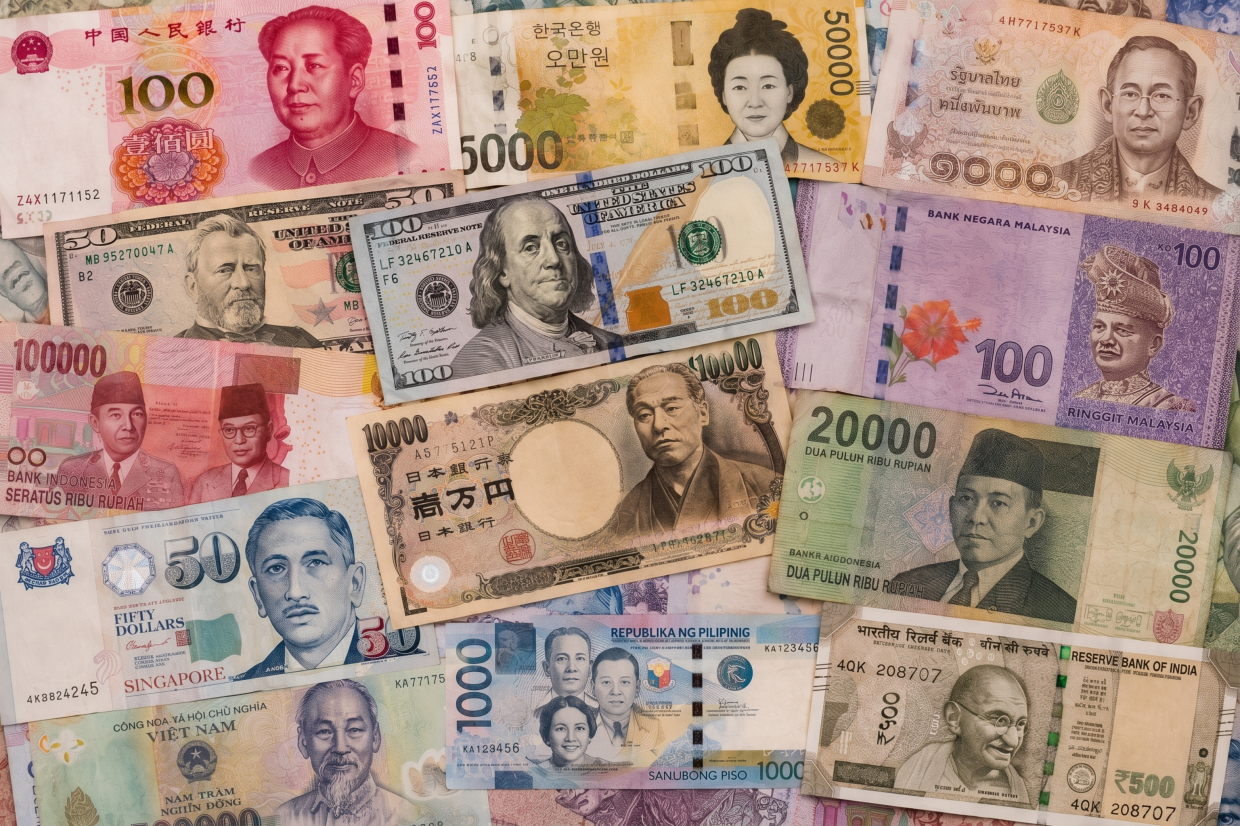
Asian financial markets convulsed on Monday under the dual pressures of geopolitical instability in the Middle East and mounting concerns about inflationary momentum, creating a challenging environment for regional policymakers and investors alike. The renewed outbreak of regional tensions in the Gulf saw crude oil prices jump four percent, catalysing a broad-based retreat across emerging Asian currencies as traders reassessed inflation risks and braced for the possibility of more aggressive monetary tightening from central banks worldwide. The U.S. dollar strengthened accordingly, advancing against a basket of major currencies as investors sought the safety of America's reserve currency in the face of mounting uncertainty.
The impact rippled across emerging Asia's currency markets with particular force. Indonesia's rupiah touched 18,140 to the dollar, marking its weakest level in more than a month as investors repositioned their regional exposure downwards. South Korea's won depreciated to 1,507.9 per dollar, reflecting broader risk-aversion sweeping through Asian financial centres. Malaysia's ringgit retreated to 4.0780 against the greenback, though the currency had already faced headwinds from deepening political uncertainty at home that promised to complicate the government's economic management in coming months.
South Korea bore the brunt of equity market turmoil, with the KOSPI benchmark index suffering a precipitous 7.96 percent decline that sent it to a ten-week trough. The primary culprit was a dramatic thirteen percent selloff in SK Hynix, the globally dominant chipmaker specialising in high-bandwidth memory essential for artificial intelligence infrastructure. The sharp reversal followed the company's impressive U.S. market debut on Friday, as fund managers crystallised gains following the recent euphoria surrounding AI-related equities. The volatile single-stock exchange-traded funds popular among Korean retail investors exacerbated the downward momentum, amplifying daily price swings and triggering mandatory circuit breaker halts designed to cool trading fervour.
Underlying the sharp correction in semiconductor stocks lies a more fundamental anxiety about the sustainability of extraordinary profit growth that has underpinned the AI boom. Investors increasingly question whether demand for memory chips will justify the historically elevated valuations now assigned to manufacturers, and whether the hyperscaler companies driving procurement will continue their aggressive spending trajectories or adopt more disciplined capital allocation. These structural doubts have weighed heavily on chipmaking equities across the region recently, despite South Korea's benchmark remaining among the world's best performers with a sixty-three percent gain since the beginning of 2024.
The KOSPI's current twenty-five percent decline from its June 22 record close underscores the tension between long-term bullish views on AI-driven growth and short-term concerns about valuation and earning sustainability. Highly leveraged derivative products magnify these moves, creating additional volatility that can intimidate international investors and complicate efforts by the Bank of Korea to manage broader financial stability.
Malaysia confronted a distinct challenge as political instability threatened to undermine the macroeconomic confidence that has supported the ringgit's relative resilience compared to regional peers. Prime Minister Anwar Ibrahim's coalition suffered a crushing defeat in Saturday's Johor state election to what had previously been considered a key government ally, an outcome that exposed fractures within the ruling bloc and sparked speculation about an imminent snap general election. The electoral setback and subsequent coalition turbulence created a new political risk premium that filtered into currency and equity valuations, even as Malaysia's underlying economic fundamentals remained supportive of longer-term stability.
Goldman Sachs analysts cautioned that continued uncertainty surrounding the federal coalition's durability and the government's capacity to maintain consistent economic policymaking could erode the "policy-stability premium" that has underpinned Malaysian asset valuations. The investment bank acknowledged, however, that Bank Negara Malaysia's June initiatives to encourage foreign exchange inflows should provide some protective cushion against excessive ringgit depreciation. The central bank's policy toolkit, combined with Malaysia's solid macroeconomic position, could help contain currency volatility even if the domestic political situation remains fluid and concerning to overseas investors.
Elsewhere across the emerging Asian landscape, equity market responses proved more muted. Stocks in the Philippines edged modestly higher, while Indonesia's benchmark gained 0.5 percent, suggesting that the full force of Gulf-related anxiety concentrated more heavily in the region's larger and more developed market centres. Taiwan's stock index declined slightly, while Singapore's exchange snapped a remarkable seven-day streak of record closings with a 0.7 percent retreat, indicating that even the region's safest havens were not immune to the broader risk-off sentiment.
The week ahead promises several important catalysts that will shape how regional assets perform in coming days. Investors will scrutinise Singapore's second-quarter economic growth figures for advance estimates, the latest U.S. inflation data that will influence Federal Reserve expectations, and South Korea's central bank rate decision, all of which carry implications for regional monetary policy trajectories. Malaysia's own inflation print and preliminary economic output data will provide crucial signals about domestic price pressures and growth momentum at a particularly sensitive moment for confidence in the government's economic stewardship.
The convergence of external shocks and domestic political fragility creates a complex backdrop for Malaysian and Asian policymakers. While short-term currency weakness and equity volatility may prove temporary as markets digest the latest headlines, the underlying questions about sustainable AI-driven growth, inflation dynamics, and the durability of regional political coalitions will likely preoccupy investors for months ahead. For Malaysian officials, the challenge will be demonstrating that coalition instability and electoral setbacks need not translate into policy incoherence or macroeconomic deterioration, a task that requires both political discipline and clear economic messaging to reassure international capital markets.

