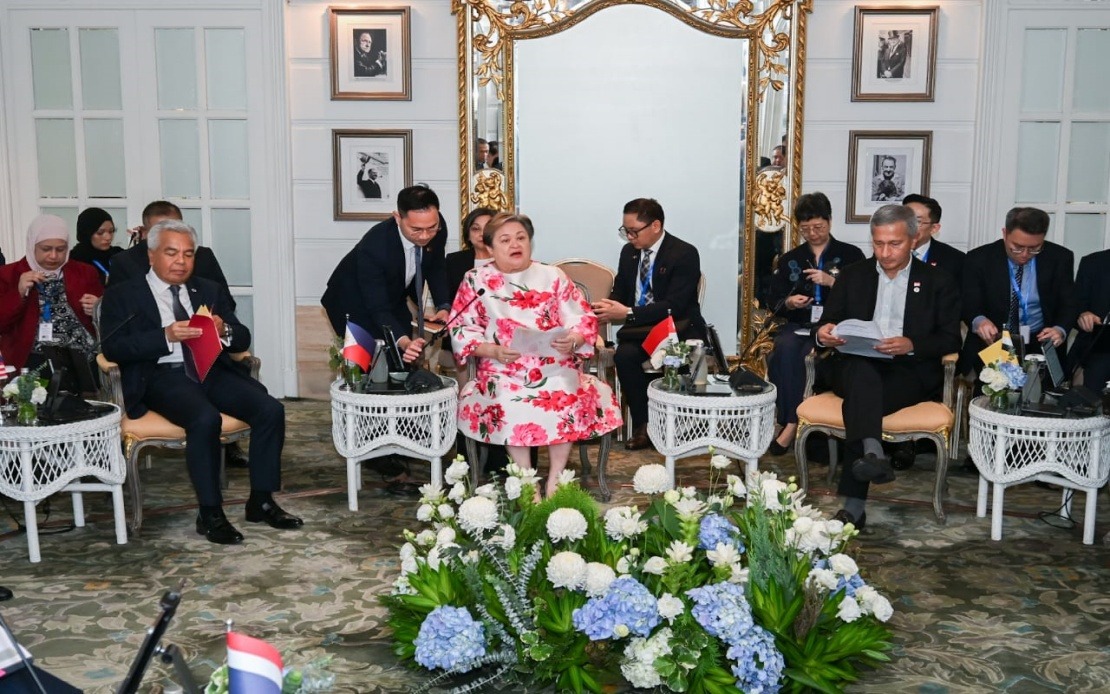
ASEAN's commitment to resolving Myanmar's political crisis through its Five-Point Consensus remains unwavering, even as the Southeast Asian bloc confronts stiffening resistance from Naypyidaw. At a crucial ministerial gathering in Bangkok on Sunday, regional foreign ministers reaffirmed that this framework, adopted in April 2021, constitutes the bedrock of their engagement strategy with Myanmar's military government and all relevant stakeholders. The consensus, which calls for immediate cessation of violence, inclusive political dialogue, humanitarian assistance, and mediation through an ASEAN Special Envoy, has become the litmus test for measuring progress on an issue that increasingly threatens ASEAN unity and regional stability.
Philippine Foreign Secretary Maria Theresa Lazaro, acting as the ASEAN Chair's Special Envoy on Myanmar, conveyed an unambiguous message about regional resolve. Speaking at a joint press conference with Thailand's Foreign Minister Sihasak Phuangketkeow, she stressed that ASEAN members stand collectively behind the Five-Point Consensus regardless of Myanmar's stance towards it. This declaration comes at a particularly sensitive moment, as Myanmar's parliament passed a motion last week formally rejecting the peace plan—a move that underscores the deepening chasm between the military junta and the international community. Rather than viewing this rejection as a dealbreaker, Lazaro and her colleagues have shifted focus towards concrete implementation measures that might gradually pressure Naypyidaw toward compliance.
The ministerial meeting, the first in-person gathering between ASEAN foreign ministers and their Myanmar counterpart since the February 2021 coup, represents both a diplomatic breakthrough and a test of ASEAN's often-criticized strategy of constructive engagement with authoritarian neighbours. By maintaining dialogue channels despite Myanmar's intransigence, ASEAN seeks to preserve its relevance as a mediating force while avoiding the isolation that might render it powerless. However, this balancing act grows increasingly precarious as the humanitarian situation deteriorates and political prisoners languish in detention. The presence of Malaysia's Foreign Ministry Secretary-General Tan Sri Amran Mohamed Zin at the meeting, alongside representatives from most ASEAN states, underscores the region's continued investment in finding a peaceful resolution.
Three specific expectations emerged from the talks, each addressing a critical dimension of Myanmar's crisis. First, ASEAN aims to significantly expand humanitarian assistance channels, with the Philippine Chair planning a dedicated mission to explore mechanisms for increasing aid delivery to vulnerable populations. This focus reflects growing international concern over the humanitarian toll of ongoing violence and economic collapse. Second, the bloc has called for a demonstrable reduction in violence directed at civilians, recognizing that military operations continue to drive displacement and casualties across the country. Third, and perhaps most ambitiously, ASEAN has pressed for inclusive political dialogue that would foster national reconciliation and create space for releasing political prisoners—demands that directly challenge the junta's monopoly on power.
Thailand's position as host and facilitator of the meeting adds particular significance to its framing of ASEAN's approach. Sihasak emphasized that the regional bloc's policy of calibrated engagement functions as a two-way street, requiring reciprocal commitment from Myanmar's government. This language suggests growing frustration with one-sided diplomacy; ASEAN has repeatedly extended olive branches only to encounter closed fists. The Thai Foreign Minister's comment that implementing the Five-Point Consensus requires a clear strategic roadmap, rather than mere affirmation, hints at internal discussions about whether existing approaches have become insufficient. Thailand's own internal complexities—including its historically close ties to Myanmar and its strategic interests in border stability—make its diplomatic leadership particularly consequential.
The question of timelines looms large in ASEAN's Myanmar strategy. When pressed on whether the bloc had imposed deadlines for Myanmar to address its concerns, Sihasak indicated that progress would be assessed at the ASEAN Summit scheduled for later in the year. This delayed accountability mechanism reflects ASEAN's characteristic preference for patience and non-interference, yet it also risks appearing toothless to external observers. For Malaysia and other members, the absence of firm benchmarks raises questions about how ASEAN will ultimately measure success or acknowledge failure. The regional organization's credibility depends partly on demonstrating that dialogue produces tangible improvements rather than simply delaying accountability indefinitely.
Myanmar's parliamentary rejection of the Five-Point Consensus, delivered through an official motion last week, represents a significant escalation in the junta's defiance of regional consensus. This move signals that Naypyidaw increasingly views ASEAN mediation as an unwelcome constraint on its sovereignty and military operations. For Malaysian policymakers and others across Southeast Asia, the rejection underscores the limits of constructive engagement when a government views its survival as contingent on maintaining absolute control. The junta's intransigence raises difficult questions about whether ASEAN members will eventually need to consider stronger measures, including targeted sanctions or support for alternative stakeholders, to influence Myanmar's trajectory.
The diplomatic dynamics within ASEAN itself merit scrutiny. Cambodia's absence from the ministerial meeting, combined with the broader alignment of most members around the Five-Point Consensus framework, suggests reasonably cohesive regional positioning on this issue. However, underlying tensions persist regarding how far ASEAN should go in pressuring one of its own members. Some nations, particularly those with significant economic ties to Myanmar or strategic concerns about Chinese influence in the country, may resist more assertive interventionism. Malaysia's consistent participation in these discussions reflects its broader commitment to ASEAN mechanisms and regional stability, even as bilateral relations with Myanmar remain complicated by shared maritime boundaries and economic interests.
The humanitarian dimension of ASEAN's approach addresses the most visible and undeniable consequence of Myanmar's political impasse. With the health system collapsing, agricultural production disrupted, and millions facing food insecurity, the need for expanded assistance has become urgent. However, delivering aid into a country controlled by a military government determined to prevent aid from reaching opposition areas presents logistical and ethical dilemmas. ASEAN's humanitarian mission, when undertaken, will need to navigate these complexities while maintaining pressure for political progress. For countries like Malaysia with significant Myanmar diaspora populations and refugee communities, the humanitarian stakes extend beyond abstract regional interests to affect citizens directly.
The broader implications for Southeast Asia extend beyond Myanmar itself. How ASEAN handles this protracted crisis will shape the organization's role in future regional disputes and its credibility with major powers. The United States, European Union, and other external actors increasingly question whether ASEAN's patient diplomacy can produce meaningful outcomes when one party shows no inclination toward compromise. Conversely, ASEAN's commitment to maintaining dialogue, even under difficult circumstances, reflects a philosophical approach to regional problem-solving rooted in the organization's founding principles. For Malaysian readers and policymakers, understanding this tension between principle and pragmatism remains essential to evaluating regional stability.
Moving forward, ASEAN faces mounting pressure to demonstrate that its Five-Point Consensus strategy can generate concrete results rather than simply providing cover for inaction. The assessment at this year's ASEAN Summit will prove critical in determining whether the bloc maintains its current diplomatic course or pivots toward more assertive measures. Myanmar's government, for its part, appears gambling that ASEAN's institutional constraints and diversity of interests will prevent unified action regardless of Naypyidaw's behaviour. This calculus may prove correct, but sustained defiance carries risks, including potential international isolation and deepening humanitarian catastrophe. For Malaysia and other regional members committed to both ASEAN unity and Myanmar's eventual stabilization, the months ahead will test whether dialogue without consequences can ultimately produce meaningful change.

