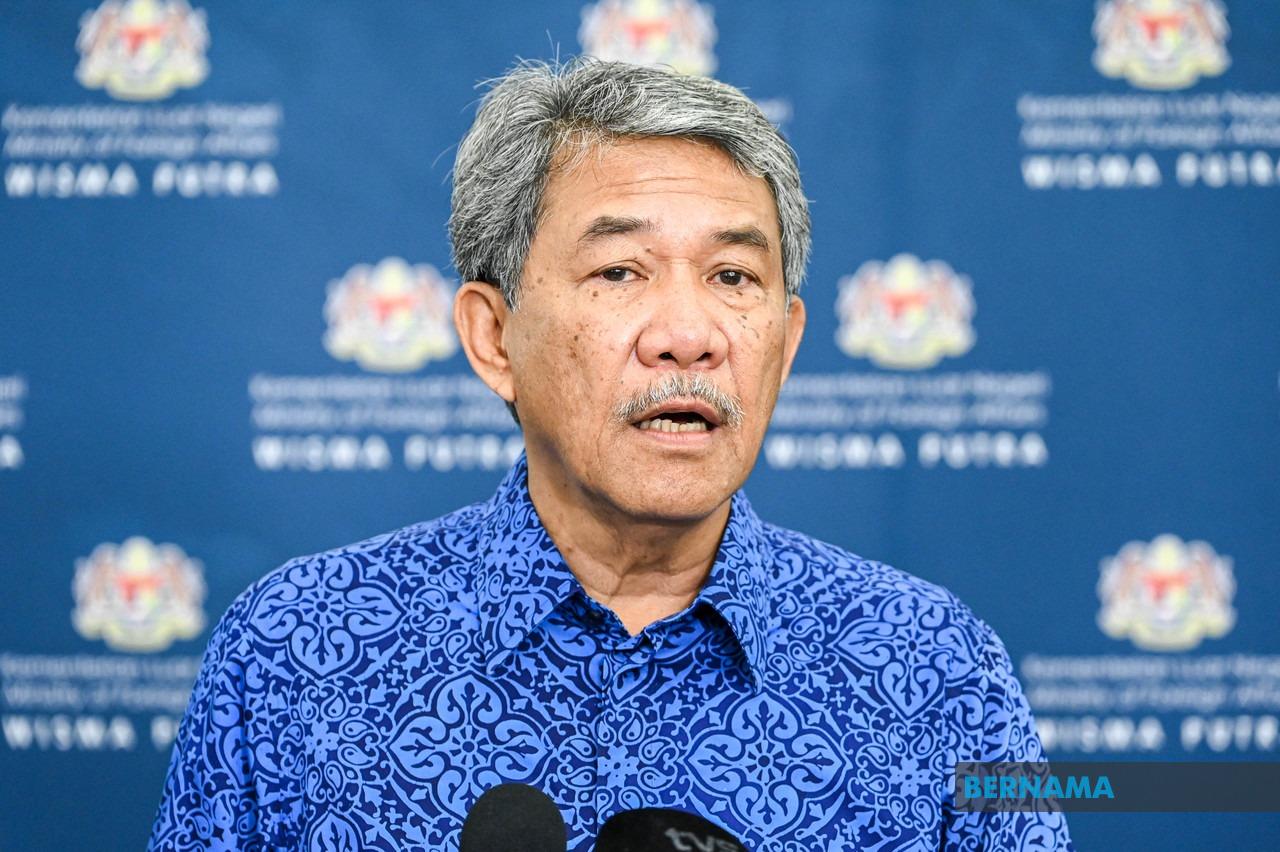
Malaysia's Foreign Minister Datuk Seri Mohamad Hasan has sounded a clarion call for ASEAN to defend its strategic autonomy as the pillars of the international system crack under strain from major power rivalries and geopolitical fracturing. Speaking at the 59th ASEAN Day celebration in Putrajaya on Monday, Mohamad described the current moment as uniquely challenging, characterised by unprecedented fragmentation that extends far beyond traditional diplomatic friction to encompass competition for economic dominance and the visible unravelling of multilateral frameworks. The bloc's foundational principle of centrality—the notion that ASEAN itself should remain the driving force in shaping regional outcomes rather than being shaped by external powers—has become more vital than ever precisely because the global environment that once supported such autonomy is rapidly destabilising.
Mohamad underscored a crucial distinction: ASEAN's centrality is not an inherent right that member states can take for granted, but rather a privilege that must be actively maintained and continuously reinforced through collective discipline and political will. This framing reflects growing anxieties within the bloc that internal divisions, compounded by external pressure from rival powers seeking to expand their influence, could gradually erode the very foundation upon which ASEAN's effectiveness rests. The Foreign Minister's language—describing the world as increasingly complex, analytical, and unpredictable—captures the disorientation many Southeast Asian policymakers feel as Cold War-style bifurcation resurfaces alongside novel forms of technological and economic competition that complicate traditional alliance structures.
The minister portrayed ASEAN's commitment to regional integration and multilateral cooperation as the stabilising anchor that has enabled decades of relative peace and prosperity across Southeast Asia. By positioning itself as a champion of open, inclusive, and rules-based engagement rooted in justice, ASEAN has historically carved out space to manage relations with multiple great powers without becoming subordinate to any single one. However, this balancing act is growing precarious. As China, the United States, India, and other powers increasingly resort to zero-sum competition and strategic decoupling in key sectors, ASEAN's preferred approach of remaining everyone's partner while committing fully to no one faces mounting pressure from all sides. Powers demand clearer allegiances precisely when ASEAN's strategic value derives from its ambiguity and flexibility.
Mohamad stressed that the bloc must function as an agent of strategic change rather than a passive observer of global reordering. This requires ASEAN not merely to react to shifts initiated by external powers but to proactively shape the norms, rules, and institutions that govern regional behaviour. The emphasis on ASEAN punching above its weight by expanding partnerships signals recognition that the bloc's influence flows partly from its ability to attract diverse suitors competing for access to Southeast Asian markets, resources, and geopolitical positioning. Yet this strategy only succeeds if member states negotiate from positions of strength and equality rather than desperation, ensuring that engagement occurs on ASEAN's terms rather than those dictated by more powerful interlocutors.
A critical challenge that Mohamad obliquely acknowledged is the vulnerability created by internal fragmentation within ASEAN itself. The bloc cannot afford to display visible disunity when confronting major powers, as such fissures invite external manipulation and undermine collective bargaining power. Recent years have witnessed instances where member states have pursued divergent foreign policy approaches—particularly regarding China, Myanmar's political crisis, and maritime disputes—that have tested ASEAN's vaunted consensus-based decision-making processes. The Foreign Minister's warning that member states cannot allow internal divisions to weaken collective influence reflects anxiety that ASEAN could splinter into competing factions aligned with rival great powers, fundamentally destroying the centrepiece of its strategic architecture.
The digital economy has emerged as a crucial frontier for ASEAN's next growth phase, and Mohamad identified the ASEAN Digital Economy Framework Agreement as a priority initiative that could simultaneously deepen regional integration while enhancing competitiveness against external players. This reflects strategic thinking that sees economic interdependence within ASEAN as reinforcing political cohesion and shared interests. By binding member economies more tightly through digital infrastructure, cross-border e-commerce, and technology standards, ASEAN hopes to create incentives for maintaining unity even when geopolitical pressures mount. The modernisation of trade agreements with China, India, and South Korea demonstrates ASEAN's intent to remain economically engaged across the region while avoiding exclusive alignments.
Mohamad's emphasis on embedding sustainability at the core of ASEAN's economic strategy reflects recognition that climate change and energy security represent emerging challenges that transcend traditional power competition. The acceleration of the ASEAN Power Grid exemplifies how regional cooperation on green energy can simultaneously advance environmental objectives, attract investment, and strengthen long-term resilience. For Malaysian policymakers and readers across Southeast Asia, this positioning carries particular resonance given the region's vulnerability to climate impacts and its dependence on energy imports. By framing sustainability not as a constraint but as an economic opportunity, ASEAN seeks to maintain momentum on integration even as geopolitical headwinds intensify.
The organisational history Mohamad referenced—from the 1967 Bangkok Declaration through successive enlargements culminating in Timor-Leste's admission in 2024—underscores ASEAN's historical trajectory of expansion and inclusivity. This evolution matters because it demonstrates the bloc's capacity to absorb new members and navigate complex admission processes while maintaining its core principles. However, the admission of Myanmar during political crisis and the continued challenges of ensuring compliance with ASEAN's standards for governance and human rights illustrate the tensions between the expansion of membership and the maintenance of cohesion around shared values. For Malaysia and other members, the question of how to enforce standards while respecting sovereignty remains perpetually vexing.
The theme selected for 2026—"Navigating Our Future Together" under Philippine chairmanship—encapsulates ASEAN's aspiration to remain a unified entity even as individual members pursue divergent national interests. Implicit in this framing is acknowledgment that the decade ahead will test ASEAN's resilience as never before. The geopolitical environment shows no signs of stabilising; if anything, great power competition will likely intensify across multiple domains including technology, military capabilities, and influence over Southeast Asian development trajectories. ASEAN's success in maintaining centrality will depend on whether member states continue prioritising collective interests over individual great power relationships and whether the bloc can innovate institutional mechanisms that deepen integration without sacrificing the sovereignty that member states jealously guard.
For Malaysia specifically, supporting ASEAN centrality carries direct implications. As a founding member with significant regional influence and close ties to multiple great powers, Malaysia plays an outsized role in shaping whether ASEAN remains a cohesive bloc or fractures into competing camps. Malaysian diplomacy that bridges divides, facilitates consensus-building, and reminds other members of their shared interests will be essential to ASEAN's survival as a meaningful force. The challenge lies in balancing this regional role with Malaysia's own national security concerns and economic dependencies, a balancing act that will only grow more delicate as external pressures mount.
Mohamad's speech ultimately represents both a reaffirmation of ASEAN's foundational commitments and an implicit acknowledgment that those commitments face unprecedented strain. The existence of such statements themselves—repeated iterations of ASEAN solidarity and centrality—perhaps suggests some anxiety that the consensus may be slipping. By invoking these principles at the 59th ASEAN Day celebration, Malaysia's Foreign Minister sought to reinforce them precisely when they appear most at risk. Whether ASEAN can translate rhetoric into sustained institutional practice remains the fundamental question shaping Southeast Asia's strategic future.

