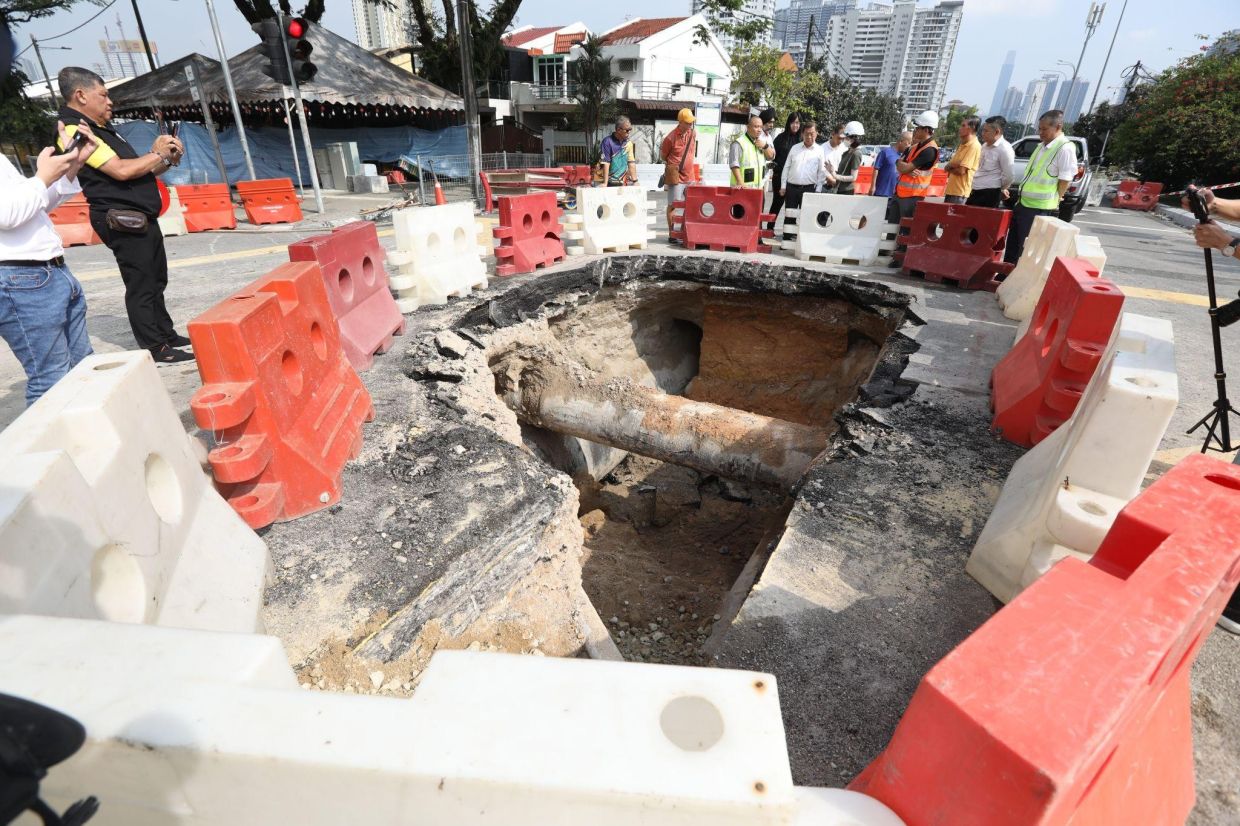
Malaysia's increasingly unpredictable weather patterns are creating fresh challenges for the nation's underground sewerage infrastructure, with sinkholes emerging as a growing concern as rainfall becomes more frequent and severe. The phenomenon, which has attracted heightened public attention and concern from infrastructure managers, stems from a complex interplay of natural geological processes, construction activities, water dynamics and the deteriorating condition of ageing pipes that underpin the country's sanitation systems. Understanding these mechanisms is crucial for residents and policymakers alike, particularly as climate variability threatens critical urban infrastructure that millions depend upon daily.
Sinkholes do not emerge from a single cause but rather result from multiple contributing factors working in concert beneath the surface. Natural geological conditions create inherent vulnerabilities in certain areas, while underground water movement can gradually weaken soil composition. Construction activities and vibrations from heavy traffic can compromise structural integrity, yet the most pressing culprit for Malaysian cities remains the state of subsurface sewerage networks themselves. Each incident presents a distinct technical puzzle, requiring thorough investigation to pinpoint root causes before remedial action can be undertaken effectively.
Indah Water Konsortium, the national sewerage services provider, operates one of the region's most extensive underground infrastructure networks, managing approximately 22,500 kilometres of public sewer pipelines spanning the Malaysian peninsula. Within this vast system, particular vulnerability concentrates in the large reinforced concrete trunk sewers measuring 600 millimetres in diameter and above. These critical conduits, which form the backbone of urban sanitation, typically operate at or near maximum capacity, subjecting them to exceptionally high flow velocities and prolonged exposure to hydrogen sulphide gas—a corrosive compound that progressively degrades concrete structures and accelerates the timeline toward potential failure.
The mechanical stress operating within these major sewers represents only part of the deterioration puzzle. Hydrogen sulphide accumulation, generated through biological processes within the waste stream, creates an acidic environment that chemically attacks the concrete matrix itself. Over decades, this combined assault of mechanical pressure and chemical corrosion steadily weakens pipe walls, creating hairline fractures that eventually propagate into more serious structural failures. For IWK, managing this invisible deterioration process requires constant vigilance and preventive intervention rather than reactive emergency repairs.
Recognising these risks, IWK has adopted a sophisticated risk-based asset management approach designed to identify vulnerabilities before they manifest as public safety hazards. The company deploys advanced inspection technologies including Ground Penetrating Radar, closed-circuit television crawler systems, push rod cameras and pole-mounted equipment, selecting tools based on site-specific accessibility and operational constraints. This periodic assessment regime allows engineers to map the precise condition of critical sewer assets across the network, establishing maintenance priorities based on actual deterioration patterns rather than guesswork or arbitrary schedules.
When inspections reveal defects or structural compromise, IWK implements rehabilitation strategies ranging from trenchless sewer lining—a non-invasive technique that reinforces pipes from within—to complete pipeline replacement in cases of severe damage. These interventions restore structural integrity to ageing infrastructure and significantly reduce the probability of catastrophic failures that could endanger public safety or damage surface infrastructure. The financial and social costs of sinkhole incidents, which can close major roads, damage buildings and potentially cause injuries, create a compelling business case for preventive spending on network renewal and maintenance.
IWK Chief Executive Officer Narendran Maniam has articulated the multifaceted threat posed by extreme weather to underground infrastructure in increasingly urgent terms. Heavy rainfall destabilises ground conditions, causing soil to shift and potentially displacing or misaligning sewer pipes—a seemingly subtle movement that can trigger blockages, breaks and cascading system failures. The sheer volume of water generated during intense storms creates surge pressures within pipes that exceed their design parameters, causing cracks, bursts and severe leaks that necessitate expensive replacement rather than simple repairs.
Saturated ground loses structural strength, compounding the vulnerability of ageing pipes already stressed by decades of operation. When compromised pipes shift, crack or fail beneath increasingly waterlogged soil, the surrounding earth becomes mobilised and washed away into expanding underground cavities. As these subterranean voids grow progressively larger, the ground above loses support and eventually collapses suddenly into a sinkhole—a dramatic failure that creates immediate hazards for public safety, damages roads and undermines buildings and nearby infrastructure. This cascading failure sequence demonstrates why prevention through proactive maintenance proves far more cost-effective than managing crises after they occur.
The entry of large volumes of stormwater into sewer networks through cracks, joints and compromised manholes represents an underappreciated threat multiplier. Older pipes, particularly vulnerable to such infiltration, experience additional hydraulic loading that exceeds their operational design. This water ingress places extreme pressure on systems already operating near maximum capacity, accelerating deterioration and increasing the probability of failures. The cumulative stress from both internal wastewater flows and external groundwater infiltration creates conditions where structural failure becomes not a question of if but when, absent intervention.
To strengthen its institutional readiness for managing sewerage emergencies in an era of intensifying extreme weather, IWK recently conducted a comprehensive crisis simulation exercise at its Asian Sewerage Training, Research & Innovation Centre of Excellence facility. The scenario modelled a major sinkhole incident involving casualties and suspected damage to a large trunk sewer pipeline, requiring activation of the full emergency response architecture spanning multiple government agencies. The exercise tested operational team mobilisation protocols, crisis management decision-making, inter-agency communication and coordination involving the Fire and Rescue Department, Royal Malaysia Police and other relevant authorities.
These drills serve a practical purpose beyond theoretical preparation. They expose gaps in procedures, clarify chain-of-command ambiguities and test the actual feasibility of coordination between organisations that rarely interact outside genuine emergencies. The findings from IWK's exercise will feed directly into enhanced crisis management standard operating procedures, ensuring employees understand their specific roles and maintain preparedness for rapid, effective responses during actual incidents. This institutional learning approach, grounded in simulation rather than relying on ad-hoc improvisation during real crises, represents best practice in emergency management and significantly improves outcomes when disasters strike.
The imperative for infrastructure resilience has shifted from optional best practice to necessity as Malaysian weather patterns exhibit greater extremes and unpredictability. Through continuous asset assessment, targeted rehabilitation, rigorous testing of emergency protocols and sustained collaboration with disaster response agencies, IWK aims to maintain a sewerage system that remains not merely functional but genuinely resilient against the intensifying environmental stresses of the twenty-first century. For Malaysian communities, this commitment translates into reduced sinkhole incidents, safer roads, protected property and the continued reliable delivery of essential sanitation services that underpin public health and urban functionality.

