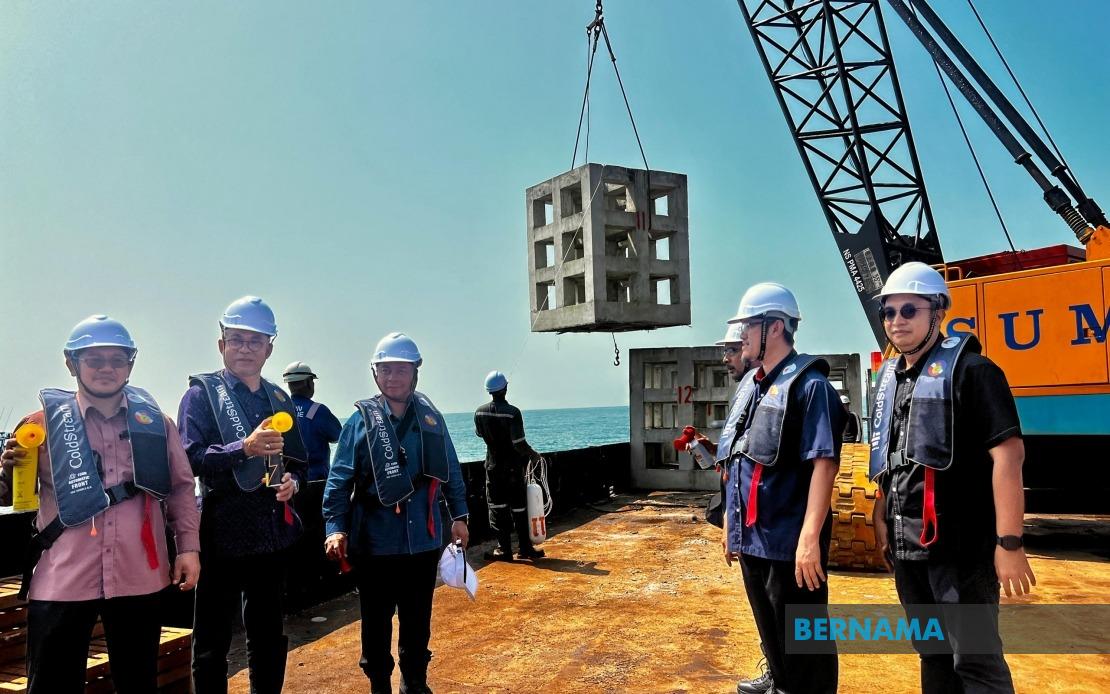
The Kelantan Fisheries Department is leveraging an innovative marine conservation strategy to shield coastal fishing communities from industrial-scale incursion. Thirty newly installed artificial reef structures, positioned approximately 4.6 nautical miles off the Tok Bali Jetty, represent the state's latest effort to reclaim and safeguard traditional fishing grounds whilst simultaneously rehabilitating marine ecosystems. The initiative, funded through a donation by Sultan Muhammad V, addresses a persistent challenge facing Southeast Asian fisheries: the tension between small-scale coastal operators and large commercial vessels seeking access to resource-rich shallow waters.
Artificial reefs function as multifaceted interventions within marine policy. Beyond their conventional role as fish habitat generators, these structures physically obstruct the operation of industrial fishing gear. Kelantan Fisheries Department director Ismail Ibrahim explained that the reef configurations cause nets and trawl equipment to snag and become entangled, effectively rendering encroachment economically unfeasible for larger vessels while posing minimal inconvenience to traditional fishermen employing hook-and-line or smaller-scale methods. This passive deterrent mechanism operates continuously without requiring active enforcement, reducing the surveillance burden on already stretched maritime authorities throughout the region.
The ecological dimensions extend beyond immediate protection of fishing rights. When reef structures stabilise on the seabed, they create complex physical environments that attract juvenile fish species and provide secure breeding zones. Fish populations congregating around these artificial habitats experience reduced predation pressure and improved feeding opportunities during critical early life stages. For coastal communities dependent on consistent fish landings, this translates into more abundant, predictable catches over the medium to long term. Ismail noted that tangible improvements in reproductive success typically materialise within six months, though the timeline depends heavily on local oceanographic conditions and how quickly native species colonise the new structures.
Kelantan's deployment programme reflects cumulative institutional learning. Since 2007, the state's fisheries department has installed approximately 400 artificial reefs across four distinct locations, with an additional 72 units scheduled for phased deployment throughout the current year. This steady expansion indicates genuine commitment to scaling what initially appeared as experimental intervention into systematic marine management. The progression from isolated reef installations to coordinated, landscape-level deployment suggests the department has gathered sufficient evidence regarding effectiveness and is now positioning itself to address the encroachment problem across multiple vulnerable coastal zones simultaneously.
For Malaysian policymakers and neighbouring Southeast Asian governments facing analogous pressures, Kelantan's approach offers practical lessons. The region's small-scale fisheries employ millions and remain economically vital for coastal livelihoods, yet they face systematic disadvantage against technologically superior industrial competitors. Artificial reefs represent a low-cost, technologically straightforward intervention requiring neither advanced equipment nor sophisticated surveillance infrastructure. Unlike restrictive licensing schemes or military enforcement, which often trigger political backlash, reef deployment operates through environmental modification rather than regulatory prohibition, potentially generating broader acceptance among fishing communities.
The initiative also demonstrates creative deployment of royal patronage toward tangible development outcomes. Sultan Muhammad V's financial contribution channels resources directly into fisheries conservation whilst strengthening institutional capacity within the state department. This model of directed royal support for sectoral development might gain replication across other Malaysian states where traditional fishing communities seek more robust protection against industrial encroachment. The political economy of such initiatives matters considerably, as interventions framed as heritage preservation and community protection typically mobilise support more effectively than those emphasising environmental conservation alone.
Maintenance and monitoring emerge as critical components often overlooked in reef deployment literature. Kelantan's fisheries department conducts regular cleaning operations to remove accumulated fishing debris, lost nets, and tangled rope from reef surfaces. Without such intervention, detritus accumulation would gradually degrade habitat quality and potentially create navigation hazards. The commitment to systematic maintenance suggests institutional understanding that artificial reef projects represent long-term commitments rather than one-time interventions. For other Southeast Asian governments considering similar programmes, the resource implications of perpetual monitoring and maintenance deserve careful budgetary consideration.
The spatial distribution of Kelantan's reefs warrants examination. Positioning reef clusters within five nautical miles of the coast deliberately targets the shallow-water fishing grounds most accessible to small-scale operators whilst remaining far enough offshore to require substantial additional effort for industrial vessels to justify operation. This strategic placement maximises protection for traditional fishermen whilst minimising market distortion for larger-scale operators who possess genuine competitive advantages in deeper waters. The 4.6 nautical mile placement off Tok Bali specifically targets one of Kelantan's most productive small-scale fishing zones, suggesting the department prioritised intervention in areas experiencing most acute encroachment pressure.
Food security dimensions underpin the broader rationale for this initiative. Malaysia's fisheries sector contributes substantially to domestic protein supply, and any degradation of small-scale fishing productivity threatens nutritional outcomes for lower-income coastal populations dependent on affordable, locally-sourced fish. By protecting coastal fish stocks and enhancing breeding conditions, artificial reef programmes directly support nutritional security alongside livelihood protection. This intersection of economic and food security objectives strengthens the case for continued investment and potentially attracts international development financing from agencies focused on sustainable food systems.
Looking forward, Kelantan's programme invites examination of scalability across maritime Southeast Asia. Thailand, Vietnam, Indonesia and the Philippines all confront comparable pressures from industrial fishing expansion into artisanal zones. Each country possesses shallow coastal ecosystems capable of supporting artificial reef installation. Adoption of Kelantan's model, adapted to local oceanographic and socioeconomic conditions, could provide a relatively cost-effective mechanism for protecting millions of small-scale fishermen whilst simultaneously restoring degraded marine habitats. Regional coordination on reef deployment standards and monitoring protocols might further amplify effectiveness, creating cross-border marine management frameworks that address shared challenges in fisheries sustainability.
The Kelantan initiative ultimately reflects pragmatic coastal governance balancing competing claims on limited marine resources. Rather than pursuing prohibitive approaches that risk social conflict, artificial reefs offer an environmentally constructive intervention generating benefits across ecological restoration, livelihood protection, and food security simultaneously. As Southeast Asian governments grapple with intensifying maritime pressures, such innovative approaches warrant serious consideration and continued investment.

