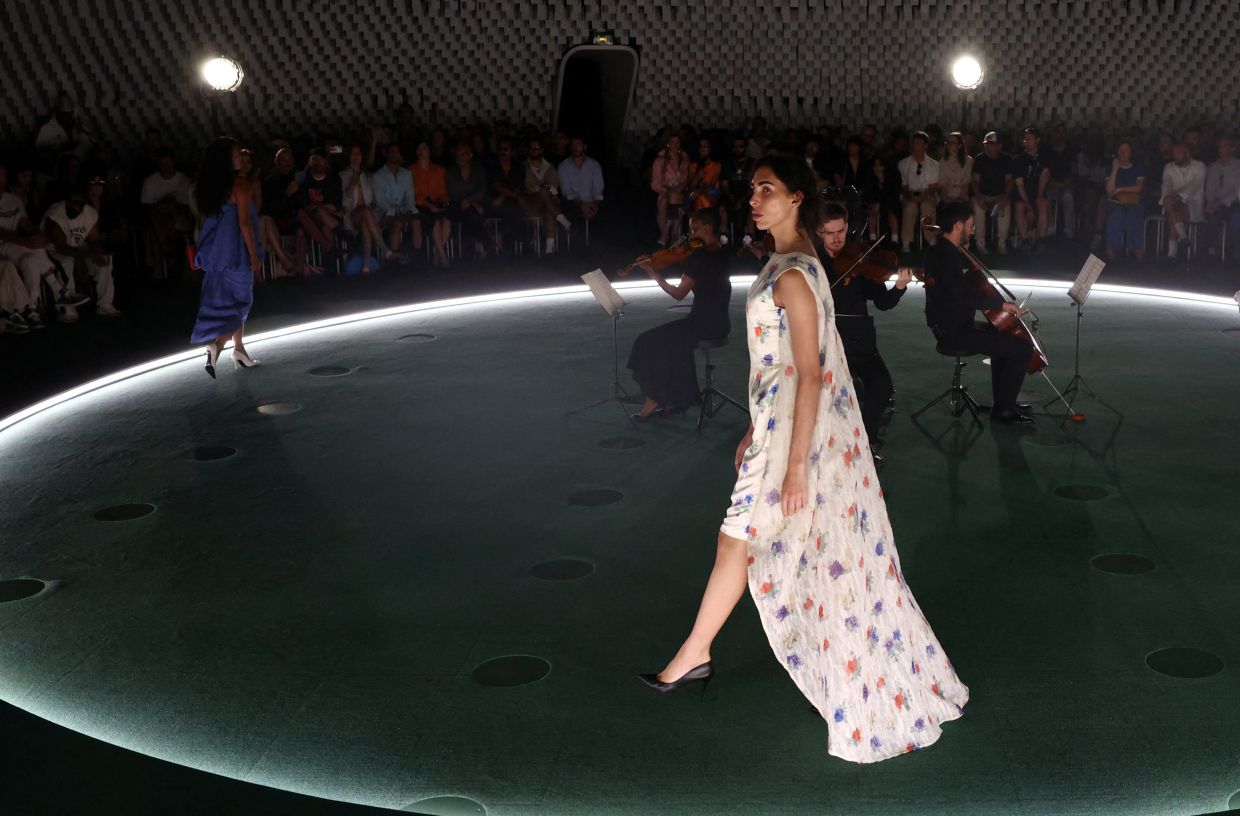
The world is increasingly embracing sleeveless fashion, and the numbers tell a striking story. According to Cognitive Market Research, the global sleeveless apparel market is expected to nearly double in value, expanding from US$24.36 billion (approximately RM99.38 billion) in 2021 to over US$51.39 billion (RM209.65 billion) by 2033. Fashion search engine Tagwalk reported a 133 percent surge in sleeveless designs featured across Spring 2026 collections compared to Spring 2025, signalling that this is far more than a fleeting seasonal preference. Designer Willy Chavarria, who prominently showcased sleeveless pieces during Paris Fashion Week, observed that "the past two seasons our sleeveless has outperformed sleeved substantially", reflecting what industry insiders already know: the armless silhouette has become the dominant aesthetic.
Multiple factors are driving this shift, and the most pressing is environmental. As summers grow increasingly intense across the globe, including Southeast Asia where heat and humidity are year-round challenges, consumers naturally gravitate toward designs that demand less fabric and offer greater breathability. The fitness movement has further accelerated the trend, with gym culture and the celebration of toned physiques making bare arms feel aspirational rather than transgressive. Perhaps most significantly, evolving gender norms have recalibrated what women can and should wear in public and professional spaces, dismantling old taboos about female flesh. You need only watch contemporary news broadcasts to observe that female anchors routinely appear in sleeveless dresses, normalising a look that would have been considered scandalous in newsrooms barely a decade ago.
Yet despite—or perhaps because of—sleevelessness becoming mainstream, many women remain deeply ambivalent about the trend. The question of whether to bare one's arms is not merely a fashion choice; it is entangled with complex psychological, social, and temporal anxieties that deserve serious examination. Women who resist the sleeveless aesthetic often do so for reasons that extend far beyond personal preference or style inclination. Understanding why requires unpacking the relationship between arms, age, gender expression, and professional acceptance.
Arms occupy a peculiar position in the female body hierarchy. Decades of marketing, media representation, and casual social conditioning have trained women to view their arms—particularly the upper arms—with suspicion and shame. Even within contemporary discussions of body positivity and self-acceptance, arms remain conspicuously overlooked, treated as acceptable sites of insecurity even as other body parts are celebrated. Yet arms communicate far more than skin texture; they reveal chronological age in ways that modern medicine has learned to conceal elsewhere. While cosmetic procedures and rigorous fitness regimens can preserve or transform the face, neck, and décolletage, the arms tell an unforgiving story. The loosening of tricep skin, the accumulation of soft tissue at the armpit, the way ligaments and muscles shift with age—these changes are difficult to disguise and impossible to ignore.
This anxiety about arm exposure has historical and gendered dimensions that run surprisingly deep. For centuries, professional norms dictated that women's arms should be covered, particularly in workplace settings. The unspoken logic held that visible arms were somehow provocative or insufficiently serious. Only in 2017 did the United States House of Representatives formally change its dress code rules, prompted by a "sleeveless protest" in which congresswomen deliberately wore sleeveless dresses to challenge the restrictions. The Senate took an additional two years to follow suit. The delayed institutional acceptance reveals how recently and reluctantly professional America accepted female arms as legitimate in positions of power and authority.
The case of former United States First Lady Michelle Obama provides a particularly instructive example of how fraught the politics of female arms have been. Her well-documented preference for sleeveless dresses became a flashpoint for public debate that was both scandalised and racialised. When her first official White House portrait was unveiled—featuring her in a sleeveless sheath dress—the ensuing discourse revealed how deeply invested observers remained in policing what women wore and, by extension, what women's bodies should display. Some deemed it inappropriate; others championed it as empowering. The fact that such a straightforward fashion choice generated significant cultural commentary underscores the burden that sleevelessness carries for women, especially those in the public eye.
Beyond age and history, arms represent a paradox in gendered body politics. Arms are conventionally coded as markers of strength and capability—biceps are colloquially called "guns", after all. Yet for decades, women whose arms displayed visible musculature were derided as unfeminine or overly masculine. This double standard created an impossible bind: arms that were too soft seemed weak or aging, while arms that were too defined seemed threatening or mannish. Contemporary fashion's embrace of sleevelessness does offer an opportunity to escape this trap, but only if women feel secure enough to take it.
Designers and industry voices increasingly acknowledge that sleevelessness need not be an all-or-nothing proposition. Antonin Tron, creative director of Balmain, articulated a refreshingly progressive perspective when discussing the issue: "I think the ageing body can be beautiful. There is this idea that women's sexuality stops when they get older, and I don't agree with that." This sentiment opens space for a more nuanced approach to the trend. Rather than either fully capitulating to or resisting sleevelessness, women can engage with it strategically and thoughtfully.
Practical styling strategies can help ease the transition into sleeveless dressing for those who feel apprehensive. Beginning with subtle experimentation—pairing a simple sleeveless top with a bold necklace or statement bangles to redirect visual attention—allows a gradual acclimation to arm exposure without the shock of full commitment. Hybrid styles offer a middle ground: cold-shoulder tops, open-arm designs, or cap sleeves provide partial coverage while maintaining contemporary visual interest. For those seeking additional coverage, sheer or transparent layering pieces can create a visual buffer without the heaviness of full sleeves. Armhole construction matters significantly; a high-cut but relaxed armhole flatters most body types and avoids the unflattering pulling or gaping that poorly proportioned sleeveless pieces often produce.
Ultimately, the sleeveless debate crystallises a larger question about how women relate to their own bodies across the lifespan. Arms, it bears noting, are repositories of lived experience and capability. They have delivered presentations and lifted children; they have moved boxes and furniture; they have typed emails and documents; they have embraced loved ones and earned the means for independence. Viewed from this functional and emotional perspective, arms deserve visibility and appreciation rather than concealment and shame. The sleeveless trend, for all its complexity and the discomfort it may trigger, presents an opportunity to reconsider whether covering arms was ever truly necessary or whether it was simply another mechanism through which women were encouraged to minimise themselves. Whether a woman chooses to embrace sleevelessness or not, the decision should emerge from confidence rather than capitulation to either fashion dictates or internalised anxieties.

