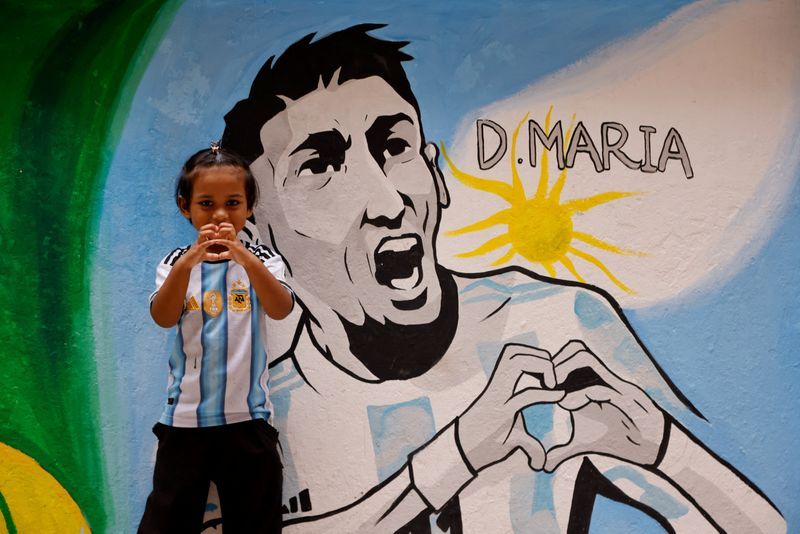
Argentina and Switzerland will meet once more in the World Cup knockout stage on Saturday in Kansas City, Missouri, bringing with them the weight of history and the ghost of a dramatic encounter from over a decade ago. The last time these nations collided in the tournament's latter stages, Angel Di María's extra-time goal in Sao Paulo proved decisive in breaking Swiss resistance and propelling Lionel Messi's Argentina toward their eventual final appearance. Now, in a striking twist of fate, the two sides meet again under vastly different circumstances, with the passage of time having fundamentally reshaped both teams' trajectories and aspirations in world football.
The Argentina squad that travelled to Brazil in 2012 carried the weight of a generational burden—the need to deliver Messi his first World Cup trophy while attempting to end their nation's 28-year drought without a global title. Switzerland, by contrast, were perennial tournament participants seeking to finally break through the quarter-final barrier, a goal that had eluded them since 1954. The intervening years have been transformative in opposite directions. Argentina succeeded where they had repeatedly failed, clinching the trophy in Qatar in 2022 after finishing runners-up in 2014, while Switzerland finally achieved their long-cherished quarter-final milestone, eliminating Colombia on penalties in a goalless draw to reach this stage for the first time in 72 years.
The symmetry of history meeting the realities of the present creates a fascinating narrative. Argentina arrive as defending champions with the target on their backs, having just engineered a remarkable turnaround against Egypt after trailing 2-0 with merely 11 minutes of regulation time remaining. The ability to summon such resilience in the knockout phase speaks to their championship pedigree, yet concerns about their defensive stability persist. Messi, now 39 years old, is a shadow of the physical specimen who terrorised defences in his prime, yet somehow the tournament continues to orbit around his presence. His leadership and experience have become the glue holding a squad together that is far from being as dominant as their silverware suggests.
Murat Yakin's Switzerland side represents a different proposition than the pragmatic, defensive-minded team of the 2014 era. While organisation and disciplined structure remain hallmarks of their approach, the Swiss have evolved tactically to incorporate more creative ambition. Midfielder Johan Manzambi's creativity was notably absent in their penalty victory over Colombia due to injury, and his return could significantly alter the balance of their midfield play. Yakin has detected potential weaknesses in Argentina's armoury, particularly their vulnerability against intense pressing and direct attacking transitions. The Switzerland coach believes his side can exploit the frailties exposed by Cape Verde and Egypt, signalling that the Swiss approach will not be merely reactive but proactively aggressive.
Of the 22 players who graced the 2014 encounter, only three remain: Messi, Swiss captain Granit Xhaka, and defender Ricardo Rodríguez. Xhaka, now 33, approaches the fixture with a mixture of reverence and realism, acknowledging Messi's singular quality whilst noting that Argentina's strength extends far beyond their captain. Rodríguez, similarly aged, has watched his opposing nation claim the world's biggest prize and understands the magnitude of the challenge. Yet for Switzerland, this represents an opportunity that comes once in a generation—the chance to prove themselves against the tournament favourites when it matters most.
Argentina's coach Lionel Scaloni is unlikely to deviate significantly from the personnel and formation that secured the dramatic comeback against Egypt. He anticipates a stern examination from a Switzerland outfit with established tradition in global football and technically gifted players across multiple positions. The psychological edge swings both ways: Argentina carry the confidence of champions and the experience of navigating difficult moments, while Switzerland possess the hunger of underdogs with nothing to lose and everything to prove. Switzerland's journey to this point has been unfamiliar territory, lacking the automaticity of a nation accustomed to deep tournament runs.
From a Southeast Asian perspective, this fixture underscores how the World Cup's knockout stage generates drama that transcends continental boundaries. The possibility of an upset resonates with football cultures across the region that celebrate underdog performances and tactical acumen overcoming raw pedigree. Argentina's experiences in this tournament mirror broader themes of resilience and recovery, while Switzerland embodies the potential for systematic football development to yield results regardless of historical prestige. Both narratives offer lessons for emerging footballing nations seeking sustainable improvement.
The tactical dynamics will likely determine the outcome. Argentina's forward players, particularly their attacking midfield options, will seek to exploit Switzerland's defensive width, while the Swiss will press aggressively to compress space and force hurried decisions. Set pieces could prove consequential given Switzerland's aerial competence. Messi's positioning and decision-making will be scrutinised intensely—his ability to orchestrate play from deeper positions may be as important as any individual dribbling contributions. The Swiss will need to balance their desire to attack with maintaining structural integrity, a balance that previous rounds suggest they have managed reasonably well.
As both nations prepare for Saturday's encounter, they do so with full awareness that this rematch carries different weight than the original. Twelve years have elapsed, careers have been reshaped, and legacies rewritten. For Argentina, progression represents consolidation of their status as champions. For Switzerland, it would represent something more fundamental: validation of their belief that systematic excellence can produce extraordinary results on the world's grandest stage.

