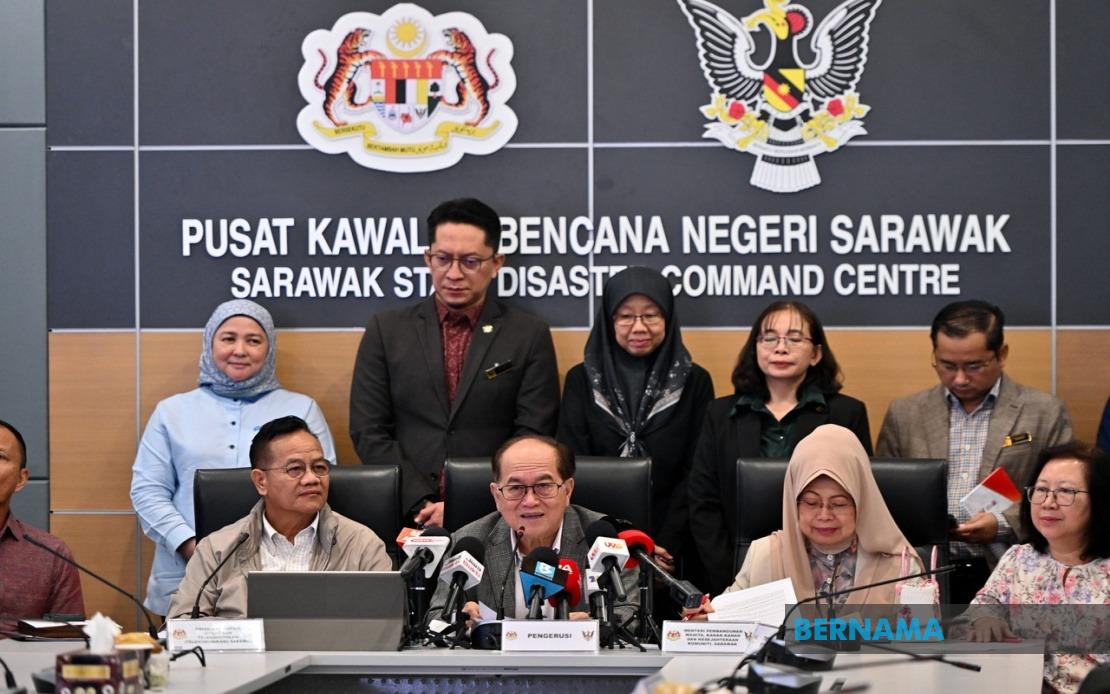
Sarawak Deputy Premier Datuk Amar Douglas Uggah Embas has outlined the state's response protocol to severe air quality degradation, confirming that an Air Pollutant Index reading of 500 will activate emergency procedures across affected regions. Speaking after chairing a meeting of the Sarawak State Disaster Management Committee in Kuching on August 31, Uggah explained that such a critical threshold would necessitate escalation to the National Disaster Management Agency in Kuala Lumpur, which would coordinate the federal government's involvement under established disaster protocols.
The activation of emergency status carries significant operational consequences for the state. According to Uggah, all government offices alongside both public and private sector establishments within impacted zones would face mandatory closure, with only services deemed essential permitted to maintain operations. This measure underscores the severity with which authorities regard air pollution at that level, acknowledging the substantial health and safety risks posed to the population when atmospheric contamination becomes extreme.
The cross-border nature of the haze challenge requires diplomatic coordination extending beyond Sarawak's administrative boundaries. Uggah characterised the issue as fundamentally regional in scope, demanding engagement among multiple governments through formal channels. The Sarawak State Disaster Management Committee has accordingly engaged Natural Resources and Environmental Sustainability Minister Datuk Seri Arthur Joseph Kurup, who holds the position of deputy chairman within the committee structure, to facilitate dialogue with Indonesian authorities through established ASEAN mechanisms.
Sarawak's approach emphasises channelling grievances and concerns through institutional frameworks rather than unilateral action. The state has committed to maintaining cooperation with federal authorities to ensure that Sarawak's perspective on the haze situation reaches appropriate national and regional forums. Uggah indicated that any bilateral assistance initiatives targeting neighbouring countries would necessarily pass through federal oversight, reinforcing the hierarchical nature of diplomatic engagement in environmental matters affecting multiple nations.
Beyond the emergency threshold framework, Sarawak has initiated practical measures aimed at ameliorating current air quality conditions. Cloud seeding operations represent one such intervention, scheduled for implementation between September 3 and 5 subject to prevailing meteorological conditions. Rather than functioning exclusively as a haze mitigation strategy, these operations serve a dual purpose within Sarawak's environmental management framework.
The secondary objective of cloud seeding addresses an equally pressing concern confronting the state: water resource depletion resulting from prolonged drought conditions. Four distinct water catchment areas have demonstrated significant strain on available supplies, namely Simunjan, Lingga, Spaoh and Lijok. The artificial precipitation generated through cloud seeding would contribute to replenishing water reserves across these critical infrastructure zones, thus tackling two interconnected environmental challenges simultaneously.
For Malaysian policymakers and environmental observers, Sarawak's response framework illustrates how state administrations navigate complex transboundary environmental challenges within a federal system. The establishment of specific numerical thresholds for emergency activation provides clarity regarding the escalation pathway, yet also highlights the limitations of unilateral state action when confronting phenomena originating across international boundaries. The region's persistent vulnerability to seasonal haze demonstrates that technological interventions like cloud seeding, while valuable, represent supplementary rather than comprehensive solutions.
The diplomatic dimensions merit particular attention for Southeast Asian stakeholders. Sarawak's emphasis on channelling concerns through ASEAN mechanisms and federal diplomatic apparatus reflects institutional conventions, yet also suggests that bilateral relationships and regional pressure mechanisms may ultimately determine whether Indonesian authorities implement sufficient measures to prevent atmospheric contamination from reaching catastrophic levels. The scheduling of cloud seeding operations, meanwhile, indicates that Malaysian administrations have adopted a pragmatic approach accepting that haze mitigation cannot rely exclusively on resolving upstream causes.
The implications for Malaysian businesses and residents extend beyond Sarawak's borders. If the API reaches critical levels in the state, the cascading effects of widespread non-essential service closures would reverberate through supply chains and economic activity. For companies with operational footprints in Sarawak or dependent on the state's economic output, understanding these emergency protocols and their potential activation constitutes essential business continuity planning. The precedent established in Sarawak may also inform how other Malaysian states anticipate and prepare for similar environmental crises.

