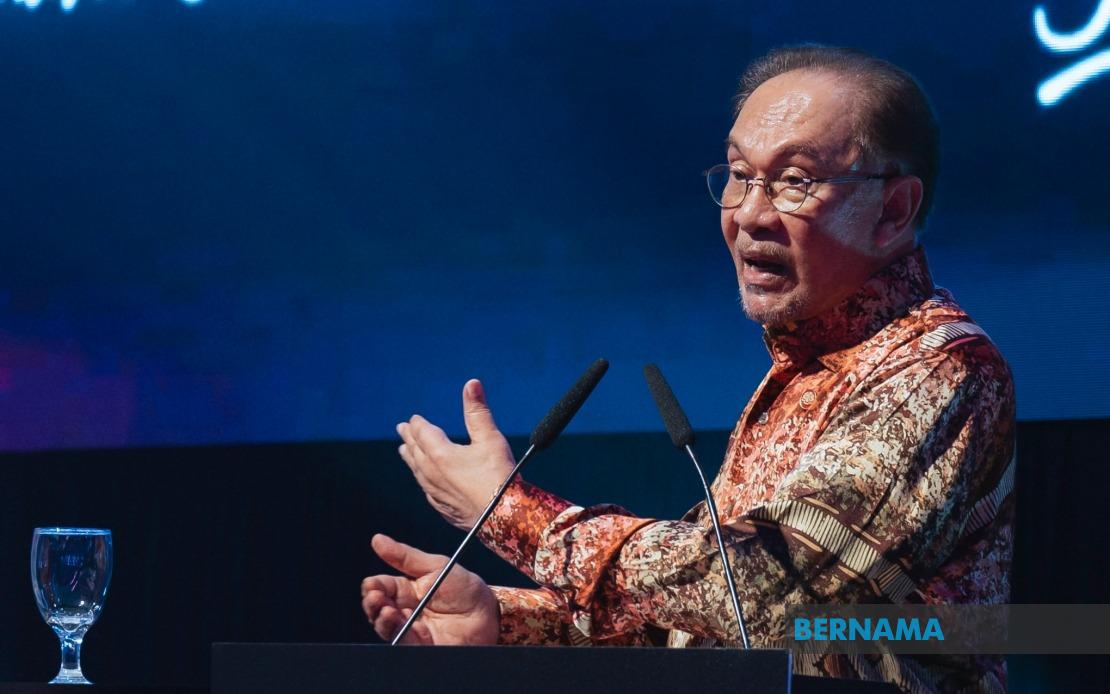
Prime Minister Datuk Seri Anwar Ibrahim's recent comments regarding Taiwan generated significant controversy, particularly his acknowledgement of China's position that force may be considered should peaceful reunification efforts ultimately fail. Yet a closer examination reveals these remarks reflect classical deterrence doctrine rather than advocacy for military confrontation. The distinction matters considerably for understanding Malaysia's foreign policy posture in one of the world's most volatile geopolitical flashpoints.
Anwar's core argument rests on a straightforward principle of statecraft: no sovereign nation willingly accepts territorial disintegration without maintaining the capacity to resist it. He employed Malaysia itself as an instructive parallel, positing that no Malaysian government would passively acquiesce to the breakup of the federation if faced with such a prospect. This analogy grounds his position in universally recognised principles of state behaviour rather than in any specific endorsement of China's approach to the Taiwan question. The reasoning suggests that defending territorial integrity constitutes a fundamental prerogative of statehood, one that all nations implicitly reserve.
Crucially, Anwar's framework positions force as a final recourse rather than a preferred instrument of policy. The prime minister emphasised that negotiation, legal mechanisms, and political settlement must exhaust themselves before military options become relevant. This hierarchy of preferred solutions aligns Malaysia's position with broader international norms favouring diplomatic resolution. By framing deterrence as a precondition for effective negotiation rather than as an alternative to it, Anwar articulates a position common among Southeast Asian policymakers who have long navigated great power competition while maintaining commitment to peaceful settlement principles.
The strategic logic underlying Anwar's remarks centres on a paradoxical truth recognised across international relations scholarship: the credible possibility of action often prevents the need to act at all. Deterrence functions precisely through uncertainty regarding consequences if a challenger proceeds. A state that categorically renounces force entirely removes a critical element from this calculus, potentially emboldening rivals to test boundaries. Conversely, maintaining the abstract possibility of defensive action, even while prioritising peaceful alternatives, preserves strategic flexibility and reinforces the incentive for others to pursue negotiated settlements. This dynamic explains why even thoroughly peaceful nations maintain armed forces—not because they desire conflict, but because the capacity for defence strengthens rather than weakens the case for dialogue.
Anwar's position, when examined within Malaysia's official One China framework, achieves internal consistency that critics may have overlooked. Malaysia formally recognises the People's Republic of China and does not extend diplomatic recognition to Taiwan, yet maintains extensive commercial relationships and people-to-people connections with Taipei. Within this delicate balance, accepting the legitimacy of One China as policy simultaneously requires acknowledging Beijing's genuine security concerns regarding territorial integrity. The prime minister's logic suggests that Malaysia cannot coherently maintain official One China policy while simultaneously dismissing as entirely illegitimate China's insistence that reunification constitutes an internal matter of national concern. This does not translate to endorsing any particular method of achieving reunification, but rather recognising the legitimacy of the aspiration itself from Beijing's perspective.
Taiwan's perspective presents an entirely different frame, one that rejects the One China premise entirely and asserts Taiwan's existing status as a sovereign, democratic polity. From Taipei's standpoint, any invocation of force as a residual option regarding Taiwan constitutes veiled coercion fundamentally at odds with the principles of self-determination that underpin Taiwan's political identity. Taiwan observers understandably view references to military options with deep concern, perceiving therein an implicit threat to their democratic system. This genuine tension between Beijing's claim to Taiwan as part of One China and Taiwan's assertion of existing sovereignty cannot be easily resolved through rhetorical framings, no matter how carefully constructed.
Yet Anwar's intervention was never intended as a resolution to this fundamental disagreement but rather as an explanation of deterrence logic as it operates in international politics. China's strategic doctrine explicitly reserves military options partly because, from Beijing's perspective, uncertainty regarding consequences deters secessionist movements. Whether one finds this reasoning persuasive or objectionable, it reflects standard deterrence theory that shaped Cold War strategy and continues influencing contemporary military doctrine globally. Anwar essentially articulated what Beijing already maintains as policy position, rather than advancing any novel or provocative argument.
For Malaysia specifically, the implications of Taiwan Strait instability extend far beyond the bilateral relationship between Taipei and Beijing. A military conflict in these waters would devastate regional trade networks, disrupt critical semiconductor supply chains upon which Malaysian manufacturing depends, and potentially undermine the consensus-based approach that has characterised ASEAN's collective foreign policy. Malaysia's geographical proximity to this potential flashpoint, combined with its substantial economic exposure to Taiwan and China alike, creates an interest in conflict prevention that transcends ideological considerations. Malaysian policymakers therefore maintain strong incentive to champion restraint, dialogue, and the exploration of peaceful mechanisms for addressing grievances.
Anwar's remarks should thus be understood not as departure from Malaysia's conflict-prevention agenda but as articulation of why deterrence actually supports rather than undermines that agenda. States that maintain capacity for self-defence while prioritising negotiation often achieve better outcomes than those perceived as helpless or unable to credibly defend themselves. The prime minister appears to suggest that Malaysia's own position—maintaining One China recognition while avoiding endorsement of coercion—depends upon upholding the principle that states preserve defensive capacity while actively promoting peaceful resolution mechanisms.
The distinction between renouncing force and refusing to preclude it entirely becomes philosophically and practically significant. A nation that declares it will never employ force under any circumstance removes a crucial variable from strategic calculations by adversaries and friends alike. Conversely, a state that reserves the right to defend core interests while enthusiastically pursuing diplomatic solutions achieves what strategists term "credible commitment" to peace—commitment that paradoxically becomes more persuasive precisely because alternatives remain theoretically available. This represents the position Malaysia appears to occupy and which Anwar articulated in his Taiwan remarks.
Moving forward, Malaysia should continue strengthening its advocacy for restraint and dialogue while avoiding any appearance of tacitly endorsing military solutions to the Taiwan question. The balance requires consistent messaging: one that acknowledges the legitimacy of deterrence doctrine while emphasising that dialogue, international law, and peaceful dispute settlement must remain paramount. Malaysia's influence within ASEAN and its relationships with both major powers position it well to encourage all parties toward negotiation. This diplomatic effort becomes more credible when grounded in recognition that deterrence and peace-seeking need not contradict—that in fact, credible defensive capacity often strengthens the incentive for peaceful resolution that all regional stakeholders ultimately prefer.

